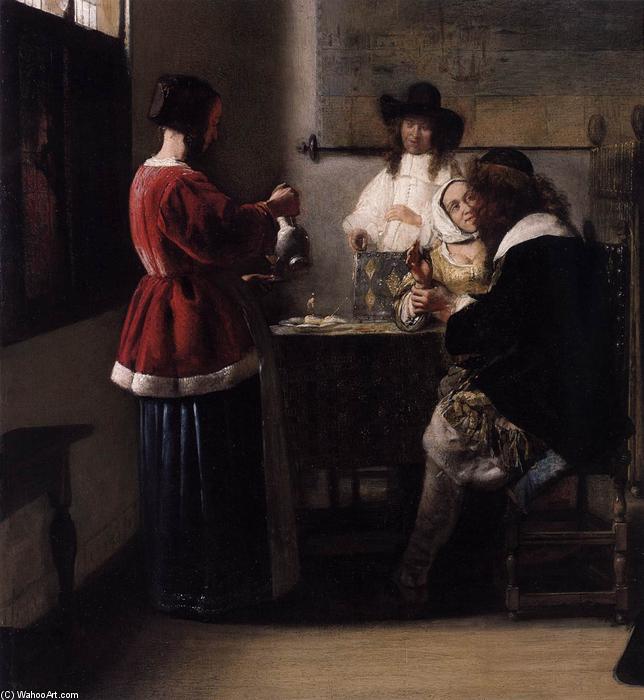
A Moment Frozen in Delft Light: Pieter de Hooch’s “The Visit”
Pieter de Hooch's "The Visit," completed around 1657, stands as an exquisite testament to the Dutch Golden Age’s fascination with capturing fleeting domestic scenes. More than just a depiction of everyday life—it’s a masterful exercise in illusionistic painting that transports us back to seventeenth-century Delft, offering a glimpse into the burgeoning bourgeois culture of the era. Currently residing within the Metropolitan Museum of Art's collection, this oil on wood panel is celebrated for its remarkable subtlety and luminous quality, qualities often attributed to Vermeer himself – a comparison that speaks volumes about De Hooch’s artistic prowess.
Composition and Technique: Mastering Light and Shadow
The painting’s genius lies in its masterful manipulation of light and shadow—a technique deeply rooted in Baroque principles but refined with an unparalleled sensitivity for nuance. De Hooch employs chiaroscuro, dramatically contrasting areas of illumination with deep recesses, creating a palpable sense of depth and realism that defies the limitations of the medium. Notice how the window’s shutters cast dappled light across the room, highlighting textures and contours with breathtaking precision. This careful attention to detail extends beyond mere visual representation; it embodies De Hooch's commitment to conveying atmosphere—the quiet intimacy of a private conversation amidst the comforts of home. The artist skillfully utilizes linear perspective to construct an interior space that feels convincingly tangible, inviting viewers into this carefully orchestrated tableau.
A Snapshot of Delft Society: Figures and Symbolism
“The Visit” portrays four figures engaged in dialogue – two women seated at a table and two men standing nearby—representing a typical scene from Delft’s upper-middle class life. The woman at the table, bathed in soft light, gestures subtly as she speaks, while her companion observes intently. The presence of a bird perched on the windowsill adds an element of natural beauty to this urban interior, symbolizing freedom and contemplation. Beyond its immediate depiction of social interaction, the painting carries symbolic weight. The teapot signifies hospitality and refinement—a hallmark of Delft’s cultural identity during this period. Furthermore, the scattered books suggest intellectual pursuits and underscore the importance of education within the burgeoning bourgeois class.
Artistic Significance: Vermeerian Influence and De Hooch's Legacy
While comparisons to Johannes Vermeer have been debated by scholars, “The Visit” undeniably possesses a similar ethereal quality—a luminous stillness that captures the essence of human experience. De Hooch’s meticulous observation of nature combined with his masterful command of light and shadow established him as one of the foremost painters of his time. His work continues to inspire artists today, demonstrating the enduring power of Baroque painting to evoke emotion and convey profound psychological insight. To experience this iconic masterpiece in a beautifully crafted reproduction is to reconnect with the artistic spirit of the Dutch Golden Age—a legacy that resonates powerfully across centuries.
The Metropolitan Museum of Art is home to many notable works, including “The Visit.” For a handmade oil painting reproduction of this masterpiece, visit https://ArtsDot.com.