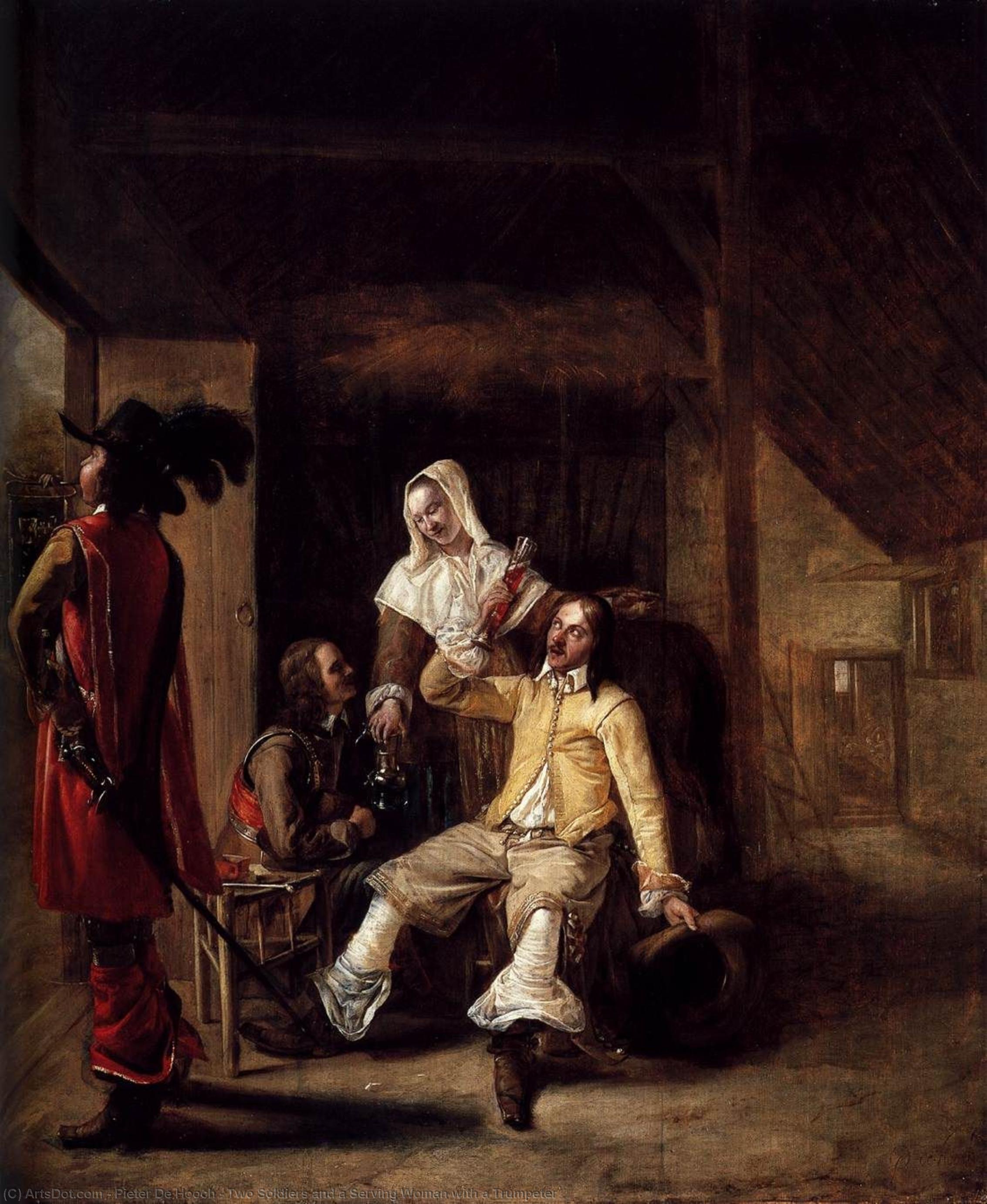
Pieter de Hooch's "Two Soldiers and a Serving Woman" (1654) captures a tranquil scene of soldiers and a woman, showcasing his masterful use of light & detail in Dutch Golden Age painting.
Pieter de Hooch (1629-1694) was a Dutch Golden Age painter known for his luminous depictions of domestic life, architectural interiors & tranquil courtyards. Explore his realistic style and influence on Impressionism.
Explore the Kunsthaus Zürich's diverse collection spanning centuries! From Monet to Giacometti & modern masterpieces, experience Swiss and international art in a stunning architectural setting.
A Moment of Quiet Camaraderie: Pieter de Hooch’s “Two Soldiers and a Serving Woman with a Trumpeter”
Pieter de Hooch's "Two Soldiers and a Serving Woman with a Trumpeter," painted circa 1650-1655, isn’t a grand historical tableau or a dramatic narrative. Instead, it offers a remarkably intimate glimpse into the burgeoning middle class of 17th-century Amsterdam – a world of subtle social interactions, quiet pleasures, and the delicate balance between formality and informality. This oil-on-panel painting, now residing in the Kunsthaus Zürich, is a masterclass in capturing fleeting moments of everyday life, rendered with an almost photographic realism that belies its emotional depth. De Hooch’s genius lies not in depicting action or spectacle, but in revealing the quiet poetry of ordinary scenes.
The Scene Unfolds: Domesticity and Social Dynamics
The composition is deceptively simple yet profoundly effective. Two uniformed soldiers, their postures suggesting a relaxed camaraderie, occupy the foreground. Their hands rest casually on their hips, conveying a sense of ease and shared experience. Between them sits a woman, her identity deliberately ambiguous – often interpreted as a serving girl or perhaps even a courtesan. Her posture is graceful, her gaze averted, hinting at a certain reserve while simultaneously inviting observation. A small table and chair suggest a brief respite from duty, a moment for conversation and refreshment. The inclusion of two trumpeters adds to the atmosphere, their instruments subtly suggesting celebration or perhaps simply the backdrop to this private encounter. De Hooch expertly uses light – diffused and natural – to illuminate the scene, creating an inviting warmth that draws the viewer into the intimate space.
Technique and Style: The Art of Subtle Detail
De Hooch’s style is characterized by a remarkable attention to detail and a masterful use of light and shadow. He eschewed the dramatic chiaroscuro favored by some contemporaries, opting instead for a softer, more nuanced approach. His brushstrokes are delicate and precise, meticulously rendering the textures of fabric, the sheen of metal, and the subtle expressions on the figures’ faces. The artist's skill is particularly evident in his depiction of the interior – the worn wooden table, the simple chair, the muted colors of the room all contribute to a sense of realism that feels both immediate and timeless. Notably, De Hooch frequently employed a technique known as "open doorway," placing figures partially obscured by doorways or windows, creating a sense of depth and inviting the viewer's imagination to fill in the gaps. This technique is prominently featured here, subtly suggesting a larger space beyond the frame and contributing to the painting’s overall feeling of intimacy.
Symbolism and Context: A Window into 17th-Century Amsterdam
“Two Soldiers and a Serving Woman with a Trumpeter” offers a valuable window into the social and cultural landscape of 17th-century Amsterdam, a period marked by unprecedented economic prosperity and burgeoning civic life. The presence of the soldiers reflects the city’s role as a major center for trade and military activity. Their relaxed demeanor suggests a degree of stability and security – a welcome contrast to the turbulent political climate of the time. The inclusion of the serving woman speaks to the evolving social dynamics of the era, where women were increasingly entering the workforce and challenging traditional gender roles. The trumpet, often associated with celebration and heraldry, hints at a sense of occasion or perhaps simply the convivial atmosphere of a tavern or public gathering.
Emotional Resonance: A Quiet Moment of Connection
Despite its seemingly mundane subject matter, “Two Soldiers and a Serving Woman with a Trumpeter” possesses a remarkable emotional resonance. It’s not a painting that shouts for attention; rather, it invites quiet contemplation. The subtle interactions between the figures – their averted gazes, their relaxed postures – suggest a shared understanding and a moment of connection amidst the bustle of daily life. De Hooch masterfully captures the essence of human interaction—the unspoken language of gestures, expressions, and shared experiences—creating an image that is both deeply personal and universally relatable. It’s a painting that reminds us to appreciate the beauty in the ordinary moments of our lives, and the quiet connections we forge with others.