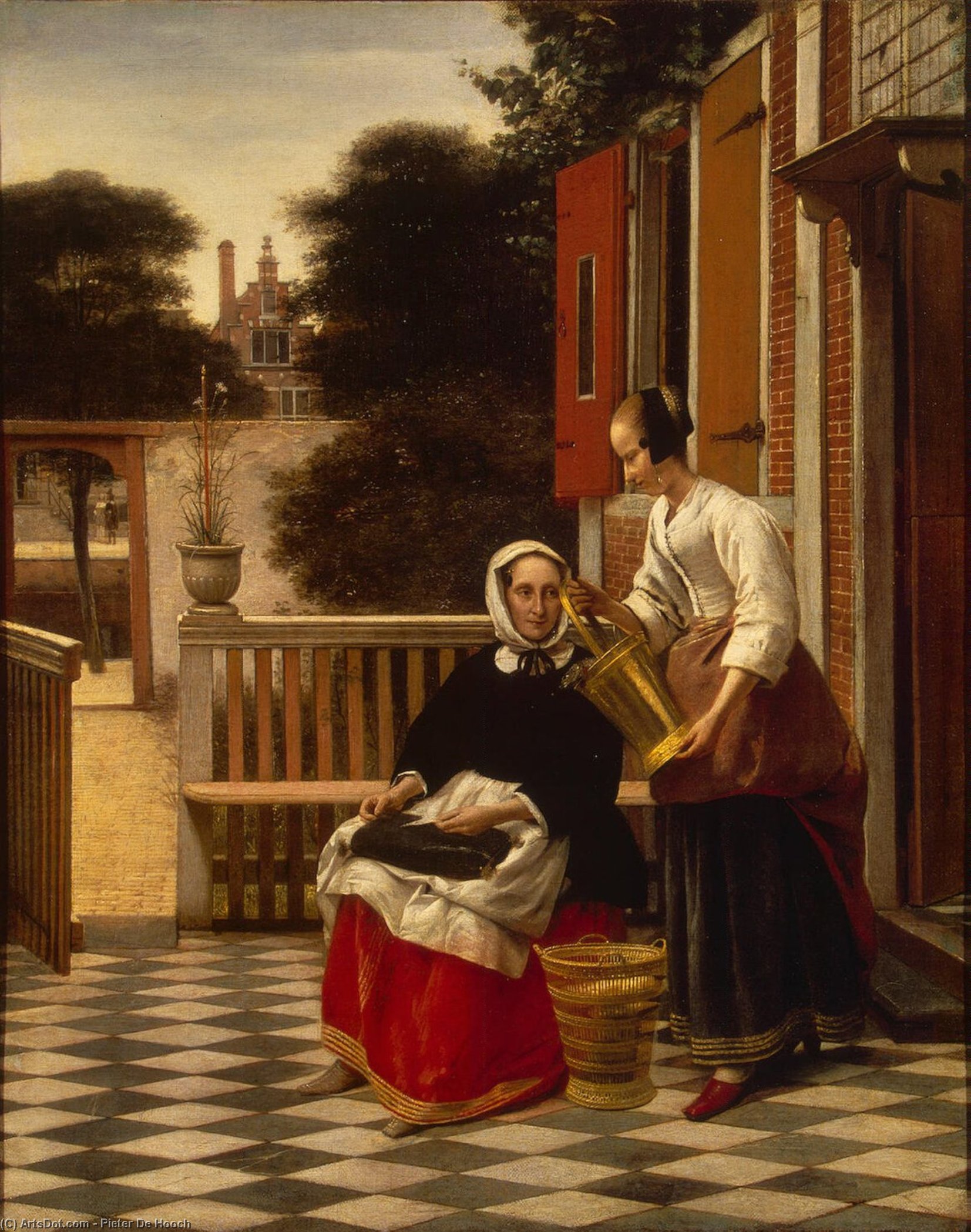
Pieter de Hooch was a Dutch painter renowned for his depictions of interiors and urban scenes during the Dutch Golden Age. His meticulous attention to detail and use of naturalistic lighting established him as a pioneer in genre painting, focusing on everyday life and capturing subtle emotions.
Pieter de Hooch (1629-1694) was a Dutch Golden Age painter known for his luminous depictions of domestic life, architectural interiors & tranquil courtyards. Explore his realistic style and influence on Impressionism.
Explore the Hermitage Museum in St. Petersburg! Discover masterpieces from Renaissance to modern times within stunning historic palaces – a cultural journey awaits.
A Moment of Domestic Harmony: Pieter de Hooch’s “Woman and Maid”
Pieter de Hooch's "Woman and Maid," painted circa 1657, stands as a quintessential emblem of Dutch Golden Age artistry—a deceptively simple tableau brimming with nuanced observation and masterful execution. More than just a depiction of daily life, it embodies the burgeoning humanist spirit of the era, reflecting an interest in portraying authentic human experience within recognizable surroundings. This captivating artwork resides within the Hermitage Museum’s collection in St. Petersburg, offering visitors a glimpse into a pivotal period of artistic innovation.
The Scene: Delft Interior and Everyday Ritual
The painting transports us to a Delft courtyard, bathed in soft, diffused light—a technique characteristic of de Hooch's signature style. Two women occupy the space; one appears to be diligently tending to a potted plant, while the other engages in conversation with an unseen companion. The presence of a bucket suggests a task – perhaps washing clothes or watering plants – highlighting the quiet routines that underpinned domestic life during this time. De Hooch’s meticulous attention to detail extends beyond mere representation; he captures the subtle textures of fabric and the play of light on surfaces, creating an immersive experience for the viewer. The inclusion of the bench reinforces the sense of place, grounding the scene in a tangible reality.
Style and Technique: Vermeer's Influence
De Hooch’s artistic sensibilities owe considerable debt to Johannes Vermeer, whose groundbreaking use of chiaroscuro—the dramatic interplay between light and shadow—established a new standard for realism. Like Vermeer, de Hooch skillfully employs light to sculpt form and convey emotion, emphasizing the contours of the women’s bodies and illuminating the courtyard with an ethereal glow. The artist's brushwork is delicate yet confident, blending seamlessly into the overall composition. He achieves remarkable depth through atmospheric perspective, subtly blurring distant elements to create a convincing illusion of space—a technique that elevates the painting beyond mere visual representation.
Historical Context: Reflecting Dutch Society
“Woman and Maid” emerged during a period of significant social transformation in Holland. The burgeoning middle class embraced artistic patronage, fostering an environment conducive to experimentation and innovation. De Hooch’s paintings resonated with contemporary sensibilities by portraying scenes from ordinary life—a deliberate departure from the grand mythological narratives favored by earlier artists. This focus on domestic interiors mirrored the growing importance of family values and the aspiration for a comfortable existence within the burgeoning urban landscape. The painting serves as a poignant reminder of a time when art sought to capture not just beauty but also the essence of human experience.
Symbolism: Quiet Contemplation and Domestic Tranquility
Beyond its visual splendor, “Woman and Maid” carries subtle symbolic weight. The woman tending to the plant can be interpreted as representing nurturing and care—a cornerstone of Dutch domestic ideals. The conversation between the women speaks to the importance of female companionship and mutual support within the household. More broadly, the painting embodies a yearning for serenity and contentment—values that underpinned the humanist worldview prevalent during the Golden Age. De Hooch’s masterful depiction captures not just what was seen but also what was felt – an invitation to contemplate the beauty of everyday life and the enduring significance of human connection.