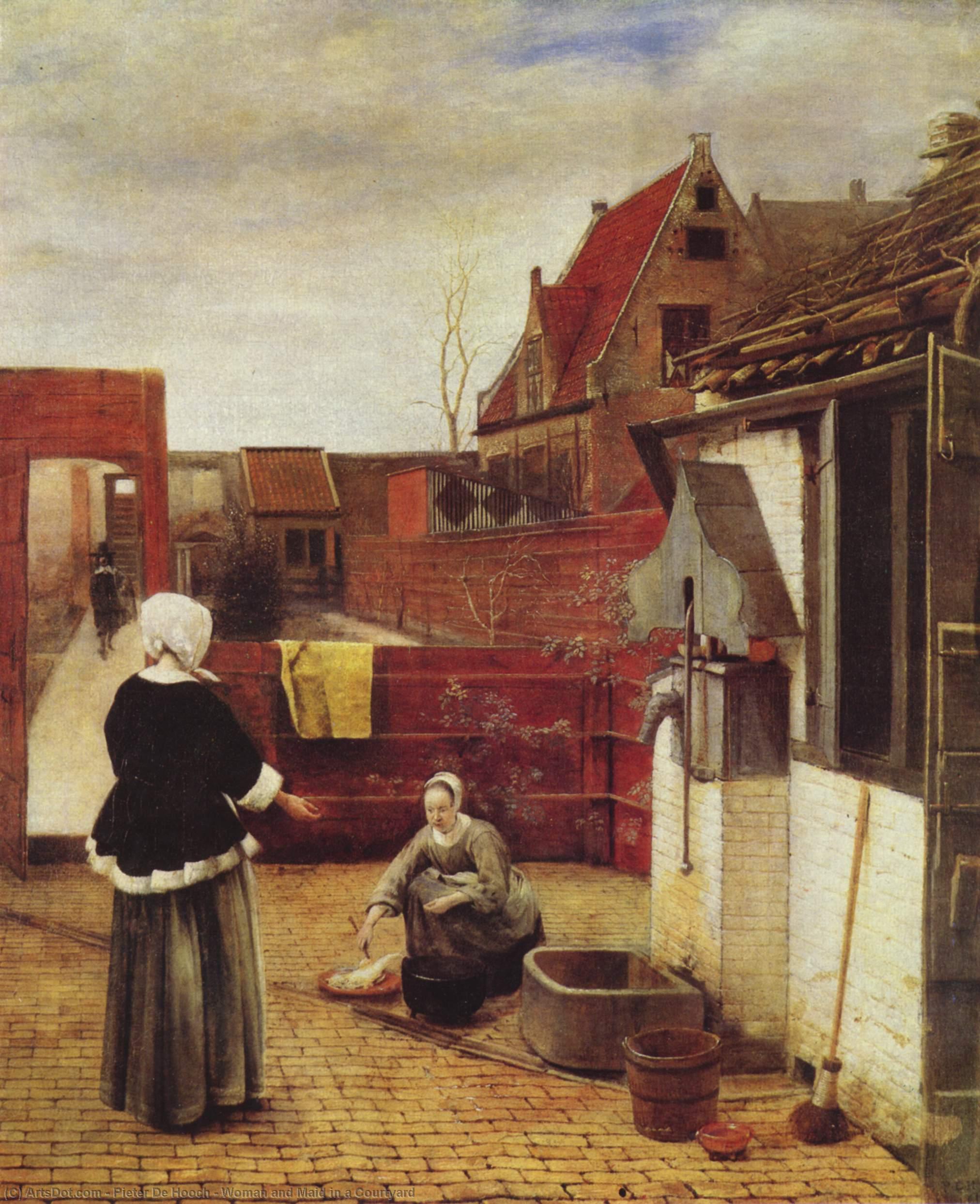
Admire Pieter de Hooch's serene depiction of domestic life – 'Woman and Maid in a Courtyard,' painted circa 1660, captures a tranquil moment within a Delft courtyard with subtle architectural details.
Pieter de Hooch (1629-1694) was a Dutch Golden Age painter known for his luminous depictions of domestic life, architectural interiors & tranquil courtyards. Explore his realistic style and influence on Impressionism.
Explore European art from the 13th-19th centuries at London's National Gallery! Discover masterpieces by Van Gogh, Rembrandt & more – free entry!
A Window into Domestic Tranquility: Pieter de Hooch’s “Woman and Maid in a Courtyard”
Pieter de Hooch's "Woman and Maid in a Courtyard," painted circa 1660, stands as a quintessential emblem of Dutch Golden Age artistry—a serene tableau that transcends mere depiction to embody the spirit of its time. Executed in monochrome watercolor and gouache on ivory paper, this artwork resides within The National Gallery’s collection in London, offering viewers an unparalleled glimpse into the subtle nuances of seventeenth-century domestic life. Its enduring appeal lies not only in its exquisite craftsmanship but also in its profound exploration of human emotion and social observation.
The Painter's Technique: Mastering Light and Atmosphere
De Hooch’s mastery is immediately apparent in his masterful manipulation of light—a technique central to the Baroque aesthetic yet deployed with remarkable restraint. Unlike many contemporaries who favored dramatic chiaroscuro, De Hooch achieves a luminous effect through careful layering of translucent washes, creating an ethereal glow that permeates the courtyard scene. This diffused illumination subtly defines forms and casts delicate shadows, fostering a palpable sense of depth and realism. The artist’s meticulous attention to detail extends beyond the light itself; he painstakingly renders textures—the rough stone wall, the smooth surface of the potted plant—further enhancing the immersive quality of the artwork. Gouache, applied in thin glazes over watercolor, contributes to the tonal richness and stability of the composition, ensuring that the image retains its luminosity throughout time.
Historical Context: Reflecting Amsterdam’s Emerging Middle Class
“Woman and Maid in a Courtyard” emerged during a period of significant social transformation within Amsterdam—the burgeoning influence of the merchant class was reshaping societal values and aspirations. De Hooch's paintings frequently captured scenes from everyday life, reflecting this shift towards valuing comfort and refinement. The courtyard itself represents more than just an architectural space; it symbolizes privacy and domestic tranquility – ideals prized by affluent families seeking respite from the bustle of urban existence. Furthermore, the presence of a woman and maid speaks to evolving gender roles within Dutch society—the woman embodies feminine grace and dignity while the maid performs her duties with quiet diligence.
Symbolism: Hints of Narrative Depth
Despite its apparent simplicity, “Woman and Maid in a Courtyard” is laden with symbolic significance. The open doorway invites contemplation on themes of observation and intimacy, suggesting that the scene unfolds beyond what is immediately visible. The potted plant—a common motif in Dutch art—represents fertility and growth, subtly reinforcing the notion of domestic harmony. While the figures’ expressions remain understated, their postures convey a sense of connection and mutual respect – qualities valued during this era. Scholars have debated whether the woman is gazing out at the courtyard or contemplating her maid, adding another layer of interpretive complexity to the artwork.
Emotional Impact: A Moment Frozen in Time
Ultimately, “Woman and Maid in a Courtyard” succeeds in evoking a powerful emotional response—a feeling of quiet contemplation and understated beauty. The subdued palette and masterful technique combine to create an atmosphere of serenity that transports viewers back to seventeenth-century Amsterdam. It’s a painting that invites us to pause, observe, and appreciate the subtle gestures of human interaction within the confines of domestic space. Like many masterpieces of its kind, it continues to resonate with audiences today, demonstrating the timeless power of art to capture and convey profound emotional truths.