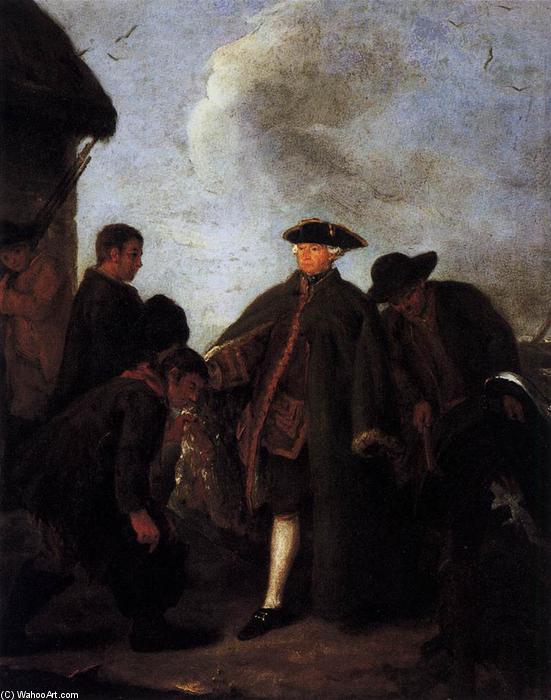
A Moment Frozen in Time: Pietro Longhi’s “Arriving for the Hunt”
Pietro Longhi's "Arriving for the Hunt," painted in 1767 and currently residing within the Fondazione Querini Stampalia in Venice, isn’t merely a depiction of a social gathering; it’s a meticulously crafted snapshot of Venetian bourgeois life – a window into the subtle dramas and carefully constructed appearances of the late 18th century. More than just a portrait, it's a study in gesture, expression, and the unspoken language of a society obsessed with propriety and leisure. Longhi, often dubbed the “Venetian Hogarth” for his satirical observations of contemporary manners, masterfully captures this atmosphere with an almost disconcerting realism, inviting us to observe and interpret the nuances of this particular scene.
The Scene Unfolds: Details of a Venetian Afternoon
The painting immediately draws the eye to its foreground – three figures engaged in conversation beneath a cloudy sky. A distinguished gentleman on the left, clad in a dark coat and white shirt, holds court with a woman in a light-colored gown, her face partially obscured by a bonnet. To their right, another man, equally formally dressed, engages in animated discussion. The background reveals two additional figures: a younger man observing the scene, and a boy attentively listening – each contributing to a tableau of quiet social interaction. Notice the careful attention to detail; the rustle of fabrics, the subtle tilt of heads, the precise arrangement of hands—all speak volumes about Longhi’s commitment to realism. The setting itself, hinted at by a distant building, suggests an outdoor location, perhaps near a hunting lodge or estate, reinforcing the theme of leisure and aristocratic pursuits.
A Masterclass in Rococo Technique and Composition
Longhi’s style is firmly rooted in the Rococo tradition, yet he transcends mere imitation. He employs a delicate palette dominated by earth tones – browns, ochres, and muted greens—creating a sense of understated elegance and subdued drama. The brushwork is remarkably smooth and refined, particularly evident in the rendering of clothing textures and facial features. The composition itself is carefully balanced, guiding the viewer’s eye through the scene with a subtle yet effective use of diagonals and converging lines. Longhi's skill lies not just in depicting what he saw, but in arranging those elements to create a compelling narrative—a story told without words.
Symbolism and Social Commentary
Beyond the surface depiction of a social gathering, “Arriving for the Hunt” is laden with symbolic meaning. The hunting motif itself represents status, skill, and control – values highly prized within Venetian society. The figures’ attire—particularly the elaborate coats and bonnets—underscores their wealth and position. However, Longhi subtly undermines this superficial display of grandeur by capturing moments of awkwardness, hesitation, and unspoken tension. The boy's attentive posture suggests a keen observer, perhaps even a critic of the adult world. The painting’s overall mood is one of restrained elegance, hinting at the underlying anxieties and complexities of Venetian society—a world where appearances were carefully maintained, and social rituals governed every interaction.
A Legacy of Observation: Longhi's Venice
Pietro Longhi’s work offers a rare glimpse into the everyday lives of 18th-century Venetians. Unlike many of his contemporaries who focused on grand historical or mythological subjects, Longhi chose to document the intimate details of Venetian society—the conversations, the fashions, and the social customs that shaped their world. His paintings are not simply beautiful works of art; they are invaluable historical documents, providing us with a unique understanding of a bygone era. Reproductions of “Arriving for the Hunt” offer a chance to bring this captivating scene into your home, allowing you to appreciate Longhi’s remarkable talent and his insightful portrayal of Venetian life.