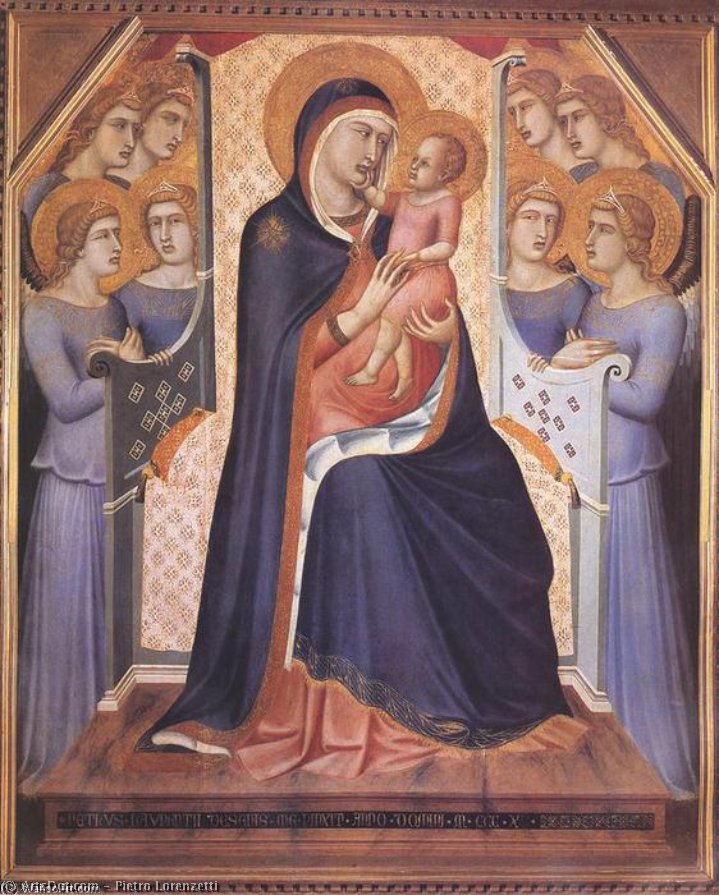
The Majesty of Faith: Pietro Lorenzetti’s Madonna Enthroned with Angels
Pietro Lorenzetti's Madonna Enthroned with Angels, painted around 1340 in Siena, isn’t merely a depiction of the Virgin Mary and Child; it’s a profound meditation on faith, divine grace, and the nascent embrace of humanism within the heart of medieval Italy. This magnificent panel, now housed within the Uffizi Gallery in Florence, offers a captivating glimpse into the artistic landscape of its time – a period poised between the rigid formality of Gothic tradition and the burgeoning naturalism that would define the Renaissance.
Lorenzetti’s genius lies not just in his technical skill but in his ability to imbue a traditional subject with an unprecedented sense of depth and emotional resonance. The composition immediately draws the eye to the central figures: Mary, radiating serenity and maternal tenderness, cradling the Christ Child in her lap. Surrounding them is a court of angels, each rendered with a delicate grace that speaks volumes about their celestial roles. Yet, unlike many earlier depictions where these figures exist as mere decorative elements, Lorenzetti’s angels possess palpable presence – they are not simply painted; they *feel* like participants in the divine drama unfolding before us.
A Bridge Between Traditions: Style and Technique
Lorenzetti's style represents a crucial turning point in Sienese art. He skillfully blended elements of Gothic formalism with emerging Renaissance principles, creating a work that is both deeply rooted in tradition and subtly forward-looking. The painting’s foundation rests firmly within the Italo-Byzantine aesthetic – evident in the hierarchical arrangement of figures, where Mary and Christ are elevated above the surrounding angels, and the use of gold leaf to highlight their sacred status. However, Lorenzetti departs from this established model by introducing a remarkable sense of spatial depth and three-dimensionality.
This innovation is particularly striking in the throne itself – a meticulously rendered structure that dominates the composition. It’s not simply a backdrop; it actively shapes the space, creating a tangible architecture that grounds the scene and anchors the figures within a believable environment. Lorenzetti's mastery of perspective, though rudimentary by Renaissance standards, nonetheless establishes a sense of volume and recession, drawing the viewer into the heart of the painting. The use of color is equally sophisticated – rich blues, reds, and golds are employed with a masterful understanding of light and shadow, creating a luminous and emotionally charged atmosphere.
Symbolism and Spiritual Significance
The Madonna Enthroned with Angels is replete with symbolic meaning. Mary’s pose, seated on the throne and gazing down upon her son, embodies both earthly motherhood and divine authority. The Christ Child, depicted in a gesture of playful engagement, represents humanity's connection to God. The angels themselves are not merely messengers; they symbolize the virtues of faith, hope, and charity – qualities essential for achieving salvation.
Notably, the inclusion of several human figures surrounding the central triad—a practice uncommon in earlier religious art—suggests a shift towards a more accessible and relatable depiction of spirituality. These individuals, likely representing members of Mary’s court or attendants, underscore the idea that faith is not confined to the cloistered world of the clergy but is an experience shared by all humanity.
A Legacy of Innovation
Pietro Lorenzetti's Madonna Enthroned with Angels stands as a pivotal work in the transition from medieval to Renaissance art. His innovative use of perspective, his nuanced portrayal of human emotion, and his skillful blending of traditional and emerging artistic principles established a new standard for Sienese painting and profoundly influenced generations of artists to come. It’s a testament to the power of art to not only represent religious belief but also to embody the evolving spirit of a changing world – a world on the cusp of rediscovering its humanity.