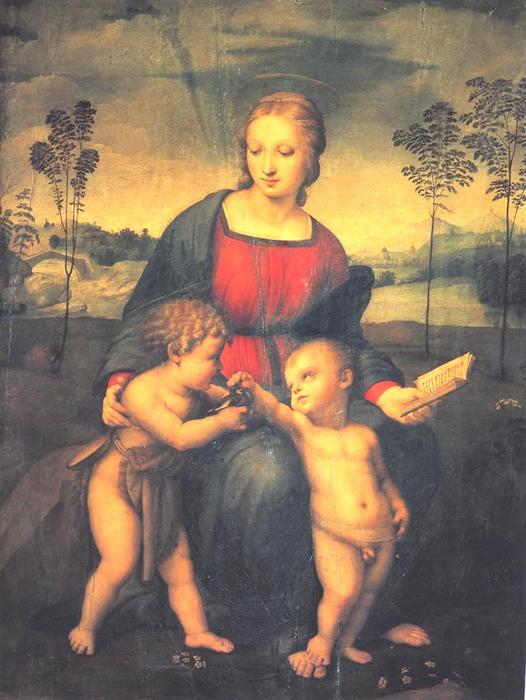
The Madonna with Goldfinch: A Symphony of Grace and Symbolism
Raphael’s Madonna del Cardellino stands as an emblem of High Renaissance artistic achievement, embodying ideals of beauty, harmony, and spiritual contemplation. Painted in Florence between 1506 and 1507, during a period marked by intellectual ferment and papal patronage—a time when artists sought to elevate human experience through idealized representations—this masterpiece transcends mere visual splendor; it speaks volumes about Renaissance humanist philosophy.
Composition and Technique
The painting’s pyramidal structure immediately establishes a sense of stability and balance, mirroring the architectural principles prevalent in Florentine art. Raphael meticulously crafted this composition using sfumato – Leonardo da Vinci's revolutionary technique—to soften contours and create an ethereal atmosphere. Light cascades across Mary’s face and robes, subtly illuminating the figures and conveying warmth. The artist skillfully blended colors with painstaking precision, achieving a luminous palette that captures the essence of Florentine idealism.
Subject Matter and Narrative
At its core, the Madonna del Cardellino depicts Mary cradling Jesus and St John the Baptist—a motif deeply rooted in Christian iconography. Mary’s serene expression embodies maternal compassion and piety, while Jesus gazes down upon his infant son with tenderness. The inclusion of St John, holding aloft a goldfinch, introduces a potent symbol: Christ’s future crucifixion. According to medieval legend, the bird’s red spot originated from the moment Christ was nailed to the cross—a poignant reminder of sacrifice and redemption.
Historical Context and Artistic Influence
Raphael's work emerged during a pivotal moment in European art history, reacting against the Gothic style that preceded it. He drew inspiration from Leonardo da Vinci’s sfumato technique and Michelangelo’s monumental sculptures—artists who championed realism alongside idealized forms. The Madonna del Cardellino exemplifies Raphael’s mastery of blending classical ideals with humanist sensibilities, securing his place as one of the foremost painters of his era.
Legacy and Emotional Impact
The painting continues to captivate viewers centuries later due to its profound emotional resonance. Its delicate beauty evokes feelings of peace, serenity, and spiritual devotion—qualities that resonate deeply with audiences across cultures. Raphael’s Madonna del Cardellino remains a testament to the enduring power of art to inspire contemplation and elevate the human spirit.
- Artist: Raphael (1483-1520)
- Date: 1506–1507
- Location: Galleria degli Uffizi, Florence
- Medium: Oil on Panel
- Dimensions: 42 x 30 cm (16.5 x 11.8 in)
Explore the exquisite detail and luminous color palette of this iconic Renaissance masterpiece with a high-quality reproduction from ArtsDot.com.