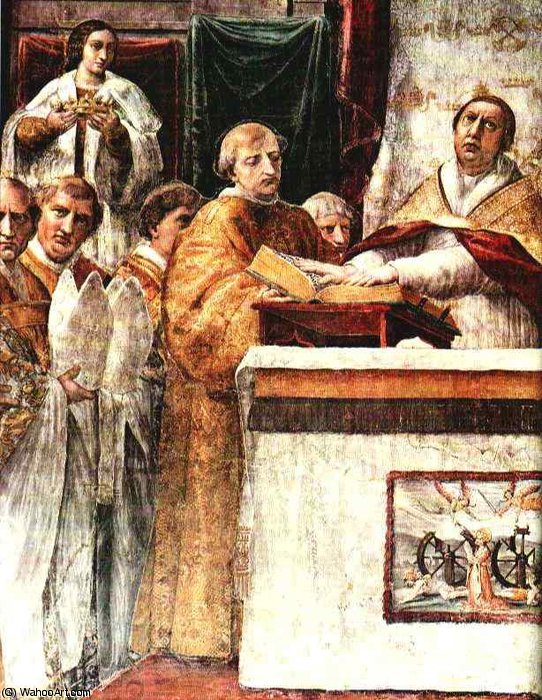
A Moment of Sacred Authority: The Oath of Pope Leo III
Raphael’s “The Oath of Pope Leo III,” a left-view panel from his monumental fresco cycle within the *Stanza dell'Incendio di Borgo* at the Vatican, is more than just a depiction of a historical event; it’s a profound meditation on power, faith, and the very foundations of papal legitimacy. Completed between 1514 and 1517 during his time in Rome, this work encapsulates the High Renaissance's fascination with classical ideals blended with Christian iconography – a potent combination that defined Raphael’s artistic signature.
The scene itself unfolds within a richly detailed interior space. A group of men, rendered with astonishing realism and psychological depth, are gathered around a table laden with books, suggesting the weighty deliberations inherent in this solemn oath. At the head stands Pope Leo III himself, his posture conveying both authority and vulnerability – he’s not simply issuing an order but accepting a sacred commitment. The figures behind him, representing cardinals and advisors, are carefully arranged to emphasize their subservience and the hierarchical structure of the Church. Notice the subtle gestures: the hand raised in solemnity, the averted gaze, the careful positioning of each figure; these details speak volumes about the importance of this moment.
The Historical Context: A Crucial Papal Oath
The painting captures a pivotal event in 816 AD – the oath taken by Pope Leo III at St. Peter’s Basilica, where he pledged allegiance to Charlemagne, effectively crowning him as Holy Roman Emperor. This act was of immense significance, solidifying the alliance between the Papacy and the burgeoning Frankish Empire and establishing a precedent for centuries of papal involvement in European politics. The fresco isn't merely a historical record; it’s a deliberate statement about the continuity of power and the Church’s role as a guarantor of order within the tumultuous landscape of 9th-century Europe.
Raphael, deeply influenced by the humanist ideals prevalent in Florence during his early career, skillfully integrates classical elements into this religious scene. The architectural details – the arches, columns, and light streaming through the windows – echo the grandeur of Roman architecture, subtly elevating the event depicted to a timeless significance. The careful use of perspective and chiaroscuro (the dramatic contrast between light and shadow) further enhances the realism and depth of the composition, drawing the viewer into this intimate moment of sacred commitment.
Symbolism and Artistic Technique
Beyond its historical narrative, “The Oath of Pope Leo III” is rich in symbolic meaning. The books on the table represent knowledge, law, and divine authority – all essential components of papal legitimacy. The clock in the background serves as a reminder of time’s passage and the enduring nature of this oath. Raphael's mastery of technique is evident in every brushstroke; observe the meticulous rendering of fabrics, the subtle variations in skin tones, and the lifelike expressions on the faces of the figures. His use of sfumato – a delicate blurring of lines and colors – creates an atmosphere of depth and mystery, inviting contemplation.
The panel’s left-view perspective offers a particularly intimate glimpse into this momentous occasion. It focuses intently on the Pope's face, conveying his solemnity and responsibility. The careful attention to detail in rendering his expression—a mixture of determination and humility—is a testament to Raphael’s skill as a portraitist. The composition is remarkably balanced, with each element contributing to the overall sense of gravity and importance.
A Legacy of Renaissance Grandeur
“The Oath of Pope Leo III” stands as one of Raphael's most celebrated works, exemplifying his ability to seamlessly blend religious subject matter with classical ideals. It’s a powerful testament to the High Renaissance’s fascination with humanism and its profound impact on Western art. Today, reproductions like those offered by WahooArt allow us to appreciate this masterpiece in exquisite detail, bringing Raphael's vision to life for a new generation of art lovers.