A Cornerstone of Renaissance Thought
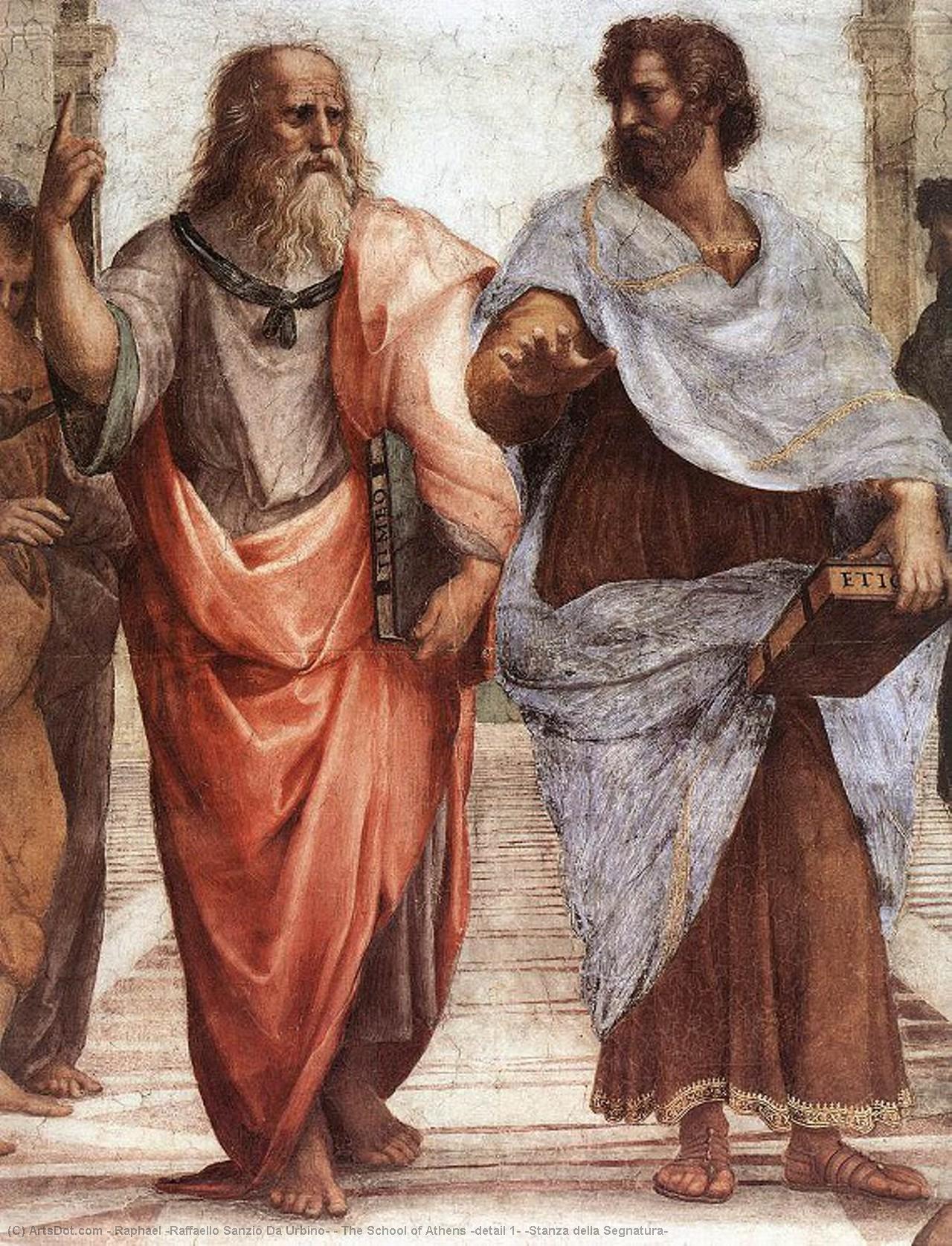
This exquisite detail from Raphael’s monumental fresco, “The School of Athens,” within the Stanza della Segnatura at the Vatican, encapsulates the High Renaissance's reverence for classical learning and philosophical inquiry. More than just a depiction of ancient thinkers, it is a visual manifesto celebrating human intellect and the pursuit of knowledge. This fragment focuses on the central figures of Plato and Aristotle, embodying two distinct yet complementary approaches to understanding the world.
Masterful Technique & Artistic Style
Raphael’s technical brilliance shines through in this section of the fresco. Executed using the *fresco* technique – painting directly onto wet plaster – it demanded precision and speed. The composition is a testament to Renaissance ideals of balance, harmony, and perspective. Note the subtle use of *sfumato*, a delicate blurring of lines that creates an atmospheric depth and softens the contours of figures and architecture. The muted, earthy color palette—ochres, browns, and reddish-oranges—enhances the sense of timelessness and intellectual gravitas, punctuated by Plato’s vibrant robe which draws immediate attention.
Historical Context & Commission
Commissioned by Pope Julius II in 1509, “The School of Athens” was part of a larger decorative scheme for the papal apartments. It reflects the humanist spirit flourishing during the High Renaissance – a renewed interest in classical antiquity and its philosophical traditions. The Stanza della Segnatura itself was intended as a grand library, signifying the Pope’s patronage of learning and intellectual pursuits. Raphael deliberately chose to represent philosophy alongside theology, poetry, and law, demonstrating their equal importance within the realm of human knowledge.
Decoding the Symbolism
The interplay between Plato and Aristotle is rich in symbolism. Plato, gesturing upwards with his hand, represents his Theory of Forms – the belief in a higher realm of perfect ideals. He holds a copy of *Timaeus*, his cosmological dialogue. In contrast, Aristotle gestures towards the earth, emphasizing empirical observation and the study of the natural world, holding his *Nicomachean Ethics*. This juxtaposition isn’t a contradiction but rather a harmonious representation of two essential paths to understanding reality: abstract thought and concrete experience. The architectural setting, inspired by Roman baths and triumphal arches, further reinforces the connection to classical antiquity.
Emotional Resonance & Interior Appeal
This detail evokes a sense of calm contemplation, intellectual curiosity, and profound respect for knowledge. It’s not merely an image; it's an invitation to engage in philosophical thought. As a reproduction, this piece adds a layer of sophistication and historical depth to any interior space. Its warm color palette complements both traditional and contemporary settings, making it ideal for libraries, studies, living rooms, or offices. The artwork serves as a powerful statement about the enduring value of learning and the pursuit of wisdom – a timeless addition to any discerning collection.