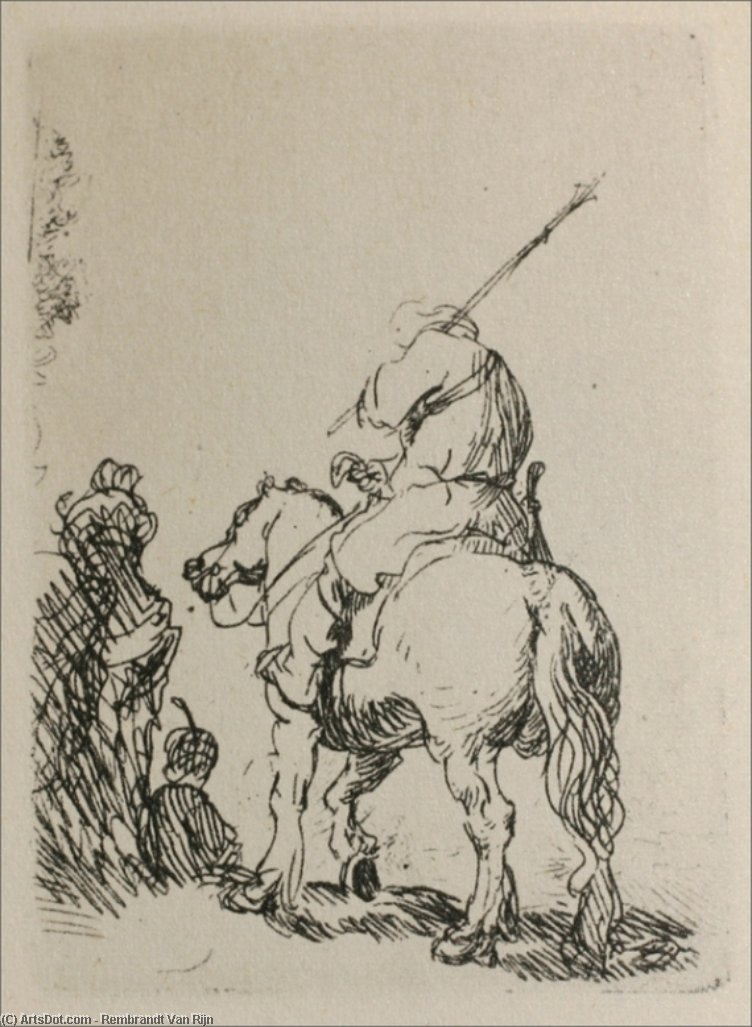
This monochrome engraving by Rembrandt van Rijn depicts a knight on horseback, rendered with exceptional detail and tonal variation using hatching and crosshatching techniques. Inspired by ‘The Polish Rider’ painting, it exemplifies Rembrandt's signature style and captures the grandeur of historical allegory.
A Man on Horesback: Rembrandt’s Dramatic Exploration of Power and Faith
Rembrandt van Rijn's “A Man on Horseback,” painted circa 1655, stands as a cornerstone of Baroque art—a testament to the artist’s unparalleled ability to capture psychological depth within meticulously rendered form. More than just a portrait, it’s an embodiment of Rembrandt’s signature style: a masterful manipulation of light and shadow that transcends mere representation, inviting viewers into a realm of emotion and contemplation.
- Subject Matter & Narrative
- Technique & Material Considerations
- Symbolism & Contextual Significance
- Emotional Resonance: Light and Darkness as Dialogue
- The Legacy of Rembrandt’s Engraving Style
Subject Matter & Narrative
The painting depicts a solitary rider, dressed in opulent armor and holding aloft a sword—a figure undeniably imbued with authority. While the precise identity of the subject remains elusive, scholars believe he represents Philip IV of Spain, embarking on a perilous journey to quell unrest in Catalonia. Rembrandt skillfully portrays not just physical appearance but also inner turmoil; the rider’s gaze is downward, suggesting introspection and perhaps apprehension amidst the grandeur of his surroundings. The inclusion of two additional figures—one seated beside him and another positioned further back—adds layers of narrative complexity, hinting at a conversation or deliberation that underscores the weight of responsibility.
Technique & Material Considerations
Rembrandt’s technique is characterized by an astonishing level of detail achieved through etching – a process he perfected during his prolific output. The artist painstakingly scratched lines onto a copper plate, utilizing specialized tools to create a matrix that would then be inked and pressed onto paper. This method allowed for exceptional tonal variation—the hallmark of Rembrandt's oeuvre—resulting in the striking monochrome palette observed today. The dense hatching and crosshatching patterns meticulously applied across the horse’s coat and armor generate textures that convincingly simulate material surfaces, conveying both solidity and vulnerability.
Symbolism & Contextual Significance
“A Man on Horseback” operates on multiple symbolic levels. The horse itself represents strength, nobility, and military prowess—symbols deeply rooted in the iconography of the era. However, Rembrandt’s masterful use of chiaroscuro – the dramatic interplay between light and dark – transcends literal representation. Light illuminates the rider's face, highlighting his gaze and conveying a sense of solemn contemplation, while shadows envelop him, symbolizing doubt and uncertainty. This duality reflects the anxieties prevalent during Philip IV’s reign—a period marked by political instability and religious fervor.
Emotional Resonance: Light and Darkness as Dialogue
Perhaps the painting's most enduring impact lies in its ability to evoke profound emotional responses. Rembrandt doesn’t merely depict a scene; he communicates an inner state—a confrontation between courage and fear, duty and introspection. The artist’s deliberate manipulation of light and shadow creates a palpable tension that draws viewers into the psychological drama unfolding before their eyes. It's this masterful orchestration of tonal contrasts that elevates “A Man on Horseback” beyond mere visual beauty, transforming it into an unforgettable meditation on human experience.
The Legacy of Rembrandt’s Engraving Style
“A Man on Horseback” exemplifies Rembrandt's enduring legacy as a pioneer of Baroque engraving. His meticulous attention to detail, combined with his expressive linework and tonal range—traits honed through years of experimentation—established a standard for artistic excellence that continues to inspire artists today. Reproductions of this iconic artwork offer collectors and interior designers alike the opportunity to experience firsthand the transformative power of Rembrandt’s vision—a timeless masterpiece that speaks volumes about human psychology and the enduring fascination with light and shadow.