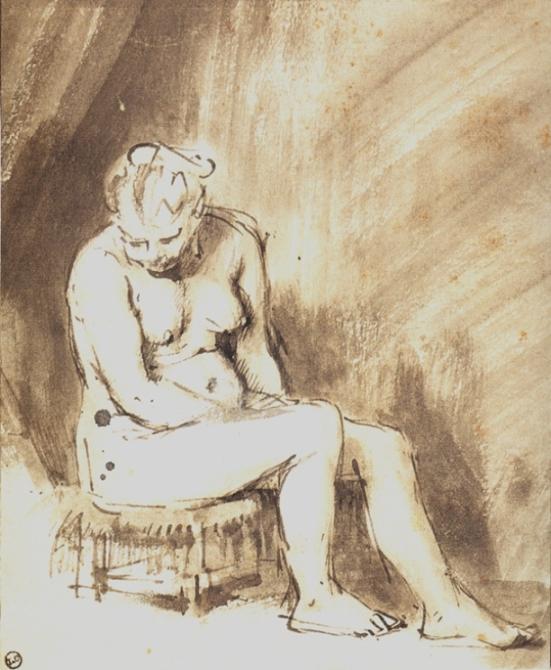
Experience Rembrandt's 'A Seated Female Nude,' a captivating drawing showcasing his mastery of form and light. Explore the artistry & historical context of this iconic work from the Art Institute of Chicago.
Explore Rembrandt van Rijn (1606-1669), Dutch Baroque master of light & shadow! Discover iconic self-portraits, biblical scenes & groundbreaking etchings. Experience the Dutch Golden Age.
Explore the Art Institute of Chicago's world-renowned collection! Discover masterpieces from Monet to Van Gogh & experience stunning architecture in this iconic landmark.
A Window into the Soul: Rembrandt’s ‘A Seated Female Nude’
Rembrandt van Rijn's “A Seated Female Nude,” created in 1660, is more than just a depiction of a woman; it’s a profound meditation on humanity, vulnerability, and the masterful manipulation of light. Housed within the esteemed halls of the Art Institute of Chicago, this drawing offers an intimate glimpse into the artist's process and his remarkable ability to imbue seemingly simple subjects with extraordinary emotional resonance. Measuring just 21 x 17 cm, its modest size belies the monumental impact of its composition – a testament to Rembrandt’s genius that continues to captivate viewers centuries later. The work immediately draws the eye to the central figure, seated gracefully on a chair adorned with a cushion, her hands resting gently in her lap. This posture, both relaxed and contemplative, speaks volumes about the subject's inner state—a quiet dignity amidst an implied solitude.
The brilliance of “A Seated Female Nude” lies not in overt sensuality, but rather in Rembrandt’s nuanced approach to portraying the human form. He eschews the idealized beauty often associated with classical nudes, opting instead for a realism that is both grounded and deeply affecting. The woman's face is deliberately generalized, devoid of specific features, allowing viewers to project their own emotions and experiences onto her. This deliberate ambiguity elevates the drawing beyond mere representation; it becomes a mirror reflecting our own understanding of beauty, vulnerability, and the complexities of human existence. The background, rendered in simple, dark tones, serves not as a distraction but as a powerful amplifier for the figure’s presence—a stark contrast that emphasizes her isolation and inner world.
Rembrandt's technical skill is immediately apparent in every stroke of his pen and wash. He demonstrates an extraordinary command of line, using it to define the contours of the body with precision while simultaneously suggesting movement and texture through subtle variations in pressure and tone. The use of subtractive highlights—scraping away layers of pigment to reveal the underlying paper—creates a remarkable sense of luminosity, mimicking the effect of light illuminating the form from an unseen source. This technique, favored by Rembrandt in his later years, adds a dynamic quality to the drawing, as if it were capturing a fleeting moment of illumination. The choice of ivory laid paper and cream laid card further enhances the visual impact, providing a neutral canvas that allows Rembrandt’s masterful techniques to truly shine.
The creation of “A Seated Female Nude” occurred during Rembrandt's active period in Amsterdam, a time marked by both artistic flourishing and personal turmoil. He was deeply embedded within the Dutch Golden Age, an era characterized by unprecedented prosperity, intellectual curiosity, and a renewed interest in classical art and humanism. This context profoundly influenced his work, which often explored themes of morality, faith, and the complexities of human relationships. Rembrandt’s exploration of the nude figure during this period reflects a shift away from purely decorative representations towards a more psychologically driven approach—a desire to capture not just the physical form but also the inner life of the subject. Furthermore, it's important to note that Rembrandt was deeply influenced by the work of Pieter Lastman, whose dramatic use of light and shadow laid the groundwork for Rembrandt’s own groundbreaking techniques.
Beyond its aesthetic merits, “A Seated Female Nude” holds significant historical importance as a key example of Rembrandt’s artistic development. It represents a pivotal moment in his career—a transition from the more rigid conventions of earlier portraiture to a looser, more expressive style characterized by an intense focus on capturing emotional depth and psychological nuance. His later works, such as “Self Portrait (8)” and "A Seated Female Nude as Susanna," demonstrate this evolution, showcasing a growing confidence in his ability to convey complex emotions through subtle gestures and carefully considered compositions. The drawing’s legacy extends far beyond its own merits, serving as an inspiration for generations of artists—from Romantic painters like Eugène Delacroix to Impressionists like Claude Monet—who sought to capture the fleeting beauty of light and shadow and the profound depths of human experience. ArtsDot offers exceptional reproductions that faithfully recreate this masterpiece, allowing you to bring Rembrandt’s evocative vision into your own space.