A Symphony of Shadow and Soul
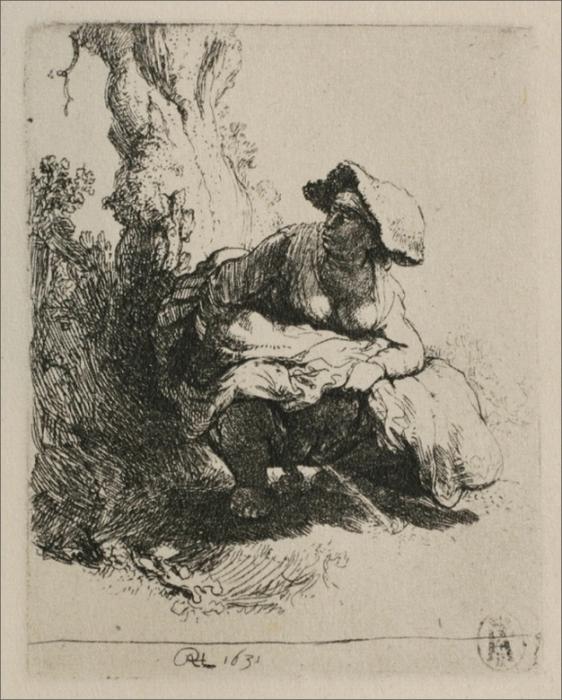
In the quiet corners of art history, few moments capture the essence of human introspection as poignantly as Rembrandt van Rijn’s “Woman Beneath a Tree.” Painted during the mid-seventeenth century, this masterpiece serves as a profound window into the psychological landscape of the Dutch Golden Age. The scene presents a woman seated in a moment of stillness, her gaze directed upward as if searching for answers in the heavens or lost in the depths of her own thoughts. There is an undeniable weight to her posture; while her hands rest gently upon her knees in a state of repose, there is a subtle tension in her expression that hints at an underlying melancholy. It is a portrait not merely of a person, but of a feeling—a delicate balance between peace and inner turmoil that resonates with anyone who has ever sought solace in solitude.
The composition is anchored by the rugged, commanding presence of a sprawling tree trunk, which acts as both a physical shelter and a symbolic pillar of permanence. Against this textured, earthy backdrop, the woman’s vulnerability is heightened, creating a striking juxtaposition between the enduring strength of nature and the fleeting, fragile emotions of the human spirit. This interplay suggests a deeper narrative of resilience, where the natural world provides a sanctuary for the wandering mind. For collectors and decorators, this piece offers more than just visual beauty; it provides a focal point of profound emotional gravity, making it an ideal centerpiece for spaces designed for contemplation and quiet luxury.
The Mastery of Chiaroscuro and Texture
To behold this work is to witness Rembrandt at the height of his technical prowess. The artist employs his signature chiaroscuro—the dramatic, masterful manipulation of light and shadow—to sculpt the scene from the darkness. He does not simply paint light; he breathes it into existence through a meticulous process of layering thin, translucent glazes over a carefully prepared underpainting. This technique allows light to appear as though it is emanating from within the canvas itself, creating an ethereal glow that illuminates the woman’s face and the rough, tactile bark of the tree with equal brilliance.
Every brushstroke serves a purpose in building the painting's rich, atmospheric depth. The way the light filters through the unseen canopy to catch the folds of her clothing or the subtle contours of her features invites the viewer to linger, searching for detail within the shadows. This level of craftsmanship is what makes a high-quality reproduction of such a work so transformative for an interior. When placed in a well-curated room, the painting’s ability to command light and shadow can alter the very mood of a space, bringing a sense of historical prestige and academic sophistication to modern decor.
A Legacy of Light and Human Connection
Beyond its technical brilliance, “Woman Beneath a Tree” is deeply rooted in the cultural ferment of seventeenth-century Holland. This was an era defined by scientific advancement, humanist ideals, and a burgeoning sense of individual identity. Rembrandt’s ability to imbue a seemingly simple genre scene with such complex psychological depth reflects the period's preoccupation with the inner life of the individual. The painting transcends its historical moment, offering a timeless meditation on the human condition that remains as relevant today as it was in 1650.
For the discerning art lover or interior designer, acquiring a reproduction of this caliber is an opportunity to invite a piece of the Dutch Golden Age into the contemporary home. It is a work that speaks to the soul, offering a sense of stability and profound beauty. Whether used to anchor a formal study or to add a layer of narrative complexity to a living space, Rembrandt’s vision continues to inspire awe, reminding us all of the enduring power of light to reveal the hidden truths of our hearts.