Rembrandt's Masterpiece: A Moment Frozen in Time
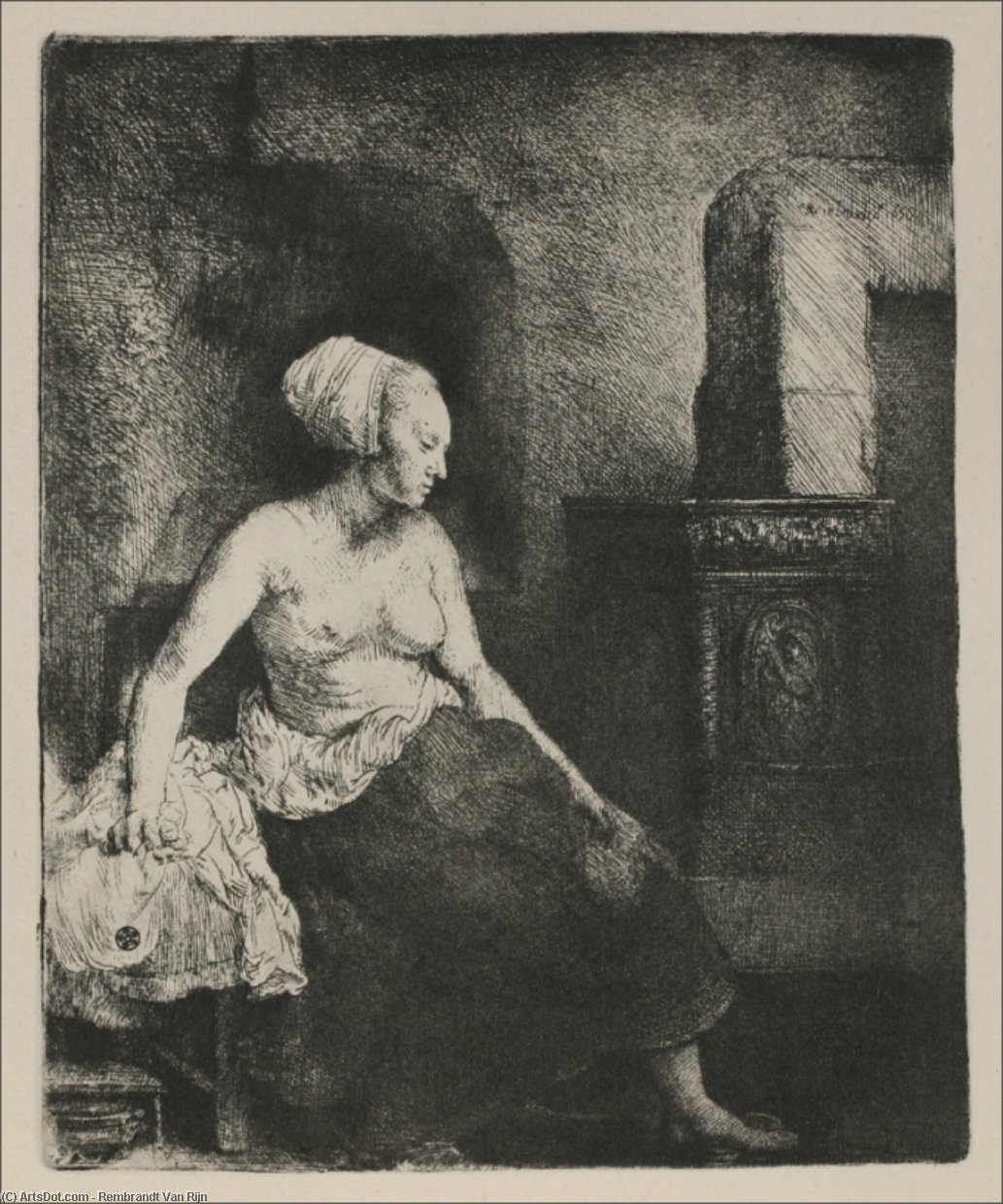
“A Woman Seated Before a Dutch Stove,” etched by Rembrandt van Rijn around 1658, isn’t merely an image; it’s a distillation of the artist’s profound understanding of human emotion and masterful manipulation of light—elements that cemented his legacy as one of the greatest painters in Western history. This deceptively simple composition captures a scene of domestic tranquility, yet beneath its surface lies layers of psychological depth that continue to fascinate scholars and artists alike.
The Artist’s Vision: Rembrandt's Signature Style
Rembrandt Harmenszoon van Rijn (1606-1669), born in Leiden, Netherlands, revolutionized painting with his innovative use of chiaroscuro—the dramatic interplay between light and shadow—a technique he honed during his formative years under Pieter Lastman. Unlike many contemporaries who favored idealized depictions, Rembrandt relentlessly pursued realism, striving to portray the human figure with unflinching honesty. This etching exemplifies his dedication to capturing not just outward appearance but also inner feeling, mirroring a core principle of Baroque art.
Technical Brilliance: Etching and Drypoint – A Delicate Dance
The artwork’s execution showcases Rembrandt's unparalleled skill in etching and drypoint—a painstaking process involving multiple stages. First, the artist meticulously drew the scene onto copper plate, then incised lines with a needle to create a matrix that would be transferred onto paper through pressure. Drypoint, utilizing hardened needles, produced richer tonal variations than traditional etching, allowing Rembrandt to achieve an astonishing level of detail and nuance—particularly evident in the subtle shading of the woman’s face and clothing.
Historical Context: Domestic Life During the Dutch Golden Age
Painted during the zenith of the Dutch Republic's artistic flourishing – the Dutch Golden Age – “A Woman Seated Before a Dutch Stove” reflects the values of the era. The presence of a Dutch stove, a symbol of warmth and comfort, underscores the importance of domestic life and family within Puritan society. Rembrandt’s portrayal isn’t celebratory; rather, it conveys a quiet stillness—a moment of introspection for the woman depicted, inviting viewers to contemplate themes of solitude, contemplation, and perhaps even melancholy.
Symbolism Beyond Appearance: The Woman's Gaze
Perhaps the most compelling aspect of this etching is the woman’s gaze. Turned slightly away from the viewer—and implicitly from the fireplace—her eyes hold a profound sadness, hinting at unspoken thoughts and emotions. Rembrandt skillfully uses light to illuminate her face, emphasizing vulnerability and conveying a sense of inner turmoil. This subtle gesture transcends mere representation; it speaks to universal human experiences of longing and reflection—a testament to Rembrandt’s genius in capturing the complexities of the human psyche.
A Legacy Enduring Through Reproduction
Today, high-quality reproductions of “A Woman Seated Before a Dutch Stove” offer art enthusiasts and interior designers alike the opportunity to experience Rembrandt's artistic vision firsthand. ArtsDot’s meticulous craftsmanship ensures that these prints faithfully capture the original artwork’s luminous beauty and emotional resonance—preserving a masterpiece for generations to come.