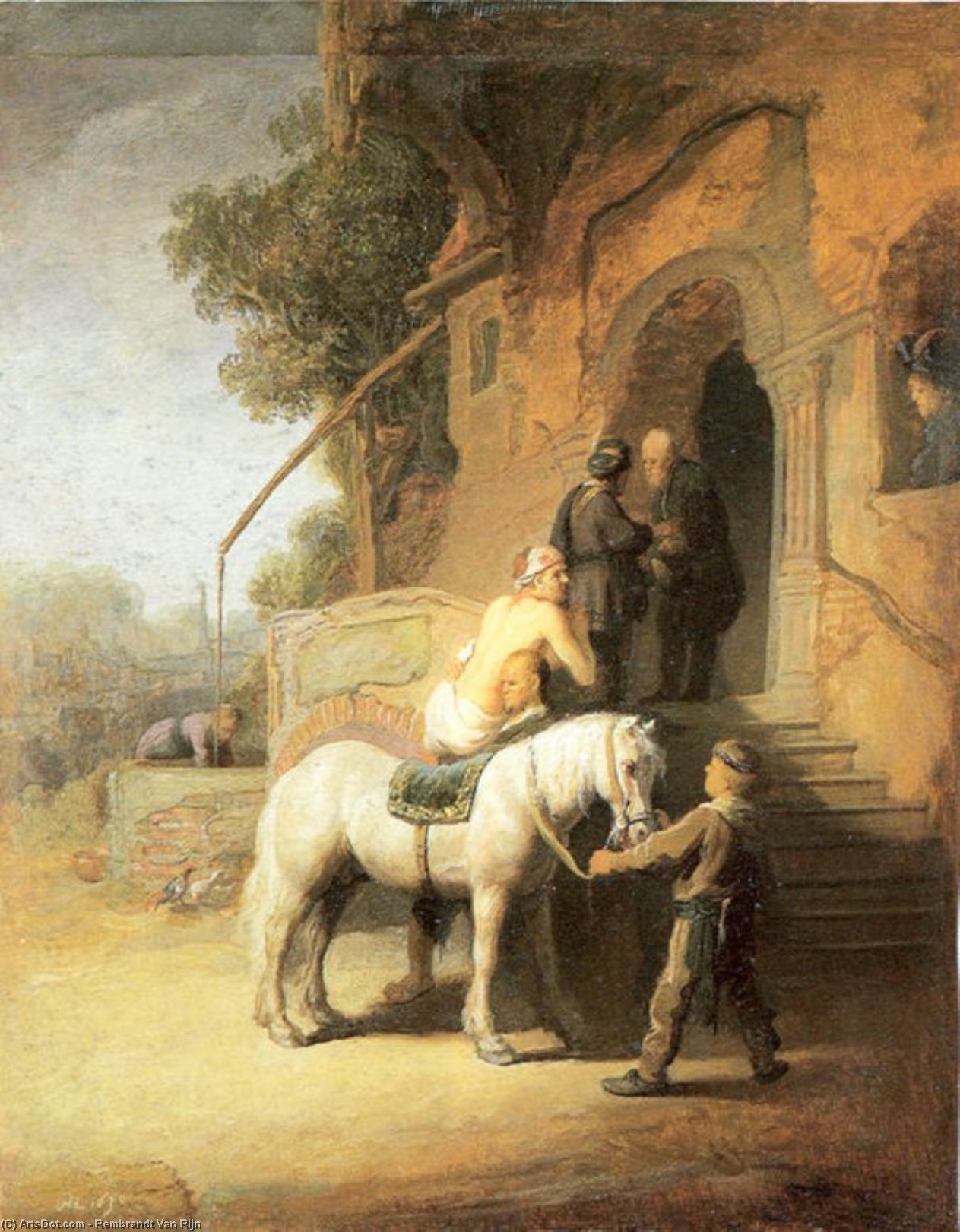
The Charitable Samaritan: A Testament to Rembrandt's Empathy
Painted by Rembrandt van Rijn, "The Charitable Samaritan" stands as a poignant embodiment of the Dutch Golden Age’s artistic values and Rembrandt’s unparalleled ability to convey human emotion. This work, rooted in the biblical parable of the Good Samaritan, transcends mere illustration; it becomes a profound meditation on compassion, responsibility, and the inherent dignity of every individual.
The Dutch Golden Age Context
To fully appreciate "The Charitable Samaritan," understanding its historical context is crucial. The Dutch Golden Age (roughly 1588-1672) was a period of remarkable prosperity and cultural flourishing in the Netherlands. Fueled by burgeoning trade and colonial expansion, Dutch society experienced unprecedented economic growth, which fostered an environment ripe for artistic innovation. Unlike the patronage systems prevalent in other European nations, the Dutch Golden Age saw a rise in private collectors and a growing middle class eager to acquire art for their homes. This shift led to a demand for genre scenes depicting everyday life, portraits of prominent citizens, and landscapes – all characterized by meticulous realism and attention to detail. Rembrandt, alongside masters like Johannes Vermeer and Frans Hals, became synonymous with this era’s artistic achievements.
Rembrandt's Technique: Chiaroscuro and Emotional Depth
Rembrandt’s mastery of chiaroscuro – the dramatic contrast between light and shadow – is central to the power of "The Charitable Samaritan." He doesn't simply illuminate the scene; he sculpts it with light, drawing the viewer's eye to key elements while shrouding others in a mysterious darkness. The warm glow enveloping the Samaritan and the injured man contrasts sharply with the shadowed figures in the background, emphasizing their interaction and creating a sense of intimacy. This technique isn’t merely aesthetic; it serves to heighten the emotional impact of the scene. The rough texture of the dirt, the worn clothing of both men, and the subtle expressions on their faces are rendered with remarkable realism, inviting viewers to connect with the narrative on a visceral level. The use of impasto – applying paint thickly – further enhances the tactile quality of the work, adding depth and dimension.
Symbolism and Interpretation
Beyond its surface depiction of the parable, "The Charitable Samaritan" is rich in symbolic meaning. The injured man represents all those suffering and in need of assistance. The Samaritan, traditionally viewed as an outsider due to his ethnicity, embodies selfless compassion and transcends societal boundaries. Rembrandt’s choice to depict a seemingly ordinary scene – a man on horseback assisting another fallen figure – elevates the parable to a universal message about human responsibility and empathy. Some scholars interpret the clock in the background as a reminder of the fleeting nature of time and the urgency of responding to suffering. The bowls scattered around the scene could symbolize charity and offering aid.
The Enduring Legacy
"The Charitable Samaritan" is more than just a painting; it's a testament to Rembrandt’s profound understanding of human nature and his ability to translate complex emotions onto canvas. Its enduring appeal lies in its timeless message of compassion and its masterful execution, solidifying its place as a cornerstone of the Dutch Golden Age and a masterpiece of Western art. It continues to inspire artists and viewers alike, reminding us of our shared humanity and the importance of extending kindness to those in need.