Rembrandt’s Intimate Portrait: Unveiling Hendrickje Stoffels
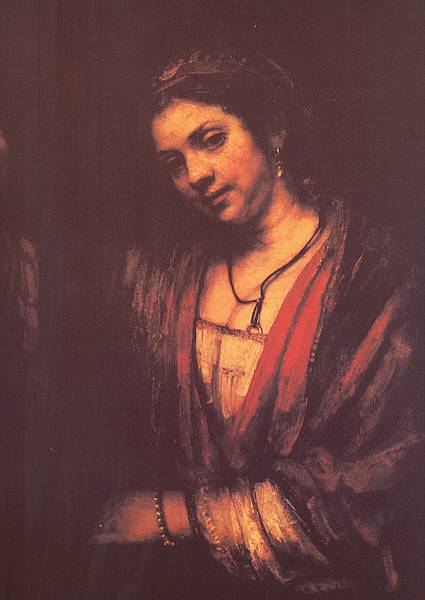
Rembrandt van Rijn's "Hendrickje," often referred to as “Hendrickje Bathing,” is more than just a portrait; it’s a poignant glimpse into the life of a woman largely obscured by history, yet profoundly significant to one of art’s greatest masters. Painted around 1654, this remarkably intimate work captures Hendrickje Stoffels, Rembrandt's longtime companion and the mother of his daughter Cornelia, in a moment of quiet contemplation. The painting immediately draws the viewer in with its masterful use of light – a hallmark of Rembrandt’s signature style – which pools softly on her face and hands, creating an atmosphere of serene vulnerability. It’s a study in contrasts: the cool, shadowed depths of her clothing juxtaposed against the luminous highlights that define her features, revealing a subtle beauty both dignified and approachable.
The composition itself is deceptively simple. Hendrickje sits slightly turned away from the viewer, holding a cloth draped across her lap – an action that suggests modesty and perhaps a hint of domesticity. Her gaze, though averted, feels direct, engaging the observer in a silent conversation. The details are meticulously rendered: the delicate folds of her dress, the subtle texture of her skin, even the slight curve of her neck—all contribute to a sense of palpable realism. Notably, there’s no overt display of wealth or status; instead, Rembrandt focuses on capturing the essence of Hendrickje's character – her quiet strength and inherent grace.
A Complex Relationship: Context and Intrigue
Hendrickje’s story is inextricably linked to Rembrandt’s own. Their relationship was a complex one, marked by both affection and legal obstacles. Rembrandt had been married to Saskia van Uylenburgh, but their union ended tragically with her death in 1642. The will stipulated that any inheritance would pass to Saskia's descendants, effectively preventing Rembrandt from marrying Hendrickje and inheriting his late wife’s estate. Despite this legal impediment, they remained together for over two decades, sharing a home, raising a child, and managing Rembrandt’s business affairs. The painting therefore becomes a powerful symbol of their enduring bond – a testament to love that transcended societal constraints.
Adding another layer of intrigue is the fact that Hendrickje was not formally depicted by Rembrandt before this portrait. While some scholars believe she modeled for several other “Tronie” portraits (single-figure compositions), this work stands out as particularly revealing, offering a rare and intimate portrayal of a woman who played a crucial role in the life of one of art’s most celebrated figures. The painting was likely intended to be a study, a preliminary sketch for a larger commission, but it quickly became a treasured piece within Rembrandt's oeuvre.
Technique and Artistic Innovation
Rembrandt’s technical skill is on full display in “Hendrickje.” He employs his signature *chiaroscuro* technique – the dramatic interplay of light and shadow – with breathtaking precision. The subtle gradations of tone create a sense of depth and volume, while the carefully placed highlights draw attention to key features. The painting’s palette is restrained, dominated by earthy tones—browns, ochres, and grays—which contribute to its overall mood of quiet contemplation. Rembrandt's use of impasto – applying paint thickly to create texture – is particularly evident in Hendrickje’s hands, adding a tactile quality to the image.
Furthermore, the painting showcases Rembrandt’s innovative approach to portraiture. Rather than presenting a formal, idealized representation, he captures Hendrickje as a real woman—with all her imperfections and vulnerabilities. This departure from traditional conventions reflects his growing interest in psychological realism and his desire to portray the inner lives of his subjects. The loose brushwork and subtle variations in tone suggest a sense of immediacy and spontaneity, capturing a fleeting moment in time.
Symbolism and Emotional Resonance
Beyond its technical brilliance, “Hendrickje” is rich in symbolism. The cloth she holds could represent domesticity, motherhood, or perhaps even the burdens of her unconventional relationship with Rembrandt. Her averted gaze invites speculation about her thoughts and feelings—her quiet dignity a powerful counterpoint to the turbulent circumstances of her life. The painting’s overall mood evokes a sense of melancholy and longing, reflecting the bittersweet reality of their enduring love.
Reproductions of “Hendrickje” offer an exceptional opportunity to connect with this remarkable woman and appreciate Rembrandt's extraordinary talent. ArtsDot’s hand-painted reproductions capture the essence of the original painting—its light, its texture, and its emotional depth—with unparalleled fidelity. Whether displayed in a private residence or a museum setting, this captivating portrait will undoubtedly serve as a poignant reminder of the complexities of love, loss, and artistic genius.