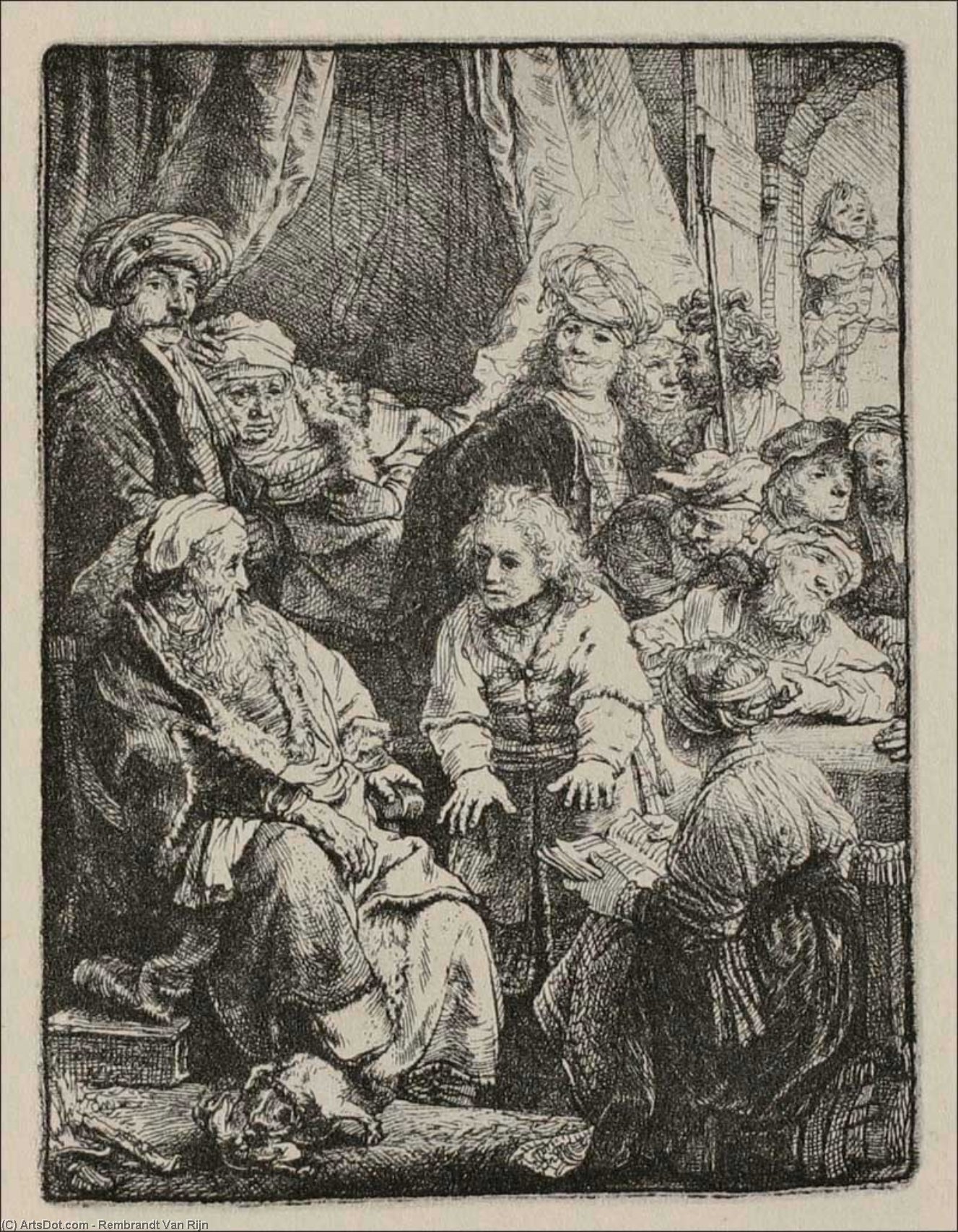
A Moment of Revelation: Rembrandt’s “Jacob Telling His Dreams”
Rembrandt van Rijn's etching, "Jacob Telling His Dreams," stands as a cornerstone of Baroque art—a testament to the artist’s unparalleled ability to capture psychological depth and dramatic emotion within a deceptively simple composition. Executed in 1638, this artwork transcends mere visual representation; it delves into biblical narrative and explores themes of faith, doubt, and familial devotion with breathtaking precision.
- Subject Matter: The etching portrays Jacob wrestling with his prophetic dreams—visions foretelling the impending judgment of God. Rembrandt meticulously depicts Jacob’s father and sons listening intently to his account, capturing a palpable tension between belief and skepticism.
- Style & Technique: Characteristic of Rembrandt's Baroque style, “Jacob Telling His Dreams” employs masterful chiaroscuro – dramatic contrasts between light and dark—to sculpt the figures and imbue them with an aura of solemn seriousness. The etching technique itself is remarkable; Rembrandt painstakingly etched lines onto a zinc plate using a needle, achieving astonishing detail through multiple impressions on paper.
- Composition & Detail: Rembrandt’s compositional choices are deliberate, creating a claustrophobic yet intimate space where the figures dominate the frame. Cross-hatching—a technique of hatching lines to create texture and shading—is extensively utilized throughout the image, conveying the roughness of clothing and the subtle nuances of facial expressions. The artist's attention to detail is extraordinary; every wrinkle on Jacob’s face, every gesture of his father conveys a profound sense of realism.
- Historical Context: Created during Rembrandt’s prolific period in Amsterdam—a city at the height of artistic innovation—the etching reflects the Baroque preoccupation with conveying emotion and spiritual contemplation. It aligns perfectly with the broader artistic movement's focus on dramatic storytelling and psychological exploration, cementing Rembrandt’s legacy as one of the greatest painters of all time.
- Symbolism & Emotional Impact: Beyond its narrative depiction of biblical scripture, “Jacob Telling His Dreams” speaks to universal human experiences—the struggle for faith amidst uncertainty and the importance of familial bonds. Rembrandt's masterful use of light and shadow evokes a powerful emotional response in viewers, prompting reflection on themes of divine judgment and moral responsibility.
A reproduction of “Jacob Telling His Dreams” offers an exceptional opportunity to experience the grandeur of Baroque artistry firsthand—to appreciate Rembrandt’s genius for capturing human emotion and transforming biblical tales into enduring visual masterpieces.