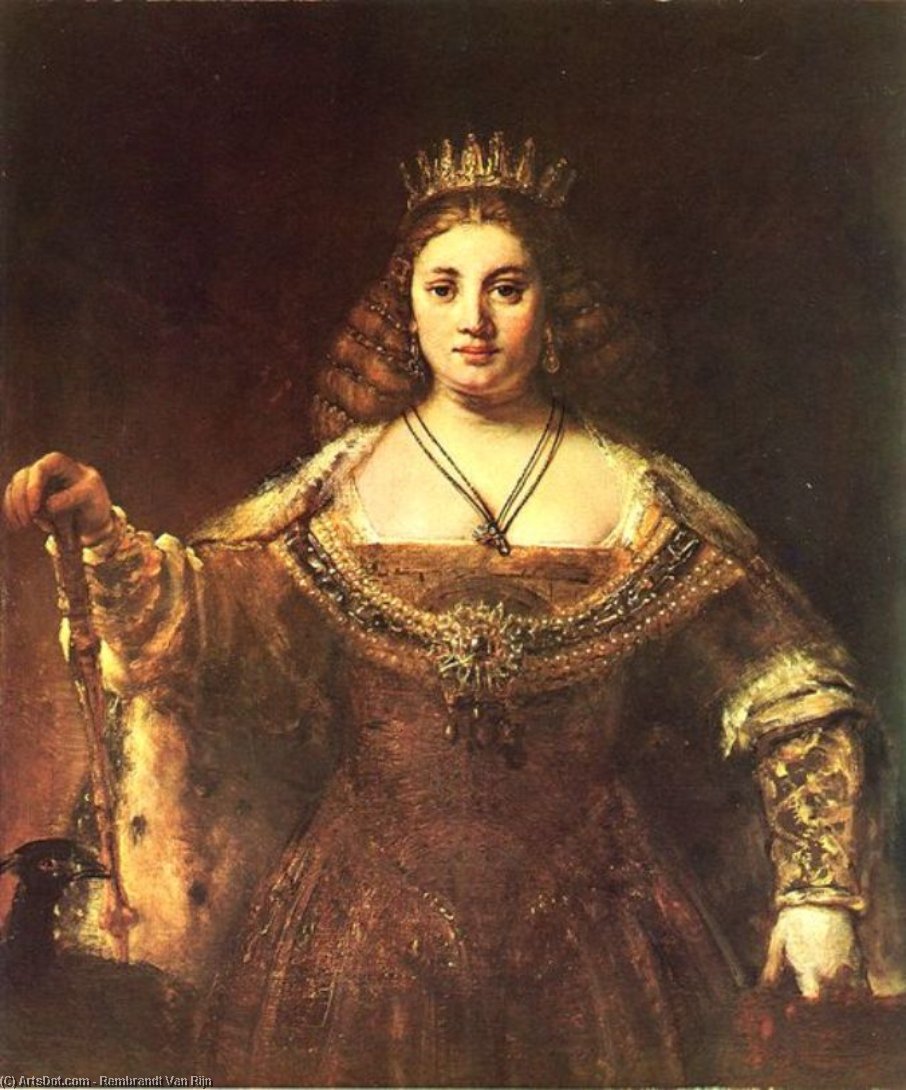
Juno by Rembrandt van Rijn: A Portrait of Divine Grace
Rembrandt Harmenszoon van Rijn, a titan amongst Dutch Baroque painters, bequeathed to posterity an unparalleled legacy of artistic brilliance—a mastery of light and shadow that continues to inspire awe centuries later. Among his most celebrated creations is “Juno,” completed in 1664-65, currently residing within the Armand Hammer Museum of Art and Cultural Center in Los Angeles. This monumental canvas transcends mere representation; it embodies a profound meditation on femininity, power, and mythological grandeur.
Composition and Symbolism: Balancing Light and Majesty
The painting depicts Juno—the Roman goddess of marriage, childbirth, and queenship—with remarkable dignity and composure. Rembrandt skillfully employs a pyramidal composition, anchoring the figure’s gaze at the center while subtly directing the viewer's eye upwards towards her crown. This deliberate arrangement emphasizes Juno’s regal bearing and reinforces her status as supreme authority. The crimson wall behind Juno serves not merely as a backdrop but as an active element of visual drama—its vibrant hue contrasts sharply with Juno’s pale skin tone, amplifying the luminosity of Rembrandt’s masterful chiaroscuro technique.
- Chiaroscuro Technique: Rembrandt's signature method – dramatic interplay between light and dark – sculpts Juno’s form, highlighting her facial features and drapery while enveloping the figure in an aura of subdued luminescence.
- Symbolic Dress: Juno’s gown is adorned with ruffled neckline, a stylistic choice that speaks to the opulent sensibilities of the era and underscores her status as a symbol of aristocratic elegance.
- The Crown: Juno's crown symbolizes divine power and sovereignty—a visual declaration of her dominion over the realm of marriage and fertility.
Historical Context and Rembrandt’s Artistic Vision
Painted during Rembrandt’s twilight years, “Juno” reflects a culmination of his artistic explorations and demonstrates an unwavering commitment to capturing psychological depth alongside technical virtuosity. Rembrandt's fascination with classical mythology—particularly the Roman goddess Juno—was evident throughout his oeuvre, and this portrait exemplifies his ability to infuse biblical narratives with humanist sensibilities. The painting stands as a testament to Rembrandt’s profound understanding of human emotion and his masterful manipulation of artistic conventions.
Further Exploration:
- Visit the Armand Hammer Museum of Art and Cultural Center in Los Angeles for an immersive experience of Rembrandt's artistry.
- Delve into Rembrandt’s broader artistic output at Het Rembrandthuis, Amsterdam—a dedicated museum celebrating his life and legacy.
- Compare “Juno” with other iconic portraits by Rembrandt, such as “Saul and David,” housed at the Mauritshuis in The Hague, to appreciate the breadth of his stylistic range.
Emotional Resonance: Capturing Divine Grace
“Juno” transcends its formal elements—composition, technique, symbolism—to evoke a palpable sense of serenity and contemplation. Rembrandt’s ability to convey inner emotion through visual representation remains unparalleled, securing Juno's place as one of the most enduring images of feminine dignity and spiritual grace. It is a painting that invites viewers to pause, reflect, and contemplate the timeless themes of power, beauty, and maternal devotion—a masterpiece destined to captivate generations to come.