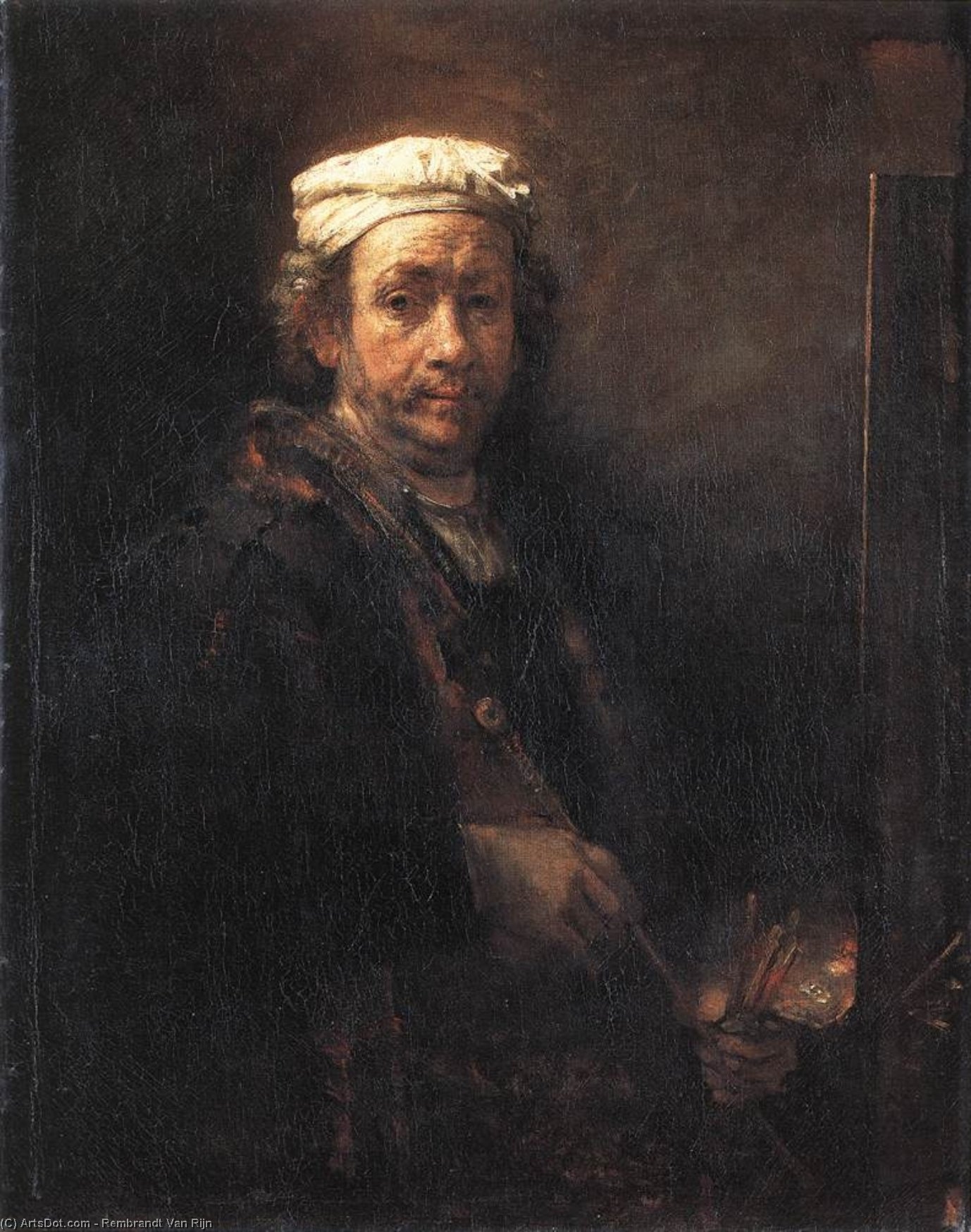
A Masterful Glimpse into Artistic Identity: Rembrandt’s 1660 Self-Portrait
This captivating oil on canvas (111 x 85 cm), housed in the prestigious Musée du Louvre, Paris, is more than a mere likeness; it's an intimate exploration of artistic identity and the passage of time, rendered with breathtaking skill by Rembrandt van Rijn. Painted towards the end of his illustrious career in 1660, this self-portrait stands as a powerful testament to the artist’s enduring legacy and mastery of Baroque painting.
The Artist at Work: Subject & Composition
Rembrandt presents himself directly facing the viewer, positioned before his easel – though the canvas itself remains largely obscured, hinting at the mysteries of creation. He is depicted from the chest up, enveloped in rich, dark clothing accented by a white collar and a subtly patterned cap. His gaze is direct and unwavering, engaging the observer with an intensity that feels remarkably personal. The artist holds a palette in his left hand and brushes in his right – not as props, but as extensions of himself, integral to his very being. This isn’t simply *a portrait of* an artist; it's a portrait *of the act* of being an artist.
Baroque Brilliance: Style & Technique
The painting exemplifies the hallmarks of the Baroque period – dramatic
chiaroscuro, intense emotional depth, and palpable realism. Rembrandt masterfully manipulates light and shadow, allowing illumination to fall across his face and hands, highlighting wrinkles etched by time and experience. This isn’t idealized beauty; it's honest representation. The loose brushstrokes and
impasto technique – the thick application of paint – create texture and volume, lending a tactile quality to the work. You can almost feel the weight of the fabric and the roughness of his skin. The limited color palette—dominated by browns, ochres, and blacks—further enhances the dramatic effect, focusing attention on Rembrandt’s expressive face.
Historical Context & The Rise of Self-Portraiture
Rembrandt was a prolific self-portraitist, creating nearly one hundred throughout his career in painting, etching, and drawing. While the Renaissance saw a growing interest in individual identity fueled by advancements in mirror technology and panel portraiture, Rembrandt elevated the genre to new heights. His self-portraits weren’t merely exercises in technical skill; they were profound explorations of his inner life, documenting his physical and emotional evolution over decades. He used himself as a readily available model, but also as a vehicle for artistic experimentation and self-analysis.
Beyond the Surface: Symbolism & Emotional Impact
While seemingly straightforward, this portrait is rich in subtle symbolism. The act of painting itself represents creation, transformation, and the artist’s attempt to capture reality on canvas. The partially obscured canvas suggests the unseen potential waiting to be realized. More profoundly, the painting conveys a sense of introspection and vulnerability. Rembrandt doesn't present himself as triumphant or aloof; he appears thoughtful, weary even, yet undeniably resolute. The portrait invites viewers to contemplate not only the artist’s life but also their own mortality and the search for meaning.
A Timeless Masterpiece for Modern Spaces
This self-portrait is a powerful statement piece suitable for a variety of interior design styles. Its rich color palette and dramatic lighting complement both traditional and contemporary settings.
- Versatility: Works well in studies, living rooms, or gallery walls.
- Emotional Resonance: Sparks conversation and inspires contemplation.
- Timeless Appeal: Transcends time, offering a glimpse into the soul of one of history's greatest artists.
A high-quality reproduction would be an invaluable addition to any art collection.