The Soul in Shadow: Rembrandt’s Masterful Study
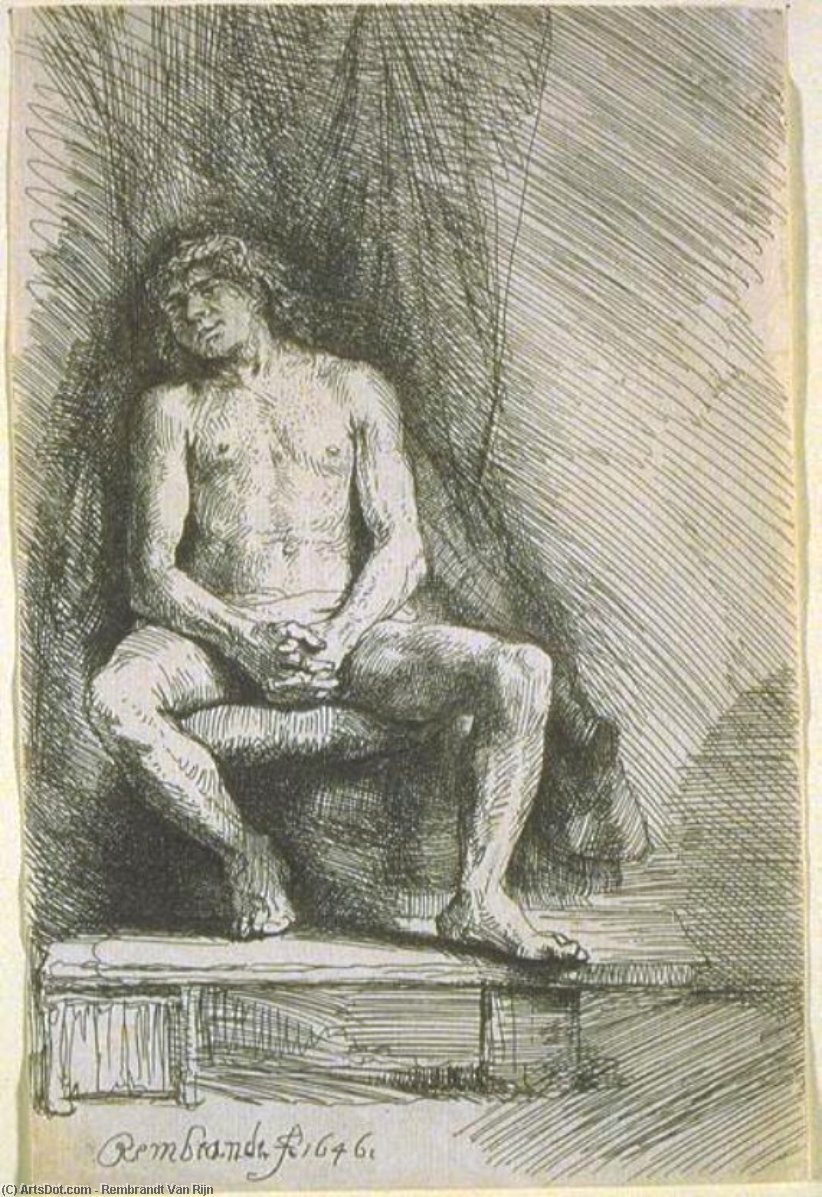
In the quiet, dimly lit chambers of the Dutch Golden Age, few artists possessed the ability to command the darkness as profoundly as Rembrandt van Rijn. His etching, Study from the Nude Man Seated before a Curtain, created around 1646, is not merely a technical exercise in anatomy but a breathtaking window into the human psyche. At first glance, the viewer is met with a deceptively simple composition: a nude male figure, seated in a moment of profound stillness, his legs crossed in a posture that suggests deep contemplation. Yet, as one lingers before the work, the interplay of light and shadow begins to breathe life into the paper, transforming a mere anatomical study into a visceral experience of existence.
The brilliance of this piece lies in Rembrandt’s unparalleled mastery of chiaroscuro. Through the delicate medium of etching, he orchestrates a dramatic dialogue between light and void. The subject is sculpted by sudden, piercing highlights that catch the curve of a muscle or the edge of a limb, while velvety, deep shadows swallow the periphery, pulling the figure forward from the darkness. This technique does more than create three-dimensional depth; it creates atmosphere. The heavy, textured lines of the curtain in the background serve as a silent witness, offering a sense of privacy and enclosure that heightens the intimacy of the scene. There is a palpable weight to the shadows, an invitation to wonder what remains hidden in the unlit corners of the composition.
A Legacy of Introspection and Form
Beyond its technical prowess, the work serves as a testament to the scientific curiosity and emotional depth characteristic of the 17th-century Netherlands. During this era, the study of the human form was often intertwined with an exploration of the soul. Rembrandt’s meticulous attention to anatomical detail—the tension in the torso, the weight of the limbs—reflects the burgeoning interest in naturalism and observation. However, he transcends mere biological accuracy by imbuing the figure with a sense of vulnerability and serenity. The seated man does not perform for the viewer; instead, we find ourselves intruding upon a private moment of quiet introspection.
For the discerning collector or the interior designer, this artwork offers much more than aesthetic beauty. It provides a focal point of intellectual and emotional gravity. Whether placed in a contemporary gallery setting or a classic study, the piece commands attention through its quiet power. A high-quality reproduction of this etching allows one to bring the timeless drama of Rembrandt into a modern space, offering a sophisticated touch of history that celebrates the enduring beauty of the human form and the eternal mystery of the light.