A Window into 17th Century Amsterdam: Rembrandt’s Portrait of a Craftsman
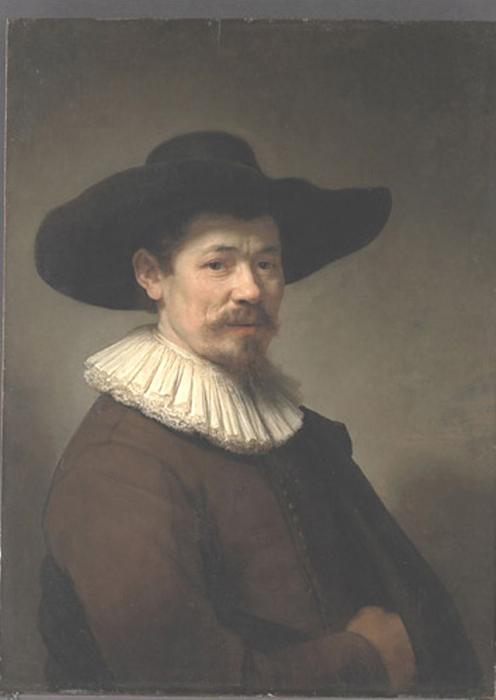
Rembrandt van Rijn's “The Framer Herman Doomer,” painted in 1640, isn’t merely a portrait; it’s a meticulously crafted snapshot of life in the bustling heart of 17th-century Amsterdam. This intimate scene, currently residing within the hallowed halls of the Metropolitan Museum of Art, offers a rare glimpse into the world of a skilled artisan – Herman Doomer, an ebony worker and framemaker – and reveals Rembrandt’s extraordinary ability to capture not just likeness but also character and quiet contemplation.
The painting immediately draws the eye with its masterful use of light. Rembrandt employs a dramatic chiaroscuro technique, bathing Doomer in a soft, diffused glow while leaving much of the background shrouded in shadow. This creates a powerful sense of depth and focuses our attention entirely on the subject. Doomer himself is depicted in a simple yet dignified pose, seated with his hands resting thoughtfully on his lap. His gaze, directed slightly off-camera, suggests an inner world – perhaps lost in thought about his craft or observing the activity beyond the frame. The subtle details—the feathered hat, the worn brown coat, and the ruffled collar indicative of his middle-class status—speak volumes about his profession and social standing.
The Context of a Golden Age Artisan
To fully appreciate “The Framer Herman Doomer,” it’s crucial to understand the historical context in which it was created. The Dutch Golden Age, spanning roughly from the late 16th to the early 18th centuries, witnessed an unprecedented flourishing of art, commerce, and culture. Amsterdam, as a major trading hub, became a melting pot of ideas and styles. Rembrandt’s work during this period reflects this dynamism, moving beyond purely religious subjects – influenced by the Christian Art Movement's emphasis on biblical narratives – to explore secular themes with remarkable sensitivity and realism.
The subject matter itself—a craftsman engaged in his trade—was a deliberate choice by Rembrandt. It’s a departure from the idealized portraits of nobility that were more commonly commissioned at the time, offering instead a relatable image of everyday life. Doomer's profession was particularly significant during this era; ebony veneering was a highly skilled craft, requiring specialized knowledge and tools, and Doomer’s success speaks to his expertise and reputation within the Amsterdam community.
Rembrandt’s Signature Technique & Influence
Rembrandt’s technique in “The Framer Herman Doomer” is characterized by its remarkable detail and emotional depth. He skillfully employs impasto—thickly applied paint—to create texture and volume, particularly in Doomer's clothing and the folds of his coat. Notice how he uses subtle variations in brushstroke to convey the weight and feel of the fabric. Furthermore, Rembrandt’s use of light is not merely decorative; it serves to illuminate Doomer’s face, revealing a hint of melancholy or introspection – a characteristic often found in his portraits.
The influence of this painting extends far beyond its immediate context. Artists like Michael Hafftka, an American expressionist painter whose work is also represented at the Metropolitan Museum of Art, demonstrate a similar commitment to capturing emotional depth and detail, echoing Rembrandt’s approach. The enduring appeal of “The Framer Herman Doomer” lies in its ability to connect us with a specific time and place while simultaneously exploring universal themes of human experience – contemplation, skill, and the quiet dignity of labor.
Bringing Rembrandt Home: High-Quality Reproductions
For those captivated by the artistry and historical significance of “The Framer Herman Doomer,” handmade oil painting reproductions are available at ArtsDot.com. These meticulously crafted replicas capture the essence of Rembrandt’s original, offering a beautiful and authentic addition to any home or collection. To delve deeper into the life and work of this extraordinary artist, we invite you to explore The Framer Herman Doomer on ArtsDot.com.