A Study in Quiet Dignity: Unveiling Rembrandt’s “The Little Polander”
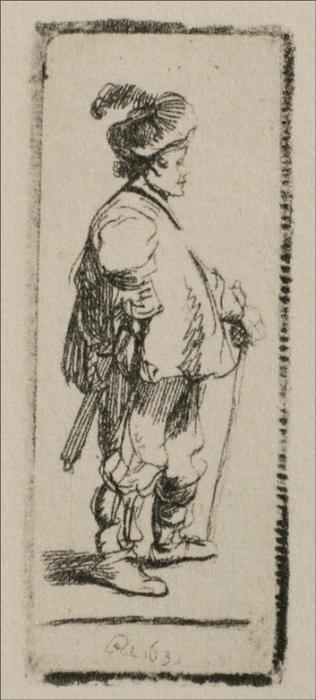
Rembrandt van Rijn's "The Little Polander," a captivating etching or drypoint print, offers a rare glimpse into the life of a 17th-century traveler – likely a Polish soldier or merchant – through the artist’s masterful command of line and shadow. This isn’t a grand portrait intended for public display; rather, it's a deeply personal study, brimming with understated observation and a subtle sense of introspection. The monochrome palette, dominated by rich blacks and delicate creams, immediately draws the viewer into Rembrandt’s world, emphasizing form and texture above vibrant color. The composition itself is deceptively simple: a single figure, rendered in meticulous detail, stands against a faintly discernible background, inviting us to contemplate his posture, gaze, and the quiet narrative he embodies.
Rembrandt's technique here is particularly noteworthy. The extensive use of hatching and cross-hatching—a hallmark of his style—creates an astonishingly realistic depiction of fabric, skin, and even the suggestion of architectural detail in the distance. These lines aren’t merely outlines; they are imbued with tonal value, building up a complex sense of depth and volume that transcends the limitations of the etching medium. The diffused lighting, absent of any strong directional source, contributes to an atmosphere of quiet contemplation, mirroring the subject's downward gaze – a gesture that speaks volumes about his inner thoughts.
The Polish Connection: Historical Context and Symbolism
The title itself, “The Little Polander,” offers a crucial clue to understanding this work. "Polander" referred to individuals from Poland, often travelers or merchants who had established trade routes in the Netherlands during that period. Rembrandt’s fascination with these figures is evident throughout his oeuvre; he frequently depicted them in intimate and often melancholic scenes. This particular etching likely served as a preliminary study for a larger painting, allowing Rembrandt to explore the subject's character and pose before committing to a more elaborate composition. The figure’s posture—relaxed yet dignified—suggests a man of experience and perhaps even some melancholy, hinting at the challenges and uncertainties inherent in travel and trade.
Further research reveals that this image is part of a series depicting various "little Polanders," each capturing a distinct personality. The Rijksmuseum’s online resource highlights Rembrandt's initial interest in portraying “pathetic wretches” before shifting his focus to the more colorful inhabitants of Dutch cities. This evolution reflects a broader shift in Rembrandt’s artistic vision, moving from purely religious subjects to a deeper engagement with human character and everyday life. The etching’s simplicity belies its profound ability to evoke empathy and invite speculation about the subject's past and future.
Rembrandt’s Legacy: Technique and Artistic Influence
“The Little Polander” is a testament to Rembrandt’s unparalleled skill as an etcher. The process itself—incising lines into a copper plate and then meticulously transferring the image onto paper—demands immense patience, precision, and control. Rembrandt's mastery of light and shadow, so characteristic of his later paintings, is brilliantly translated into this monochrome print. The subtle gradations in tone, achieved through variations in line density, create an illusion of three-dimensionality that is remarkably convincing. This technique, combined with the artist’s keen observation of human anatomy and expression, cemented Rembrandt's place as one of the greatest artists of all time.
The work exemplifies his signature style – a focus on capturing the essence of humanity through nuanced detail and emotional resonance. It stands as a poignant reminder of Rembrandt’s ability to transform simple subjects into profound works of art, inviting viewers to contemplate the complexities of human experience long after they've turned away.