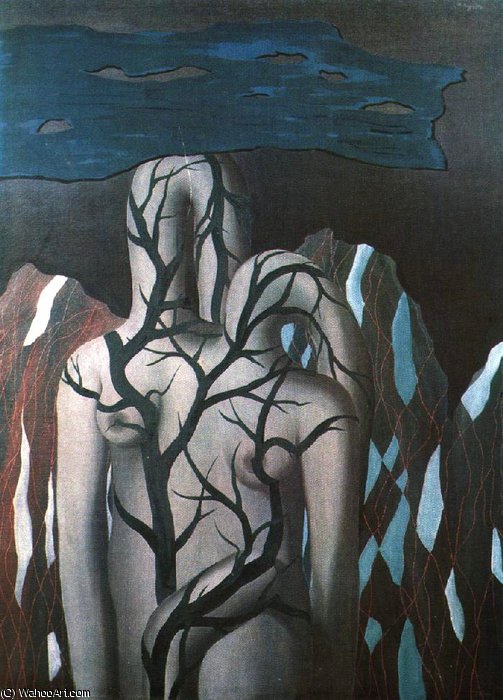
René Magritte’s surrealist masterpiece ‘Landscape,’ 1926, depicts a woman adorned with tree roots emerging from her spine—a haunting symbol of vulnerability and hidden truths within the Belgian Surrealist movement. Explore this captivating artwork and bring its enigmatic beauty into your home.
A Surreal Echo of Loss and Hidden Reality
René Magritte’s “Landscape,” painted in 1926, stands as a deceptively simple yet profoundly unsettling image—a testament to the enduring influence of personal trauma on artistic expression. During his formative years as a surrealist artist, Magritte began to master the art of the visual paradox, creating works that invite the viewer into a deep contemplation of subconscious anxieties and the elusive nature of perception. The painting depicts a woman whose torso is intimately intertwined with tree roots, presenting a striking confrontation between the human form and the relentless growth of the natural world. This deliberate pairing speaks to themes of resilience amidst decay and the inescapable connection between our individual experiences and the organic cycles of life.
The emotional weight of the piece is anchored in its muted palette, primarily composed of earthy browns and deep greens. These tones create an atmosphere of quiet, somber contemplation, punctuated by jarring visual anomalies that disrupt the stillness. Magritte’s signature surrealist style eschews realistic representation in favor of dreamlike imagery and illogical juxtapositions. His brushstrokes are remarkably smooth, contributing to a sense of eerie calm that belies the unsettling symbolism at play. For the collector or interior designer, this painting offers a sophisticated layer of mystery, acting as a focal point that provokes thought and invites long-term engagement through its layered, enigmatic composition.
Symbolism and the Unconscious Mind
The tree roots emerging from the woman’s torso are arguably the painting's most potent symbol. They represent not merely physical growth but also the inescapable influence of past experiences on present consciousness. There is a haunting resonance here with Magritte’s own history; much like the traumatic image of his mother’s body being recovered from the River Sambre, these roots evoke a sense of loss and the way memory can take root within us, becoming an inseparable part of our identity. This exploration of the unseen and the veiled aligns perfectly with André Breton's surrealist manifesto, which advocated for the liberation of the mind from rational thought to explore the vast, often dark, realms of the unconscious.
Beyond the central figure, Magritte introduces subtle elements that add profound depth to the scene. A boat visible in the distant background and a smaller, secondary figure on the right side of the canvas serve to expand the world of the painting, suggesting a larger, perhaps even more complex, reality lurking just beyond our immediate view. This layering of subjects creates a sense of narrative ambiguity, making the artwork an ideal choice for those who appreciate art that functions as a window into another dimension—a piece that does not merely decorate a space but transforms it into a site of psychological discovery.
A Timeless Masterpiece for the Modern Collector
To possess a reproduction of “Landscape” is to hold a fragment of art history’s most intriguing movement. Magritte’s ability to render the familiar as something strange and the ordinary as something profound has left an indelible mark on everything from pop art to conceptualism. This work serves as a bridge between the tangible world we inhabit and the dreamscapes of our inner lives. For those seeking to curate a collection defined by intellectual depth and aesthetic intrigue, this painting offers a unique opportunity to integrate a masterpiece of surrealist tension into a contemporary setting, providing an enduring source of inspiration and conversation.