A Surrealist Echo of Poe's Imagination
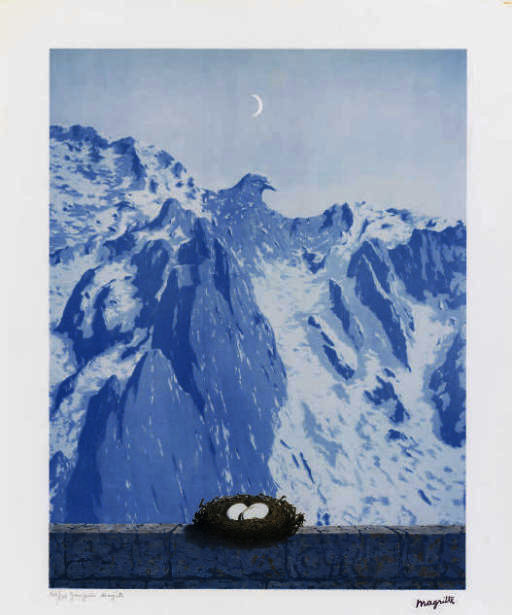
René Magritte’s “Le Domaine d’Arnheim,” painted in 1962, stands as a quintessential example of surrealist art—a deceptively simple composition brimming with layered symbolism and intellectual provocation. More than just a landscape depiction, it is an invitation to contemplate the elusive nature of reality itself. The piece draws profound inspiration from Edgar Allan Poe’s haunting tale, “The Domain of Arnheim,” which explores themes of idealized beauty and the inherent impossibility of achieving perfection. In this visual dialogue, Magritte translates literary melancholy into a silent, breathtaking landscape that lingers in the mind long after the first glance.
The painting presents a mountain range dominated by a solitary eagle perched atop a rocky outcrop, set against a sky where a moon hangs with quiet authority. Below this majestic scene lies an egg nestled on the ground, symbolizing potential and nascent life—a subtle mirror to the protagonist's ambition in Poe's story. The composition creates a sense of mystery and wonder, inviting viewers to step into a realm where the boundaries between reality and dream dissolve into a quiet, unsettling beauty.
Technique and the Art of Ambiguity
Executed in gouache on paper, Magritte utilized a technique known for its opacity and ability to achieve rich, saturated colors. This medium allowed him to create a visual tension that is central to the work's emotional impact; the muted blues of the sky contrast sharply with the earthy, grounded tones of the mountain. His meticulous attention to detail is evident in the delicate rendering of the eagle’s feathers and the subtle, soft shading on the rock face, demonstrating a dedication to capturing an idealized, almost hyper-real vision.
Magritte’s mastery lies in his ability to use familiar objects in unexpected contexts. By placing these elements—the bird, the egg, the moon—within a landscape that feels both vast and claustrophobic, he provokes questions about the nature of representation. For collectors and interior designers, this piece offers a sophisticated focal point, bringing an intellectual depth to any space. It is not merely a decoration but a conversation starter, a window into the cerebral magic that Magritte perfected during his mature period.
Symbolism and Emotional Resonance
Every element within Le Domaine d’Arnheim serves a symbolic purpose, weaving together a narrative of aspiration and limitation. The eagle, a symbol of majesty and vigilance, represents an unwavering determination; yet, its position atop the mountain suggests a ceiling to such greatness—it cannot ascend further, mirroring the futility of striving for unattainable perfection. This duality is what makes the work so profoundly moving, capturing the human struggle between our grandest dreams and our physical realities.
The presence of the egg adds a layer of poignant hope, suggesting that even within the limitations of existence, there is always the seed of something new. For those seeking to adorn their homes with art that inspires contemplation, this reproduction offers more than aesthetic pleasure; it provides an emotional anchor. It is a piece that embodies the "architect of ambiguity," making it an exquisite choice for those who appreciate art that challenges the eye and touches the soul.