A Dream Within a Forest: The Enigmatic World of Popular Panorama
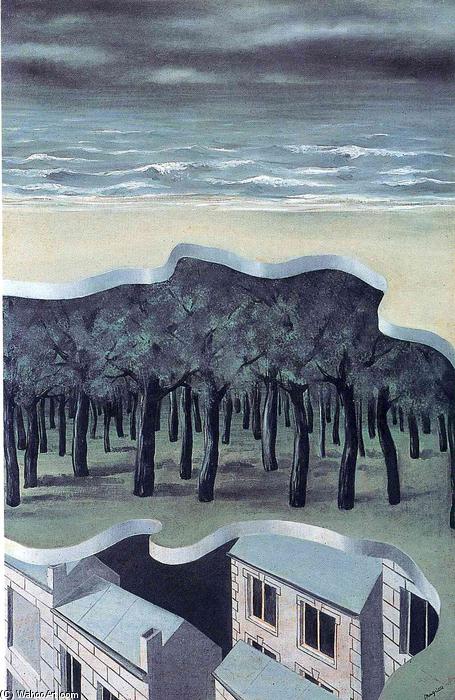
In the quiet, unsettling depths of René Magritte’s 1926 masterpiece, Popular Panorama, the boundaries between reality and the subconscious begin to dissolve. At first glance, the viewer is presented with a scene that feels almost domestic—a solitary house nestled within a dense, verdant forest canopy. Yet, as the eye lingers, the familiar architecture of the landscape begins to fracture. Magritte, a titan of the Surrealist movement, deliberately eschews the expansive, breathtaking vistas typically associated with landscape painting. Instead, he creates an intimate, claustrophobic arrangement where towering trees intertwine their branches to form an impenetrable barrier around the central home. This deliberate framing does more than just showcase a house; it evokes a profound sense of isolation, inviting us to contemplate the fragile relationship between human habitation and the untamed, mysterious power of the natural world.
The brilliance of this work lies in its masterful use of surrealist juxtaposition. Magritte was a master of the "unexpected," and nowhere is this more evident than in the sight of a boat suspended effortlessly in the sky above the house. This fantastical element disrupts the mundane reality of the forest setting, acting as a visual puncture wound in the fabric of logic. By placing a maritime object in an arboreal sky, Magritte triggers a psychological response, forcing the viewer to question their own perceptions. The painting does not merely depict a scene; it orchestrates a dream, where the laws of gravity and nature are suspended, leaving us to wander through a landscape of pure, unadulterated imagination.
Technique, Texture, and the Muted Palette of Mystery
Executed with meticulous precision in oil on canvas, Popular Panorama reveals Magritte’s profound control over texture and atmosphere. His technique is deceptively understated; he avoids flamboyant brushwork in favor of smooth, blended strokes that lend the piece an ethereal, almost ghostly quality. The palette is a somber, sophisticated arrangement of earthy greens, deep browns, and muted tones that reflect the shadowed heart of a forest. This choice of color is instrumental in conveying the painting's underlying sense of melancholy and quietude. There is a weight to the shadows here, a density to the foliage that makes the light entering through the house's open windows feel all the more precious and fleeting.
For the discerning collector or interior designer, this artwork offers a unique opportunity to introduce a conversation piece of immense depth into a curated space. The painting’s ability to balance heavy, grounded elements—like the solid structure of the house—with the weightless whimsy of the floating boat makes it an incredibly versatile subject for high-quality reproductions. Whether placed in a contemporary gallery setting or a classic study, Popular Panorama serves as a window into the psyche, providing a focal point that is both intellectually stimulating and aesthetically soothing. It is a piece that does not demand attention through loudness, but rather captures it through a persistent, haunting beauty that lingers long after one has turned away.