A Surrealist Vision of Fragrance
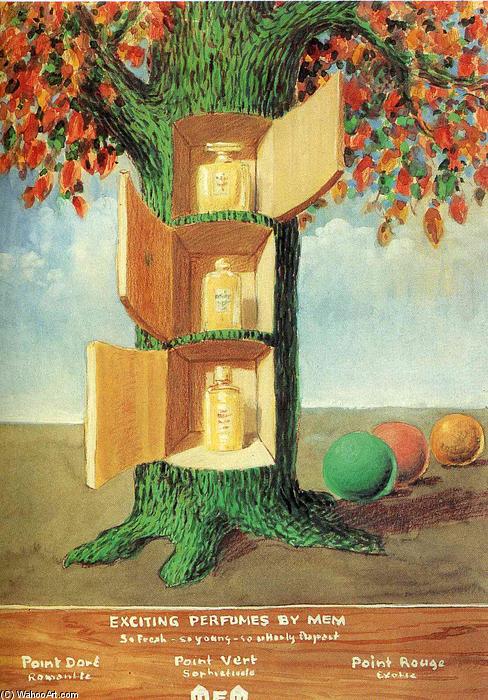
In the realm of mid-century advertising, few pieces possess the enduring mystery and poetic depth of René Magritte’s 1946 masterpiece, “Poster – Exciting perfumes by Mem.” Far more than a mere commercial tool for a perfume house, this artwork serves as a profound window into the Surrealist movement's ability to transform the mundane into the miraculous. At first glance, the viewer is greeted by a striking, dreamlike tableau: a majestic tree that defies the laws of nature, its branches laden not with fruit, but with an array of exquisite perfume bottles. Set against a serene, azure sky punctuated by soft, ethereal clouds, the composition invites us to step out of the rational world and into a space where scent becomes something visible, tangible, and infinitely wondrous.
Magritte’s technique during this period—often referred to as his Sunlit Period—is characterized by a meticulous, almost hyper-real clarity that makes the impossible feel undeniably present. Using what appears to be the smooth, controlled application of oil on canvas, he achieves a luminous quality that breathes life into every element. The tree itself is a marvel of paradoxical design; its trunk possesses the structural integrity of a cupboard, with doors left slightly ajar to reveal hidden treasures within. This seamless blending of organic growth and man-made objects exemplifies Magritte’s mastery of juxtaposition, a hallmark of Surrealism that seeks to spark a cognitive dissonance in the viewer, forcing a reevaluation of what is real and what is imagined.
Symbolism and the Language of Dreams
Every element within this composition is heavy with symbolic resonance, designed to evoke a sense of discovery. The tree, an ancient symbol of resilience and life, acts as a vessel for these "exciting perfumes," suggesting that beauty and allure are natural, burgeoning forces. The autumnal hues of the leaves introduce a poignant layer of temporal awareness, hinting at the fleeting nature of time and the ephemeral quality of scent itself. As the bottles hang at varying heights, they create a rhythmic visual melody that guides the eye across the canvas, much like the shifting notes of a complex fragrance. This interplay between the permanent (the tree) and the transient (the perfume) creates a captivating tension that has fascinated collectors for decades.
For the discerning collector or interior designer, this piece offers more than just aesthetic pleasure; it provides a conversational centerpiece that anchors a room with intellectual intrigue. The vibrant pops of color—from the deep greens of the trunk to the bright, oversized spheres resting on the ground—provide a sophisticated palette that can complement both modern minimalist settings and classic, opulent interiors. To possess a reproduction of this work is to invite Magritte’s signature brand of mystery into one's home, offering a daily reminder that beneath the surface of our perceived reality lies a world of hidden beauty, waiting to be uncovered.