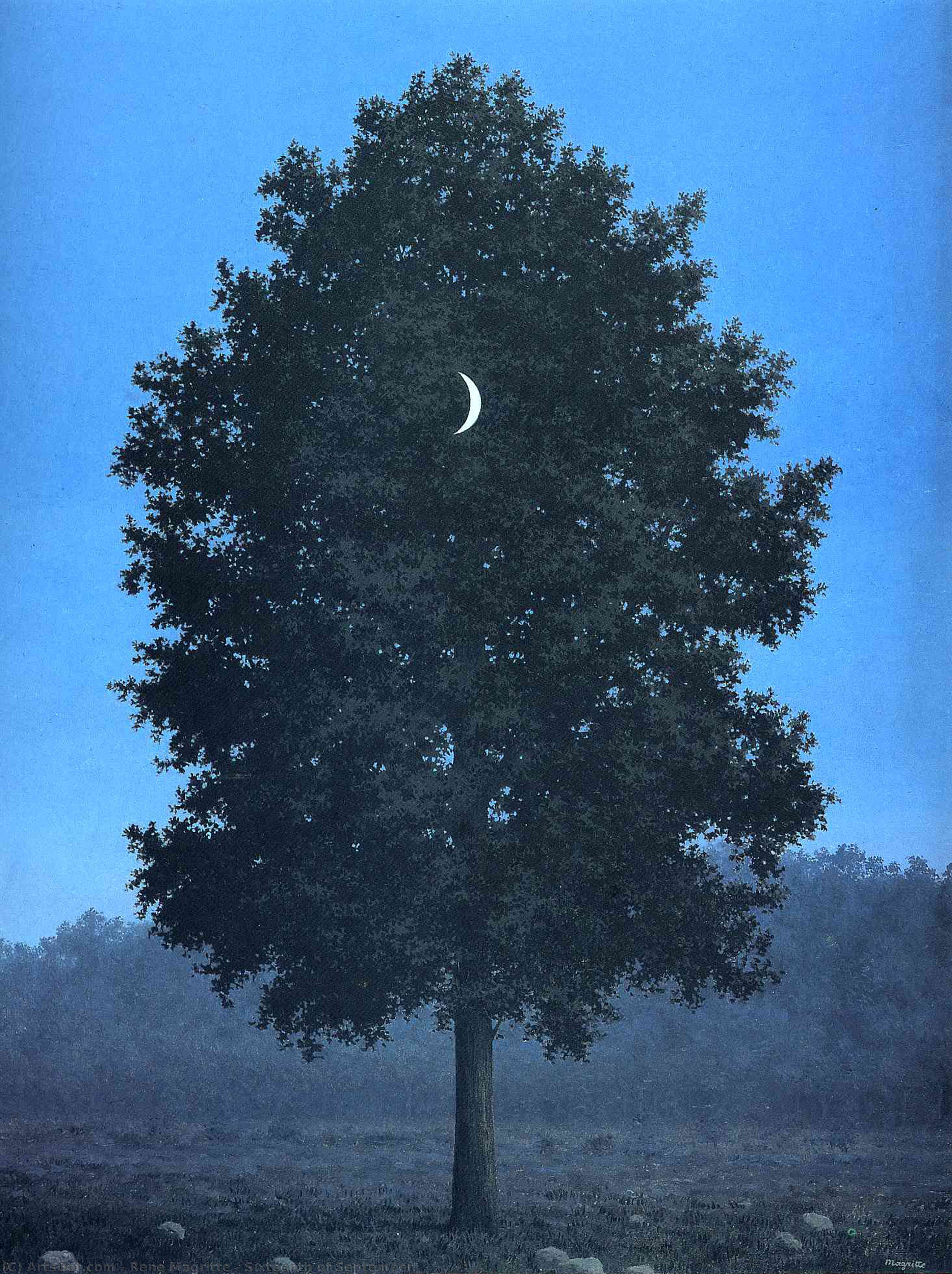
Sixteenth of September
René Magritte’s ‘Sixteenth of September’ (1956) stands as a cornerstone of Surrealist art—a deceptively simple composition brimming with layered symbolism and challenging viewers to reconsider the very nature of perception. Created during Magritte's prolific later period, this painting exemplifies his signature style: blending meticulous realism with dreamlike incongruities to provoke contemplation and unsettle expectations.
- Subject Matter: The artwork depicts a solitary tree positioned against a dusky twilight sky, punctuated by the unsettling presence of a crescent moon superimposed upon its branches—a deliberate disruption of celestial logic.
- Style & Technique: Magritte employed oil paint on canvas with remarkable precision, achieving a smooth surface finish characteristic of his meticulous approach to artistic execution. The muted palette contributes to the painting’s melancholic atmosphere and reinforces its surreal aesthetic.
- Historical Context: Produced in 1956, ‘Sixteenth of September’ reflects Magritte's ongoing exploration of philosophical concepts surrounding reality versus illusion—a preoccupation central to Surrealist thought during the mid-20th century. It aligns with Magritte’s broader engagement with existential questions and his desire to dismantle conventional visual representations.
Symbolism & Interpretation: The tree itself serves as a recurring motif in Magritte's oeuvre, representing stability and impassivity—yet here it observes the world around it, transformed into a silent witness. Simultaneously, the moon’s anomalous placement symbolizes disruption and challenges our ingrained understanding of space and time. Magritte termed this intentional juxtaposition “objective stimulus,” highlighting his belief that art could provoke profound intellectual engagement. As Louis Scutenaire, Magritte's collaborator noted, "I have just painted the moon on a tree in the grey-blue colors of evening." This seemingly banal detail underscores Magritte’s masterful ability to imbue everyday objects with symbolic significance.
- Influence & Legacy: Magritte’s influence extends far beyond Surrealism, impacting artists across genres who embrace paradoxical imagery and question accepted truths. His work continues to inspire discussions about visual representation and the subconscious mind—a testament to his enduring artistic vision.
Reproductions: A high-quality reproduction of ‘Sixteenth of September’ captures the painting's ethereal beauty and invites viewers into Magritte’s contemplative world. ArtsDot offers exceptional reproductions crafted with archival pigments on premium canvas—preserving the artwork’s original vibrancy for generations to come. Explore our collection today!