A Veil of Mystery: Unveiling The Sage's Carnival
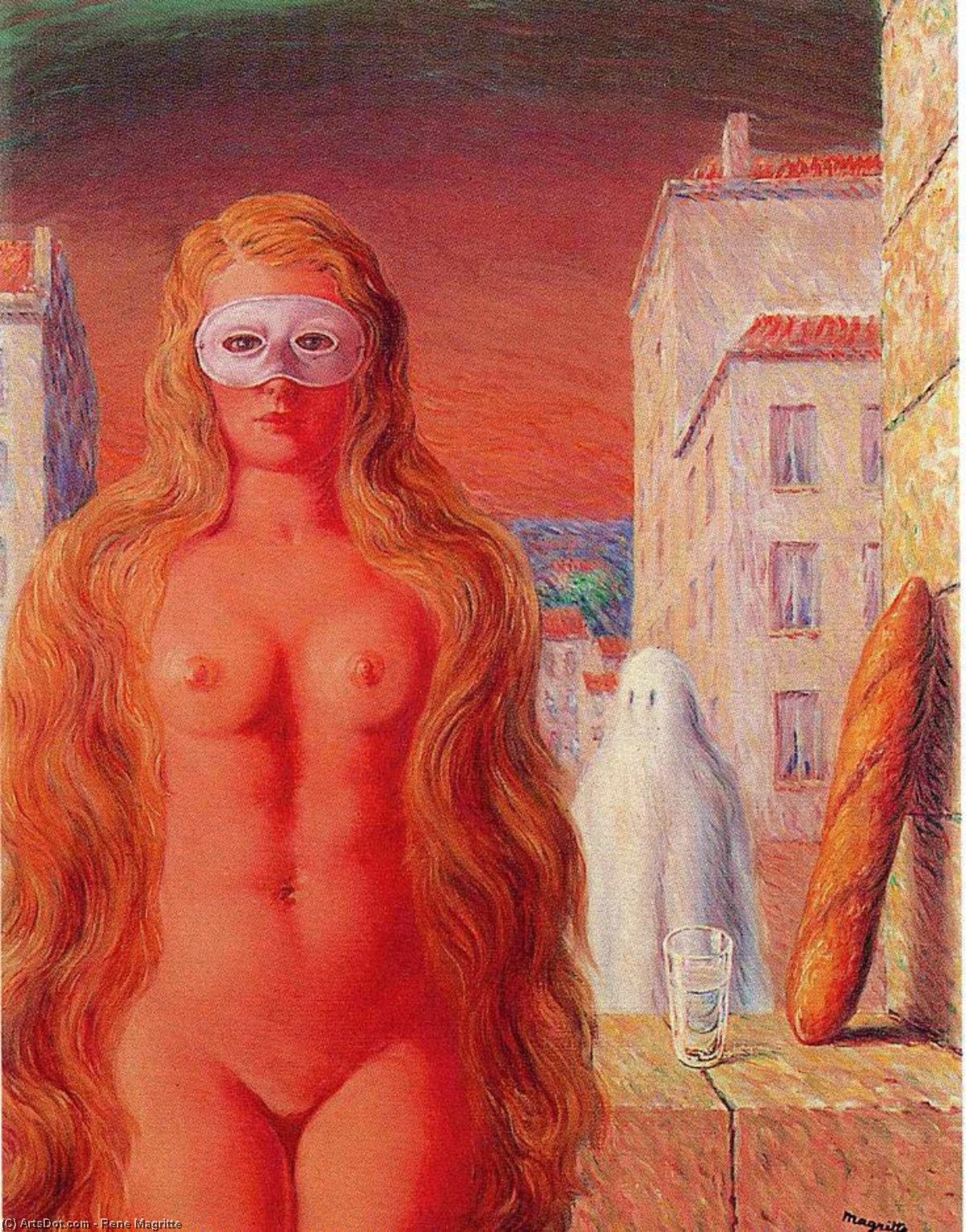
In the quiet, unsettling realm of René Magritte’s 1947 masterpiece, "The Sage's Carnival," the boundaries between the seen and the unseen begin to dissolve. At first glance, the viewer is met with a scene of deceptive simplicity: a woman stands before the architectural solidity of a building topped with a striking red roof. Yet, as one lingers, the composition reveals a profound tension. The figure, stripped of clothing yet adorned with a mask that obscures her eyes, creates an immediate psychological friction. Magritte masterfully juxtapaked the vulnerability of the nude form against the unyielding permanence of the architecture, drawing the gaze inward toward a landscape of the subconscious. This is not merely a portrait; it is an invitation to question the very nature of what we perceive as reality.
The technique employed in this work is a testament to Magritte’s signature Surrealist precision. Using oil on canvas, the artist achieves a smooth, almost clinical surface finish that belies the dreamlike distortions within the subject matter. His brushstrokes are meticulous, lending a startling clarity to the textures of the roofline and the subtle contours of the figure. The palette is intentionally restrained, dominated by muted shades of beige, brown, and earth tones, which serves to deepen the atmosphere of quiet, somber contemplation. This controlled use of color ensures that the sudden impact of the red roof and the enigmatic presence of the masked woman remain the focal points, undisturbed by unnecessary visual noise.
The Architecture of the Subconscious
To understand "The Sage's Carnival," one must look toward the historical shadows of post-World War II Europe. Created in 1947, the painting emerged during a period of intense artistic experimentation and collective anxiety. Magritte, a titan of the Surrealist movement, utilized the language of dreams to explore the irrationality of existence. The mask worn by the woman serves as the painting's most potent symbol—a vessel for concealment, illusion, and the suppression of true emotion. It mirrors Magritte’s lifelong preoccupation with hidden truths and the discrepancy between appearance and reality. Through this veil, the artist suggests that much of our identity remains perpetually out of reach, tucked away behind layers of social and psychological artifice.
For the discerning collector or interior designer, this piece offers more than mere aesthetic beauty; it provides a profound emotional resonance. The presence of the cup in the lower corner and the secondary figure on the periphery add layers of narrative ambiguity that reward repeated viewing. Bringing a high-quality reproduction of this work into a space introduces an element of intellectual depth and sophisticated mystery. It is a conversation piece that challenges the observer, making it an ideal centerpiece for a gallery-style living room or a curated study where art is intended to provoke thought and inspire wonder.