A Portrait of Grace: Exploring Guido Reni’s “Girl with a Rose”
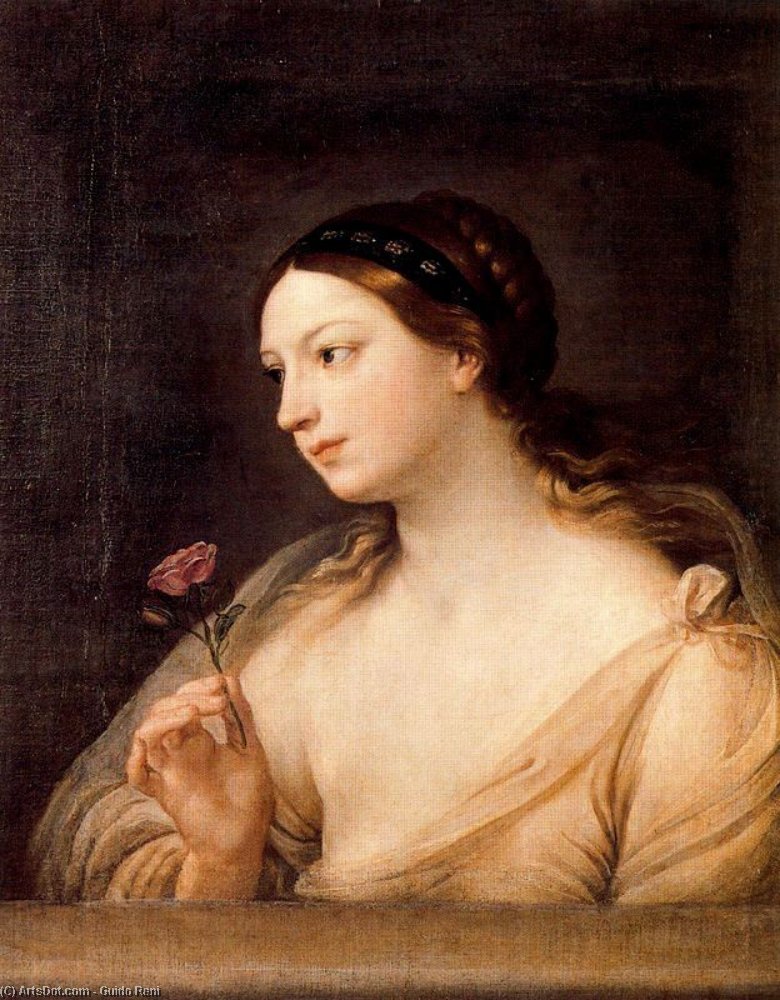
Guido Reni's "Girl with a Rose," painted circa 1631, is more than just a beautiful portrait; it’s a carefully constructed meditation on beauty, innocence, and the quiet dignity of womanhood. Reni, known as “Le Guide” (The Guide) due to his influential role in training younger artists, masterfully captures a moment of serene contemplation within the confines of a classicizing Baroque style. The painting immediately draws the eye with its harmonious palette – soft pinks and creams dominate, offset by the rich burgundy of the woman’s velvet gown and the vibrant crimson of the rose she delicately holds. This subtle contrast creates a visual depth that invites prolonged viewing.
The Artist and His Time
Born in Bologna in 1575, Guido Reni emerged during a pivotal period in Italian art history – the waning years of Mannerism and the burgeoning rise of Baroque. He was deeply influenced by the artistic traditions of his native city, particularly the legacy of the Carracci brothers, whose emphasis on anatomical accuracy and classical ideals shaped much of Reni’s early work. However, Reni quickly established a distinct style characterized by an elegant restraint and a profound understanding of light and shadow. His career spanned Rome, Naples, and Bologna, allowing him to absorb diverse artistic influences while maintaining a consistent commitment to refined beauty and emotional resonance. The painting's date aligns with the height of his creative output, reflecting a period where he was considered one of the foremost portraitists in Italy.
Technique and Composition: A Study in Light and Form
Reni’s technical skill is evident in every brushstroke. He employs a meticulous sfumato technique – a subtle blurring of lines and colors – to create an atmosphere of ethereal softness, particularly around the woman's face and hands. The modeling of her features is remarkably realistic, yet imbued with a sense of idealized beauty. Notice how he uses light to sculpt her form, highlighting the delicate curve of her neck and the gentle slope of her shoulders. The composition itself is carefully balanced; the figure occupies a central position within a shallow space, drawing the viewer’s attention directly to her gaze. The dark background serves not as a distraction but rather as a dramatic foil, intensifying the luminosity of the subject and emphasizing her presence.
Symbolism and Emotional Resonance
The rose, of course, is a potent symbol – representing love, beauty, and even mortality. Its inclusion within the composition elevates the portrait beyond a simple likeness, imbuing it with layers of meaning. The woman’s direct gaze invites intimacy, suggesting a quiet confidence and perhaps a hint of melancholy. Her posture, relaxed yet poised, conveys an inner serenity. Reni wasn't merely depicting a young woman; he was capturing a state of being – a moment of contemplative grace. The overall effect is profoundly moving, evoking a sense of timeless beauty and the poignant awareness of life’s fleeting nature.
A Timeless Masterpiece: Reproductions for Today
Guido Reni's “Girl with a Rose” remains an enduring testament to the power of classical beauty. Today, high-quality reproductions offer art lovers and interior designers alike the opportunity to experience this masterpiece in their own homes. Whether adorning a formal salon or adding a touch of elegance to a contemporary space, a faithful reproduction captures the essence of Reni’s vision – a celebration of grace, serenity, and the enduring allure of the human form. Consider commissioning a hand-painted replica to truly bring this iconic portrait into your world.