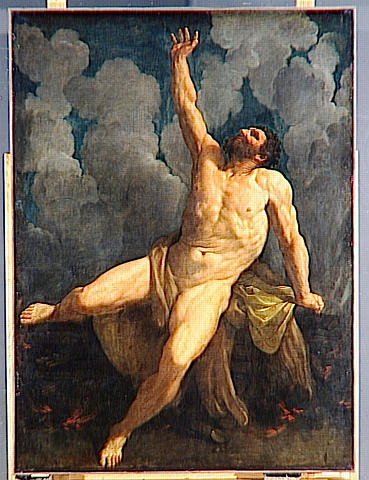
Admire Guido Reni's masterpiece 'Hercules on the Butcher,' a dramatic Baroque painting depicting Hercules battling demons amidst turbulent skies—a testament to classical artistry and emotive storytelling.
Discover Guido Reni (Le Guide), a master of Baroque painting! Explore his religious & mythological artworks, influential style, and legacy in Italy. Shop reproductions at ArtsDot.
Explore the Louvre Museum in Paris! Home to iconic masterpieces like the Mona Lisa & Venus de Milo, journey through art history from ancient Egypt to Renaissance icons. Plan your visit today!
A Titan Wrestles with Divine Fury: An Exploration of Guido Reni’s “Hercules Sur Le Bucher”
Guido Reni's "Hercules Sur Le Bucher," painted circa 1600-1625, stands as a testament to the Baroque aesthetic—a dramatic fusion of muscular physicality and ethereal spirituality. Held within the Louvre Museum’s collections (INV 538; MR 287), this monumental canvas transcends mere depiction; it embodies an emotional narrative rooted in classical mythology and imbued with profound artistic ambition.
Composition and Dramatic Lighting
The artwork immediately captivates with its dynamic diagonal movement, guiding the viewer's eye from lower left to upper right. Hercules dominates the scene, positioned powerfully amidst swirling clouds—a deliberate choice reflecting the Baroque penchant for conveying turbulent emotions through visual dynamism. The artist skillfully employs chiaroscuro – dramatic contrasts between light and shadow – highlighting Hercules’ torso and face with radiant illumination while enveloping the surrounding sky in oppressive darkness. This technique wasn't merely stylistic; it served to amplify the hero’s struggle, mirroring the internal turmoil of confronting divine judgment.
Color Palette and Anatomical Precision
Reni’s palette leans heavily into earthy tones—ochres, browns, and reds—grounding Hercules within a tangible reality. However, these hues are punctuated by splashes of azure and ivory, representing both the turbulent sky and the purity associated with mythological figures. The artist's meticulous anatomical rendering is characteristic of his era, demonstrating an unwavering commitment to classical ideals of beauty and proportion. Each muscle fiber is rendered with painstaking detail, conveying not just physical strength but also a sense of heroic dignity.
Symbolism: Confrontation and Triumph
“Hercules Sur Le Bucher” isn’t simply a portrayal of a mythological episode; it's laden with symbolic significance. Hercules wrestles with a bull—a representation of primal forces—symbolizing the hero’s battle against temptation and adversity. The bull’s horns pierce upwards, mirroring Hercules’ upward gaze as he strives for divine favor. This visual metaphor underscores the overarching theme of overcoming obstacles through unwavering resolve – a core message resonating throughout Baroque art.
Technique: Oil Painting on Canvas - A Legacy of Brilliance
The artwork is executed in oil paint on canvas—a technique perfected during Reni’s lifetime and emblematic of Baroque artistic excellence. Visible brushstrokes contribute to the painting's textural richness, conveying a palpable sense of movement and energy. The blending of colors achieves remarkable luminosity, capturing the ethereal quality of the clouds while maintaining the solidity of Hercules’ form. This masterful execution exemplifies Reni’s dedication to mastering his craft—a legacy that continues to inspire artists today.
Concluding Reflection
“Hercules Sur Le Bucher” remains a captivating masterpiece due to its harmonious blend of anatomical accuracy, dramatic lighting, and symbolic depth. It encapsulates the Baroque spirit – an aspiration for grandeur, emotion, and spiritual contemplation – cementing Guido Reni’s place as one of the foremost painters of his time and ensuring that this iconic image continues to resonate with audiences worldwide.