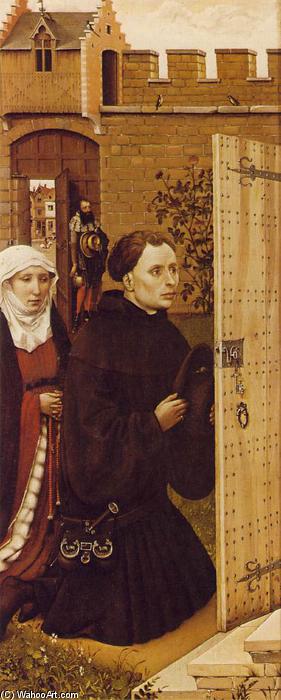
Mérode Altarpiece - A Cornerstone of Early Netherlandish Painting
The Mérode Altarpiece stands as an unparalleled exemplar of Early Netherlandish painting—a testament to meticulous craftsmanship and profound artistic vision that continues to captivate audiences centuries later. Completed around 1425-28 by Robert Campin, alongside his workshop assistants, this monumental triptych resides in The Cloisters museum in New York City, offering visitors an immersive experience into the aesthetic sensibilities of fifteenth-century Flanders. Its enduring fame stems not merely from its visual splendor but also from its pivotal role in establishing a new artistic paradigm—one characterized by unprecedented realism and psychological depth.
- Artist & Context: Robert Campin (Master of Flémalle), active in Tournai, represents a crucial juncture between Gothic formalism and Renaissance innovation. He was deeply influenced by the International Gothic style, particularly the Limbourg brothers’ luminous frescoes, yet simultaneously pushed boundaries through groundbreaking advancements in oil painting technique—a medium that would soon dominate European art production.
- Composition & Technique: The altarpiece's dramatic perspective—drawing viewers downwards into a carefully orchestrated space—is remarkably sophisticated for its time. Campin skillfully employed glazing techniques to achieve luminous effects and subtle tonal gradations, capturing the textures of stone, fabric, and skin with astonishing accuracy. The meticulous layering of paint demonstrates an unwavering commitment to observation and detail, reflecting the humanist ideals burgeoning across Europe.
- Symbolism & Narrative: Beyond its visual beauty, the Mérode Altarpiece is laden with religious symbolism. The central panel depicts the Annunciation—the divine revelation to Mary that she would conceive Jesus—a scene rendered with poignant tenderness and psychological realism. The inclusion of a firescreen symbolizes Mary’s purity and piety, while the depiction of Saint Joseph embodies paternal dignity and steadfast devotion.
- The Workshop Contribution: While Campin undoubtedly conceived the central panel, the outer wings were executed by members of his workshop, adding to the complexity of its artistic heritage. These panels showcase a distinct stylistic approach—characterized by softer brushstrokes and a more decorative aesthetic—reflecting the evolving tastes of patrons during this period.
- Legacy & Influence: The Mérode Altarpiece profoundly impacted subsequent generations of artists, establishing precedents for naturalistic representation and emotional expression that would define the Renaissance. Its influence can be discerned in works by Jan van Eyck, Rogier van der Weyden, and Hieronymus Bosch—artists who embraced Campin’s innovations and elevated Early Netherlandish painting to new heights of artistic achievement.
The Cloisters Museum & Fondation Louis Vuitton Paris