The Mérode Altarpiece: A Window into Medieval Life
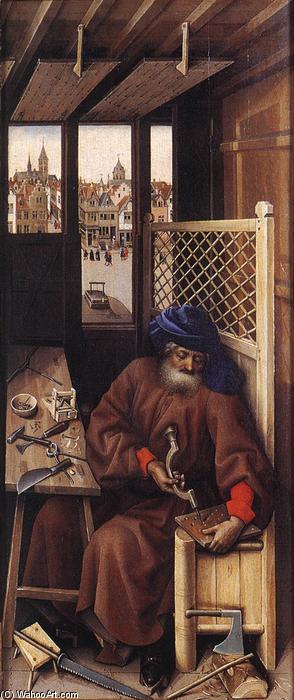
Robert Campin’s “Mérode Altarpiece” (right wing), completed around 1427, isn't merely a painting; it’s a meticulously crafted snapshot of fifteenth-century life, rendered with an unprecedented level of realism and imbued with profound symbolic meaning. Housed within the Metropolitan Museum of Art in New York, this oil on panel triptych offers a rare glimpse into the domestic sphere of a wealthy Burgundian family – a world both familiar and subtly alien to our own. It’s a testament to Campin's mastery as a painter and his pivotal role in shaping the trajectory of Early Netherlandish art.
The scene depicted is deceptively simple: a man, dressed in a rich brown robe accented with vibrant red sleeves – a detail that immediately draws the eye – sits on a humble wooden bench. He’s engrossed in a book, suggesting scholarly pursuits or perhaps even religious study. The background reveals a glimpse of a bustling townscape through a window, hinting at the vibrancy and interconnectedness of medieval society. Yet, it's not just a visual representation; Campin has deliberately constructed this scene to evoke a specific emotional response – one of quiet contemplation and familial piety.
A Symphony of Detail: Technique and Style
Campin’s genius lies in his painstaking attention to detail, a hallmark of the Northern Renaissance style. Unlike the idealized figures often found in Italian art of the period, Campin presents us with an unvarnished portrayal of everyday life. The textures of the fabrics, the worn wood of the bench, and even the subtle imperfections on the man’s face are rendered with remarkable accuracy. This commitment to realism is further enhanced by his masterful use of oil paint, allowing him to build up layers of color and create a luminous quality that was revolutionary for its time.
The painting's composition is carefully balanced, drawing the viewer’s eye through a series of interconnected elements. The man on the bench serves as the focal point, while the window provides a sense of depth and perspective. Notice how Campin subtly integrates architectural details – the crenellated wall, the arched doorway – into the scene, creating a believable and immersive environment. The use of light is particularly noteworthy; it’s diffused and naturalistic, casting soft shadows and highlighting key features without resorting to dramatic contrasts.
Symbolism Woven into the Everyday
Beyond its technical brilliance, the “Mérode Altarpiece” is rich in symbolism. The book held by the man represents knowledge, piety, and intellectual pursuits – a value highly prized during the medieval period. His attire, particularly the red sleeves, may have been a symbol of status or even a reference to the Passion of Christ. The window offers more than just a view; it symbolizes God’s presence peering into the domestic realm, inviting viewers to contemplate their place within the divine order.
Even seemingly mundane objects – the tools scattered on the table, the simple wooden bench – carry symbolic weight. They represent the everyday realities of life and serve as reminders of the importance of earthly concerns alongside spiritual devotion. The inclusion of a family within this scene is also significant; it underscores the central role of marriage and lineage in medieval society.
A Legacy of Realism
The “Mérode Altarpiece” stands as a pivotal work in the history of art, marking a shift towards greater realism and psychological depth in Northern European painting. Robert Campin’s innovative techniques – his meticulous attention to detail, his masterful use of oil paint, and his ability to capture the nuances of human emotion – profoundly influenced generations of artists who followed. It's a window into a bygone era, inviting us to contemplate the values, beliefs, and aspirations of those who lived centuries ago. Reproductions of this remarkable piece offer a tangible connection to this rich artistic heritage, allowing us to appreciate Campin’s genius in our own homes.
Size: 64 x 27 cm
Date: 1427