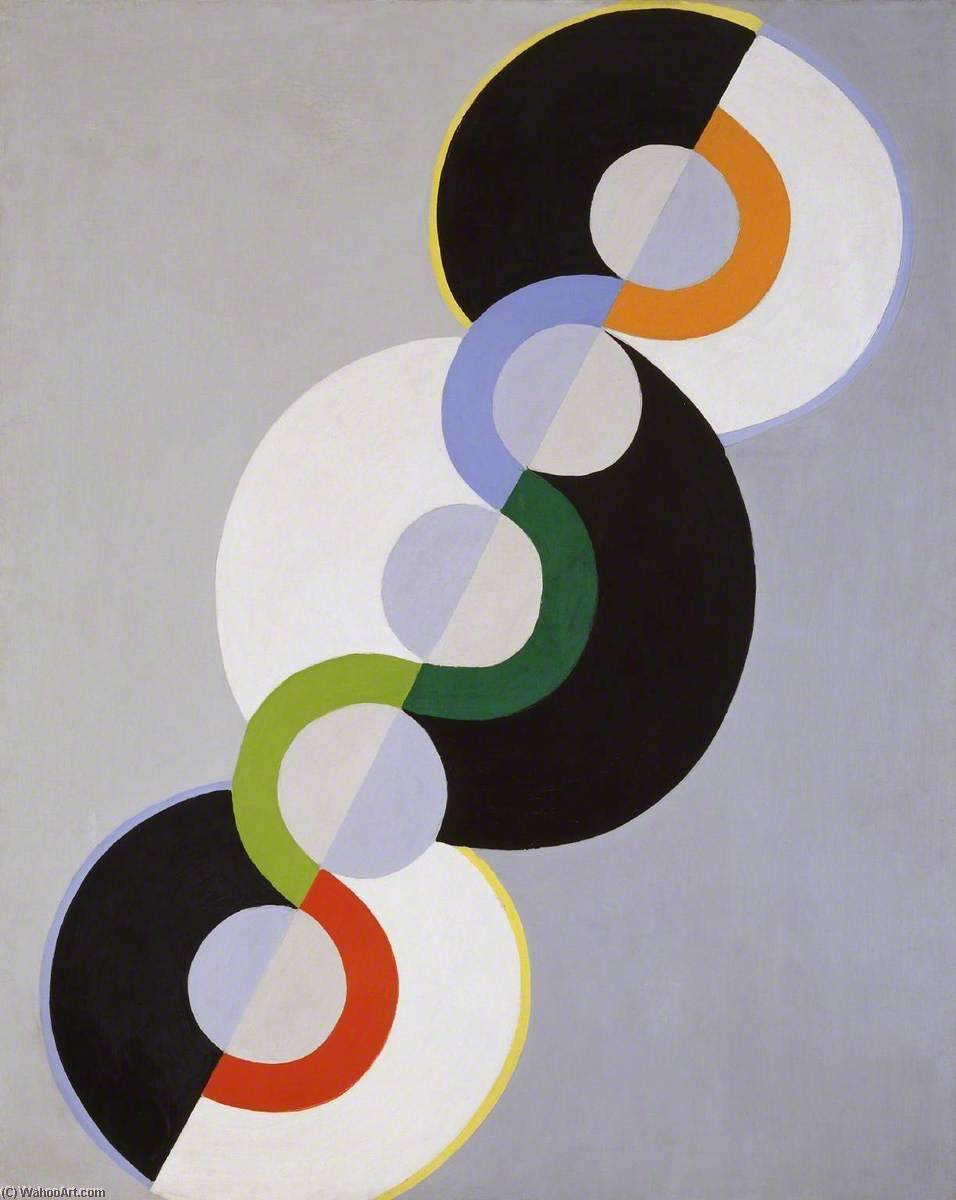
Endless Rhythm (Rythme sans fin) – A Window into Robert Delaunay’s Orphism
Robert Delaunay's "Endless Rhythm" is more than just a painting; it’s an immersion in the vibrant, revolutionary spirit of early 20th-century abstraction. Executed in 1934, this artwork embodies the core tenets of Orphism – a movement pioneered by Delaunay and his wife Sonia – that sought to liberate color from representational constraints and explore its inherent power as a visual language. The canvas pulsates with dynamic energy, achieved through a meticulously constructed arrangement of geometric forms: circles and arcs dominate, spiraling diagonally across the surface in a captivating dance. The muted grey-lavender background acts not as a void, but as a crucial counterpoint, intensifying the impact of the bold, saturated colors that explode within the circular shapes – yellows, greens, reds, blues, black, white, and orange – each meticulously applied in solid blocks, devoid of shading or blending. This deliberate flatness, characteristic of Delaunay’s approach, invites the viewer to contemplate color itself, divorced from any objectified reality.
A Synthesis of Neo-Impressionism and Cubist Influence
Delaunay's artistic journey began with a grounding in Neo-Impressionism, particularly evident in his early work like "Cathedrals" (1910), where he explored the expressive potential of color through juxtaposed tones. However, “Endless Rhythm” transcends this initial influence, incorporating elements of Cubism’s fragmented forms and spatial dynamism. The overlapping circles suggest a sense of depth, albeit a carefully controlled one – a deliberate illusion rather than a realistic depiction. This fusion reflects Delaunay's intellectual approach to art: he wasn’t simply painting what he *saw*, but actively constructing a visual experience based on scientific theories of color and light, as championed by figures like Michel Eugène Chevreul. The precise lines defining each shape speak to this rigorous methodology, while the overall composition retains a fluidity reminiscent of Cubist explorations of movement and perspective.
Decoding the Symbolism: Rhythm, Harmony, and Energy
While abstract in its purest form, “Endless Rhythm” resonates with profound symbolic meaning. The repeating circles, arranged in a spiraling pattern, evoke notions of rhythm, movement, and interconnectedness – fundamental concepts explored by Orphists. The dynamic arrangement could be interpreted as a visual representation of energy, constantly flowing and transforming. The balanced distribution of colors contributes to a sense of harmony, reflecting Delaunay’s belief that color possessed inherent power to create emotional resonance. Some scholars suggest the work symbolizes the cyclical nature of time or the interconnectedness of all things – themes frequently explored in Orphist art. The deliberate lack of shading further emphasizes this focus on pure color and its expressive potential.
Craftsmanship & Legacy: A Limited Edition Reproduction
Created using oil paints on canvas around 1934, “Endless Rhythm” exemplifies Delaunay’s meticulous technique – the application of paint in flat, solid blocks with precise edges. The artwork's dimensions (162 x 130 cm) and use of high-quality materials—likely oil paints—ensure a lasting impression. As evidenced by the gallery direct reproduction, this piece is meticulously crafted as a hand-numbered limited edition print on paper, reflecting the rarity and value of original Delaunay works. This reproduction captures not just the visual appearance but also the spirit of innovation that defined Delaunay’s legacy, making it an exceptional addition to any art collection or interior design scheme. The Gouttelette print is produced with light-fast inks on acid-free paper, guaranteeing its longevity and preserving the vibrancy of Delaunay's bold color palette for generations to come.