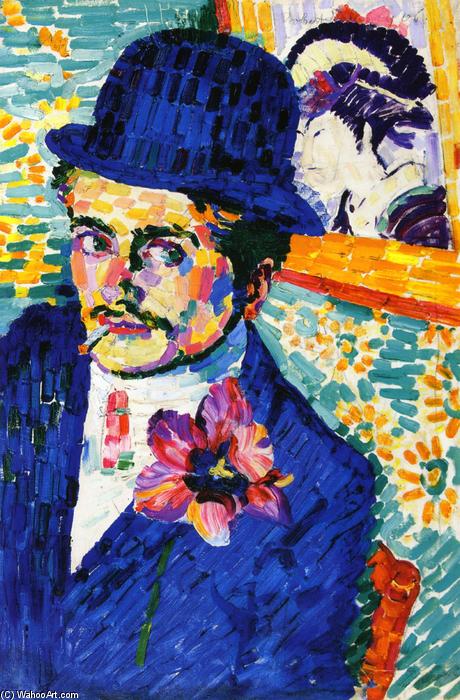
Robert Delaunay’s *Man with a Tulip* (1906): A Symphony of Color and Emotion
Robert Delaunay's *Man with a Tulip*, painted in 1906, is far more than a simple portrait; it’s a foundational expression of Fauvism – a movement that prioritized raw emotion and vibrant color over traditional representational techniques. This captivating work, now available as a hand-painted reproduction, offers a glimpse into the revolutionary artistic landscape of early 20th century Paris.
A Portrait of Modernity
The subject of *Man with a Tulip* is Jean Metzinger, a lawyer and philosopher who was also an enthusiastic supporter of Delaunay’s artistic explorations. Delaunay's depiction isn't concerned with photographic realism. Instead, he captures Metzinger in profile, dressed in the formal attire of the period – a blue jacket, white shirt, and black bowler hat – immediately establishing a sense of sophistication and status. The inclusion of the pink tulip pinned to his lapel introduces an element of delicate beauty, perhaps symbolizing fragility or fleeting pleasure – a recurring motif in Delaunay’s work.
Fauvist Techniques: A Dance of Color
Delaunay's masterful use of color is central to the painting's impact. Employing bold, non-naturalistic hues—blues, pinks, yellows—he applies thick brushstrokes with a deliberate lack of concern for traditional perspective or form. This technique, characteristic of Fauvism, creates a dynamic and somewhat chaotic composition that vibrates with energy. Notice how lines are loose and gestural, defining shapes rather than adhering to strict outlines. The flattened perspective and the emphasis on texture – achieved through impasto layering – contribute to the painting’s emotionally charged atmosphere. The background inclusion of another painting adds an intriguing layer of narrative complexity, suggesting a meditation on art itself.
Symbolism and Emotional Resonance
*Man with a Tulip* is rich in symbolic meaning. The man's attire speaks to wealth and social standing, while the tulip – a flower often associated with love and remembrance – adds a poignant emotional layer. Delaunay’s deliberate use of color and fragmented forms isn’t merely decorative; it’s an attempt to evoke a specific mood—a blend of contemplation, melancholy, and perhaps even a touch of defiance against the constraints of traditional artistic representation. This piece resonates with a profound sense of modern anxiety and excitement, reflecting the rapid changes occurring in society at the time.
- Size: 72 x 48 cm
- Date: 1906
- Artist: Robert Delaunay (1885-1941)
- Medium: Oil on Canvas