The Luminous Dance of Color: Exploring Robert Delaunay's "Political Drama"
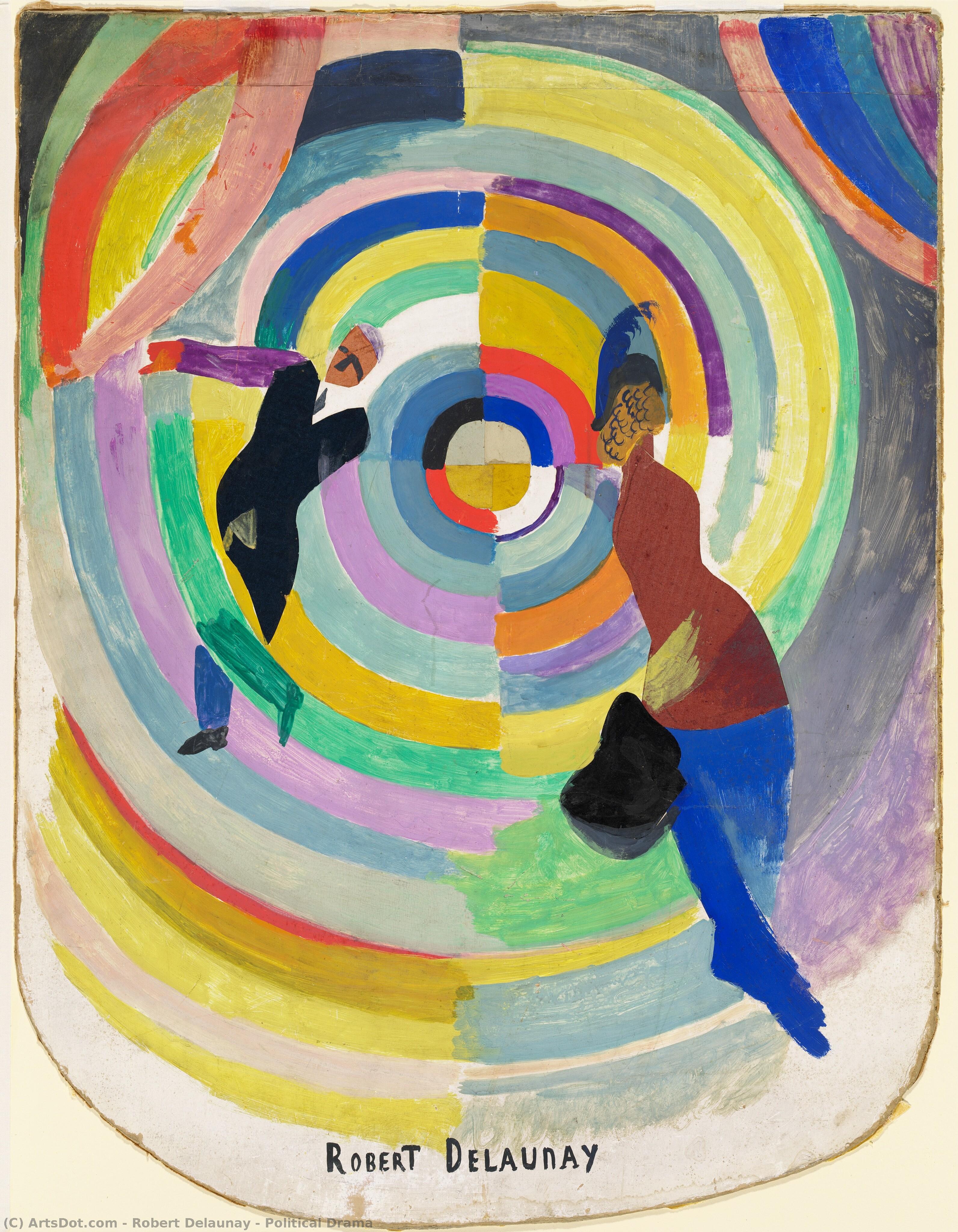
To stand before Robert Delaunay’s Political Drama is not merely to observe a painting; it is to step into a vibrant, pulsating field of pure chromatic energy. Created in the charged atmosphere of 1914, this work captures a moment suspended between figuration and abstraction—a visual echo of the tumultuous era from which it emerged. The composition immediately draws the eye into its heart, where two figures seem caught in an ethereal ballet against a backdrop that defies simple description. Delaunay, a pioneer whose life was dedicated to unlocking the expressive potential of color itself, has woven together geometric rigor with emotional fluidity, resulting in a piece that feels both intellectually stimulating and deeply soulful.
Technique and the Geometry of Light
What distinguishes this work is Delaunay’s masterful handling of color theory. The background is dominated by nested, concentric rings—a breathtaking study in optical vibration. These rings are not uniform; they fracture into quadrants, each corner kissed by a different hue: lemon yellow meeting slate blue, lilac whispering against cobalt. This systematic division of color across the circular forms speaks to an almost scientific understanding of light, yet it feels utterly spontaneous. The artist employs flat planes of color, allowing the juxtaposition of adjacent tones—the vivid red next to the cool mint green, for instance—to create a shimmering illusion that seems to breathe off the canvas. Notice how these vibrant circles soften and mute as they approach the edges, grounding the celestial energy within the frame.
Figurative Elements in Abstract Space
Against this dazzling chromatic vortex move the figures. To our right, the woman commands attention with her royal blue feathered hat, a splash of saturated color against the abstract geometry. Her dress, rendered with an intriguing collage element suggesting paper, adds a tactile layer to the otherwise smooth planes of paint. On the left, the man appears caught in a dramatic backward fall, his outstretched arm—a striking amethyst purple tipped with red—reaching toward the central nexus of circles. These figures are not merely placed within the background; they seem intrinsically connected to it, as if their very poses and colors are dictated by the underlying rhythm of the rings. They embody human drama played out upon a canvas governed by pure optical law.
Symbolism and Emotional Resonance
The title itself, Political Drama, hints at the profound undercurrents beneath the surface beauty. While the subject matter is abstract—a dance of color and form—the tension between the figures suggests narrative conflict, a human drama played out against the backdrop of historical upheaval. The circular motifs themselves often symbolize eternity, cycles, or universal forces. In this context, they might represent the relentless, cyclical nature of history or emotion itself. Owning a reproduction of this piece is to invite that dialogue into your space—a conversation between structured intellect and unrestrained feeling.
A Statement for the Modern Collector
For the discerning collector or designer seeking an anchor point of sophisticated color theory, Political Drama offers unparalleled depth. It transcends mere decoration; it functions as a visual thesis on modern perception. Whether placed in a grand hall where its scale (104 x 84 cm) can be appreciated, or curated within a more intimate setting, the piece demands contemplation. It is an invitation to look closer, to trace the line from the vivid blue of the skirt to the muted tones near the edge, and to feel the electric charge that Robert Delaunay captured at the dawn of modern abstraction.