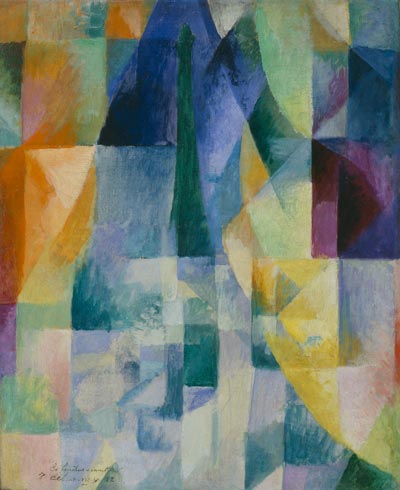
Simultaneous Windows (2nd Motif, 1st Part): A Dive into Robert Delaunay’s Orphism
Robert Delaunay's "Simultaneous Windows (2nd Motif, 1st Part)," painted in 1912, is more than just a visually arresting composition of color and form; it’s a pivotal document in the birth of modern art. Created during his fervent exploration within the Orphism movement alongside his wife Sonia Delaunay, this work embodies a radical shift away from representational painting towards an entirely new language of visual expression. It's a vibrant testament to their belief that color itself possessed inherent power and could be manipulated to evoke emotion and create dynamic experiences – a concept profoundly influential on the development of abstract art.

The Orphist Vision: Geometry and Radiant Color
Delaunay’s approach, deeply rooted in Neoimpressionism initially, evolved dramatically into what became known as Orphism. This movement sought to liberate color from its traditional role of describing objects; instead, it aimed to use color purely for its expressive qualities. “Simultaneous Windows” exemplifies this perfectly. The painting is dominated by a complex interplay of geometric shapes – squares, rectangles, and circles – arranged in a dynamic, almost kaleidoscopic fashion. These forms aren’t merely decorative; they are the building blocks of Delaunay's visual vocabulary, each shape imbued with its own distinct hue and intensity.
The color palette itself is deliberately jarring yet harmonious. Blues, greens, yellows, reds, and purples collide and overlap, creating a sense of movement and vibration. This wasn’t accidental; Delaunay meticulously layered colors using techniques like *grisaille* (a monochrome underpainting) to build up depth and luminosity before applying the final vibrant hues. The effect is one of intense visual energy – as if the windows themselves are radiating light and color simultaneously.
Historical Context & Influences
To fully appreciate “Simultaneous Windows,” it’s crucial to understand its historical context. The early 20th century was a period of immense artistic upheaval, fueled by technological advancements (particularly photography) and new scientific theories about light and color. Delaunay, like many artists of the time, was influenced by the work of scientists such as Michel Eugène Chevreul, who had explored the principles of simultaneous contrast – the idea that colors affect each other when viewed together. Furthermore, his engagement with Guillaume Apollinaire’s writings on Orphism helped solidify this movement's theoretical foundation and its place within the broader avant-garde.
The painting reflects a desire to break free from traditional notions of perspective and representation. It’s an abstract work that prioritizes sensation and emotional response over literal depiction, aligning it with the broader goals of movements like Cubism and Futurism.
Symbolic Resonance & Emotional Impact
"Simultaneous Windows" isn't simply a beautiful arrangement of color; it carries a profound symbolic weight. The title itself – “Simultaneous Windows” – suggests a multiplicity of perspectives, mirroring the fragmented nature of modern experience. The geometric forms can be interpreted as representing architectural elements, reflecting Delaunay’s interest in urban landscapes and his desire to capture the dynamism of the city.
Ultimately, this painting invites the viewer to engage with color on an emotional level. The vibrant hues and dynamic composition evoke a sense of exhilaration, energy, and perhaps even disorientation – mirroring the transformative power of art itself. It’s a bold, innovative work that continues to captivate viewers over a century later.