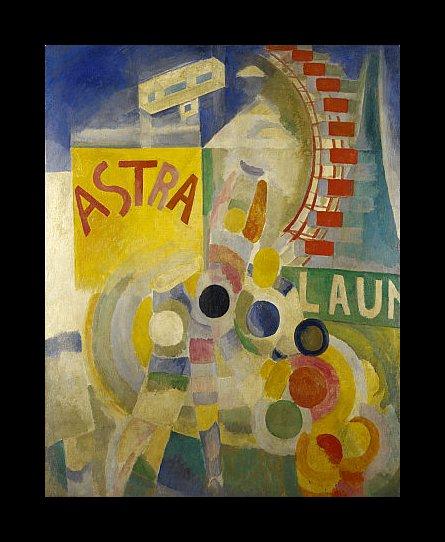
The Cardiff Team: A Vision of Urban Energy
Robert Delaunay’s “The Cardiff Team,” painted in 1922, is far more than a depiction of a rugby match; it's a vibrant embodiment of the burgeoning Orphism movement and a testament to Delaunay’s revolutionary approach to color and form. Created during a period of intense artistic experimentation following World War I, this work captures a moment of dynamic action – athletes in motion against a backdrop of urban elements – rendered with an almost ecstatic intensity. The painting's power lies not in realistic representation but in its ability to evoke a feeling of movement, energy, and the very essence of modern life.

Orphism and the Language of Color
Delaunay, alongside his wife Sonia, was a key figure in Orphism – a movement that sought to liberate color from its traditional representational role. Rejecting the Impressionists’ focus on optical realism, Delaunay and his contemporaries believed that color itself possessed inherent expressive power. “The Cardiff Team” exemplifies this philosophy through its bold, non-naturalistic palette of yellows, blues, reds, and greens. These hues aren't used to mimic reality; instead, they are deployed with a deliberate intensity, creating a visual symphony designed to stimulate the eye and evoke emotion. The geometric shapes – circles, rectangles, and triangles – further amplify this effect, acting as building blocks for Delaunay’s vibrant language.
Technique and Texture: A Brushstroke Manifesto
The painting's surface is characterized by a deliberately rough, impasto-like texture achieved through thick application of oil paint. Visible brushstrokes are not concealed but actively embraced, contributing to the overall sense of dynamism and energy. This technique reflects Delaunay’s desire to move away from traditional academic methods and create a more immediate, expressive artwork. The layering of shapes and colors creates depth, though it's flattened by the artist's deliberate choice to prioritize form and color over precise perspective. The use of lines isn't consistent; they appear as dynamic brushstrokes that guide the viewer’s eye across the canvas, reinforcing the feeling of movement.
Symbolism and Context: Modernity in Motion
Beyond its formal qualities, “The Cardiff Team” offers a fascinating glimpse into the cultural landscape of 1920s Europe. The inclusion of elements like an advertising poster (“Astra”), a biplane, and the Eiffel Tower speaks to the era’s fascination with technological progress and modernity. The rugby match itself represents a burgeoning sport, symbolizing strength, teamwork, and national pride – themes that resonated deeply in a post-war world. Delaunay's choice of subject matter—a dynamic sporting event—reflects his desire to capture the energy and spirit of the modern age. The painting is not simply a record of a game; it’s a visual manifesto celebrating the dynamism and optimism of a new era.