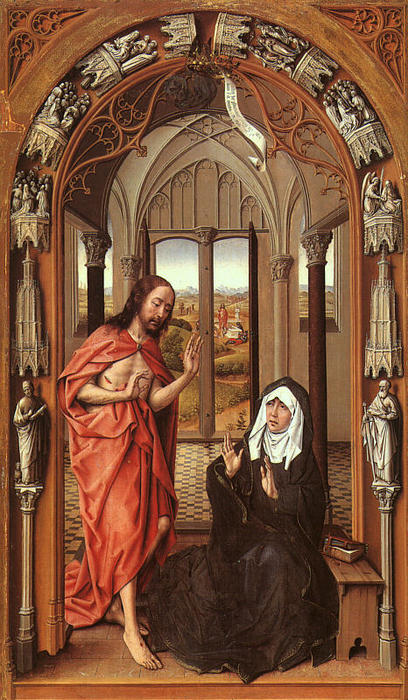
Experience the profound intimacy of Rogier van der Weyden’s masterpiece – Christ appearing to His Mother! This exquisitely detailed painting captures a tender moment between Jesus and Mary, showcasing masterful Flemish Renaissance style and evoking a serene spiritual atmosphere. Explore this iconic artwork and bring its beauty into your home.
A Divine Encounter: The Soul of Early Netherlandish Art
In the quiet, hallowed atmosphere of the fifteenth century, few artists possessed the ability to bridge the gap between the earthly and the divine as masterfully as Rogier van der Weyden. His work, Christ Appearing to His Mother, serves as a profound window into the heart of the Flemish Primitives, offering much more than a mere biblical illustration. It is an intimate, whispered conversation frozen in time, capturing a moment of spiritual reassurance that resonates with a timeless, human vulnerability. As the viewer gazes upon this sacred meeting, they are not merely observing a historical event but are invited into a sanctuary of profound emotion and meticulous grace.
The composition centers on the poignant interaction between Jesus Christ and the Virgin Mary. In a scene brimming with palpable tenderness, the figures are positioned in a way that emphasizes their shared connection—a moment of reunion following the unimaginable trauma of the crucifixion. The presence of a loaf of bread held aloft acts as a subtle yet powerful symbol of communion and spiritual nourishment, suggesting that even in moments of profound grief, there is sustenance to be found in faith. This central intimacy is framed by a carefully orchestrated group of attendants and a grounding presence of a horse in the background, creating a narrative depth that pulls the observer into the very fabric of this holy visitation.
Mastery of Light, Texture, and Technique
To behold a work attributed to Van der Weyden is to witness the pinnacle of oil painting technique during the Northern Renaissance. Moving away from the flatter, more opaque qualities of tempera, the artist utilized the burgeoning medium of oil on panel to achieve an unprecedented level of luminosity. This technical prowess allows for a breathtaking rendering of textures that feels almost tactile; one can almost sense the heavy, rhythmic folds of Mary’s robes and the soft, diffused light that illuminates the scene. The artist’s background as a goldsmith is evident here, manifesting in a precision of detail that elevates every element—from the subtle sheen on a surface to the delicate, expressive features of the faces.
This meticulous attention to detail serves a higher purpose than mere decoration. It is through this hyper-realism that Van der Weyden achieves his greatest feat: the sculpting of human emotion. He does not merely paint a face; he captures the weight of sorrow, the flicker of devotion, and the quiet strength of maternal love. For the collector or the interior designer, such a piece offers more than visual beauty; it provides an anchor of contemplative depth. A high-quality reproduction of this masterpiece brings into a contemporary space a sense of historical gravity and an enduring elegance that speaks to the soul, making it a centerpiece of profound intellectual and aesthetic significance.