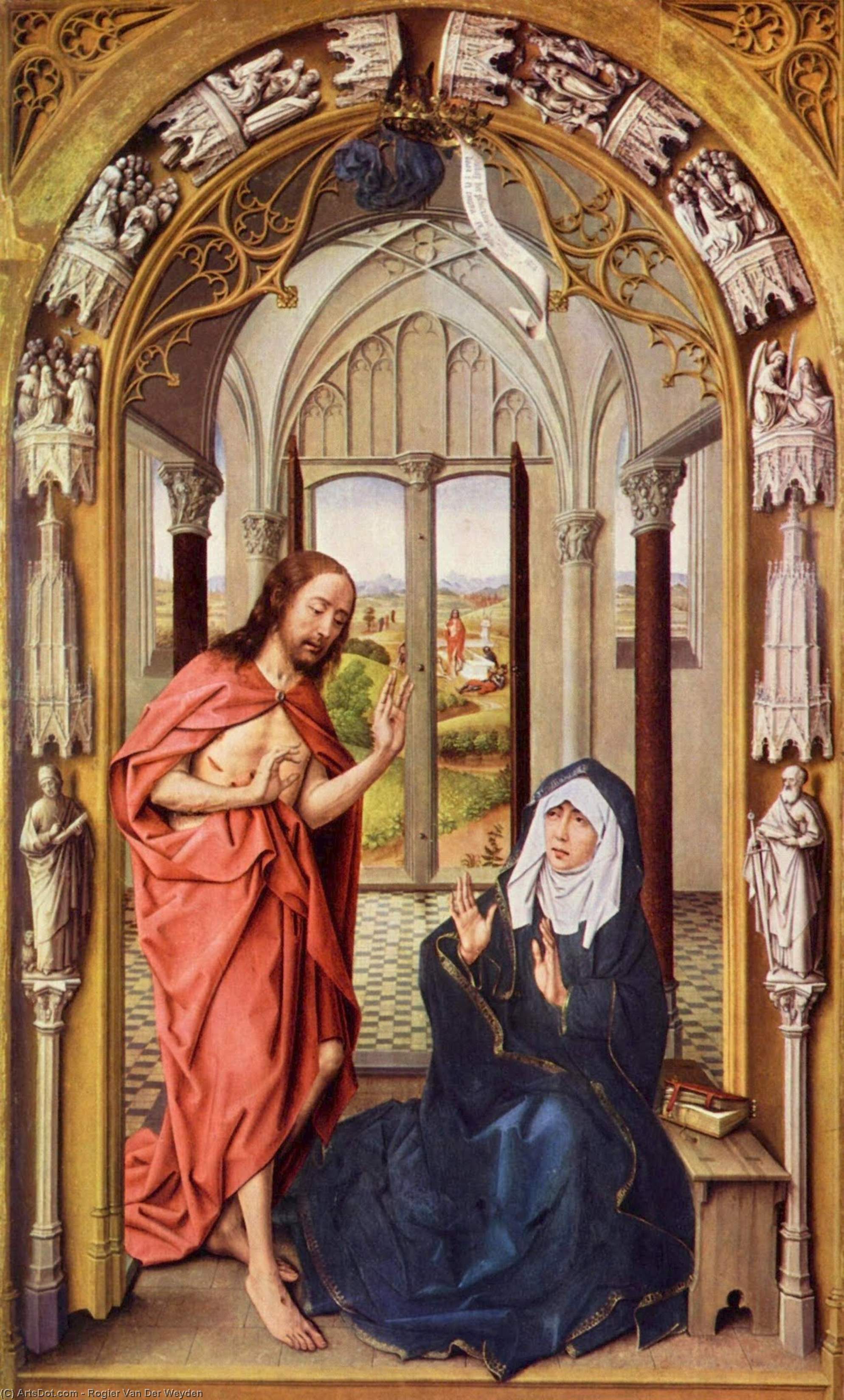
A Divine Encounter: Rogier van der Weyden’s ‘Christ Appears to Mary’
This intimate panel painting by Rogier van der Weyden, created around 1430, offers a profoundly moving depiction of a pivotal moment in Christian iconography – the appearance of Christ to his mother, Mary. Measuring 63 x 38 cm, this work exemplifies the artist's mastery of Early Netherlandish style and his ability to convey deep emotional resonance through meticulous detail and symbolic language.
Subject & Narrative
The scene portrays a quiet yet powerful encounter. While often identified as the baptism of Jesus, recent scholarship suggests it depicts Christ appearing *to* Mary after his resurrection – a moment of solace and confirmation for his mother. Jesus stands on the left, elegantly draped in crimson robes, extending his hand towards Mary Magdalene who kneels reverently in the center. John the Baptist is positioned to the right, bearing witness to this sacred exchange. The setting, framed by a grand arched window overlooking the Jordan River landscape, provides both spatial depth and symbolic context.
Style & Technique: A Masterclass in Early Netherlandish Painting
Van der Weyden was renowned for his innovative approach to painting, and ‘Christ Appears to Mary’ is a testament to his skill. The work showcases several hallmarks of the Early Netherlandish style:
- Detailed Realism: Figures are rendered with remarkable anatomical accuracy and individualized features.
- Linear Perspective: The architectural setting utilizes strong linear perspective, creating a convincing illusion of depth and drawing the viewer’s eye into the scene.
- Rich Color Palette: The dominant hues of red, blue, and gold imbue the painting with a sense of solemnity and spiritual significance. These colors weren't chosen arbitrarily; red symbolizes Christ’s passion, blue represents divinity, and gold signifies heavenly glory.
- Glazing Technique: Van der Weyden employed meticulous layering of oil paint – glazing – to achieve luminous color effects and a remarkable level of detail. This technique allows light to penetrate the layers, creating an almost jewel-like quality.
Symbolism & Iconography
Beyond its narrative content, the painting is rich in symbolism:
- The Jordan River Landscape: Represents purification and spiritual renewal – a fitting backdrop for Christ’s appearance.
- Mary Magdalene's Posture: Her kneeling position signifies humility, repentance, and devotion.
- Gestures of Recognition: The outstretched hand of Christ and Mary Magdalene’s gaze convey a moment of profound recognition and connection.
Historical Context & Artistic Legacy
Rogier van der Weyden (c. 1400-1464) was one of the most influential artists of the Early Netherlandish period, active in Belgium. His work bridged the gap between the International Gothic style and the emerging Renaissance aesthetic. He gained acclaim throughout Europe, influencing artists in Italy and Spain. This painting exemplifies his unique ability to blend meticulous realism with deeply felt emotion – a characteristic that set him apart from his contemporaries. The influence of van der Weyden can be seen in later works by artists like Hans Memling and Hugo van der Goes. His grandson, Goswijn van der Weyden, continued the family artistic tradition.
Emotional Impact & Interior Design Considerations
‘Christ Appears to Mary’ evokes a sense of quiet contemplation and spiritual reverence. The painting's somber yet luminous quality makes it suitable for spaces dedicated to reflection or prayer. Its rich color palette complements interiors with warm tones, while its vertical format lends itself well to hallways or smaller rooms. A high-quality reproduction would serve as a powerful focal point in any collection, offering both aesthetic beauty and historical significance.
The painting’s intimate scale invites close viewing, allowing the viewer to connect with the emotional depth of this sacred encounter.