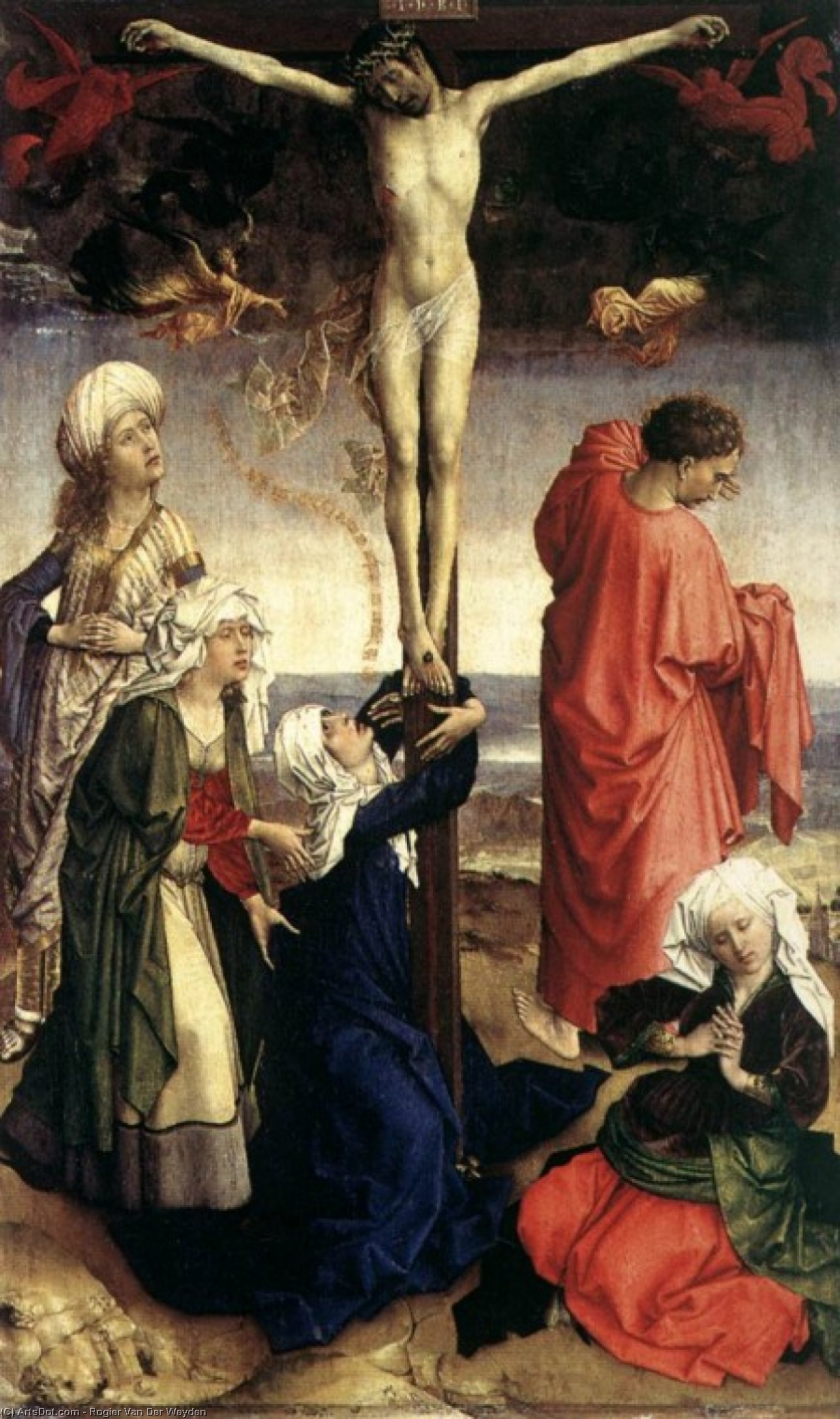
Experience the profound emotion captured in Rogier van der Weyden’s iconic Crucifixion painting from 1445—a masterpiece of Flemish Gothic art depicting Jesus Christ's suffering alongside Mary Magdalene and John, illuminated by angelic figures against a dramatic sky.
Rogier van der Weyden (c. 1400-1464): Master of Early Netherlandish art, renowned for emotive religious paintings, rich colors & naturalistic detail. Explore 'Lamentation' & more!
A Testament to Faith: Exploring Rogier van der Weyden’s Crucifixion
The painting “Crucifixion,” executed in 1445 by Rogier van der Weyden, stands as a monumental achievement of Early Netherlandish art—a work that transcends mere visual representation and delves into profound theological contemplation. More than just depicting an iconic biblical scene, it’s a masterful demonstration of artistic innovation and emotional depth, captivating viewers centuries later with its unwavering commitment to realism and spiritual resonance.
The Artist's Craftsmanship: Technique and Detail
Rogier van der Weyden wasn’t simply aiming for accuracy; he sought to capture the very essence of human suffering and divine compassion. His technique—characterized by meticulous layering of glazes—allowed him to achieve an unparalleled luminosity and textural richness. Each brushstroke is painstakingly considered, meticulously blending pigments to create subtle gradations of color that imbue the figures with palpable physicality. The artist’s mastery extends beyond pigment; he skillfully employs chiaroscuro – dramatic contrasts between light and dark – to sculpt the forms of Jesus, Mary Magdalene, and John, emphasizing their vulnerability against the backdrop of a turbulent sky. This painstaking attention to detail isn't merely decorative; it serves as a conduit for conveying the emotional weight of the narrative.
Historical Context: The Burgundian Court and Religious Devotion
Created during the reign of Philip IV of Burgundy, “Cruifixion” reflects the fervent piety that permeated aristocratic society at the time. The Burgundian court was deeply invested in religious iconography, commissioning artworks intended to inspire devotion and reaffirm faith—a practice profoundly influenced by the burgeoning humanist movement. However, Van der Weyden’s painting distinguishes itself from its contemporaries through a uniquely expressive portrayal of grief and sorrow. Unlike many depictions of Christ's crucifixion that prioritize idealized beauty, this artwork confronts viewers with unflinching realism – the wounds on Jesus’s body are rendered with astonishing precision, mirroring the suffering endured by martyrs throughout Christendom.
Symbolism: Angels, Grief, and Redemption
The composition itself is laden with symbolic significance. The angels flanking the cross represent divine compassion and foreshadow redemption—a comforting presence amidst the agony of Christ's sacrifice. Mary Magdalene’s posture embodies sorrowful grief, reflecting the universal human experience of loss and mourning. Her gaze directs our attention towards Jesus, emphasizing his central role in salvation. Furthermore, the turbulent sky serves as a visual metaphor for the spiritual struggle inherent in faith—a reminder that divine grace triumphs over earthly darkness.
Emotional Impact: A Window into Spiritual Experience
“Cruifixion” continues to resonate powerfully with audiences today because it transcends temporal boundaries and speaks directly to the human condition. The painting’s masterful execution compels viewers to confront uncomfortable truths about suffering, mortality, and faith—provoking introspection and fostering a deeper appreciation for the transformative power of art. It's not merely an image; it’s an invitation to contemplate the profound mysteries of existence and to embrace the hope offered by Christian theology. Its enduring legacy testifies to Van der Weyden’s ability to capture not just what he saw, but what he felt—a testament to the artist’s unwavering dedication to conveying spiritual truth through breathtaking artistic skill.