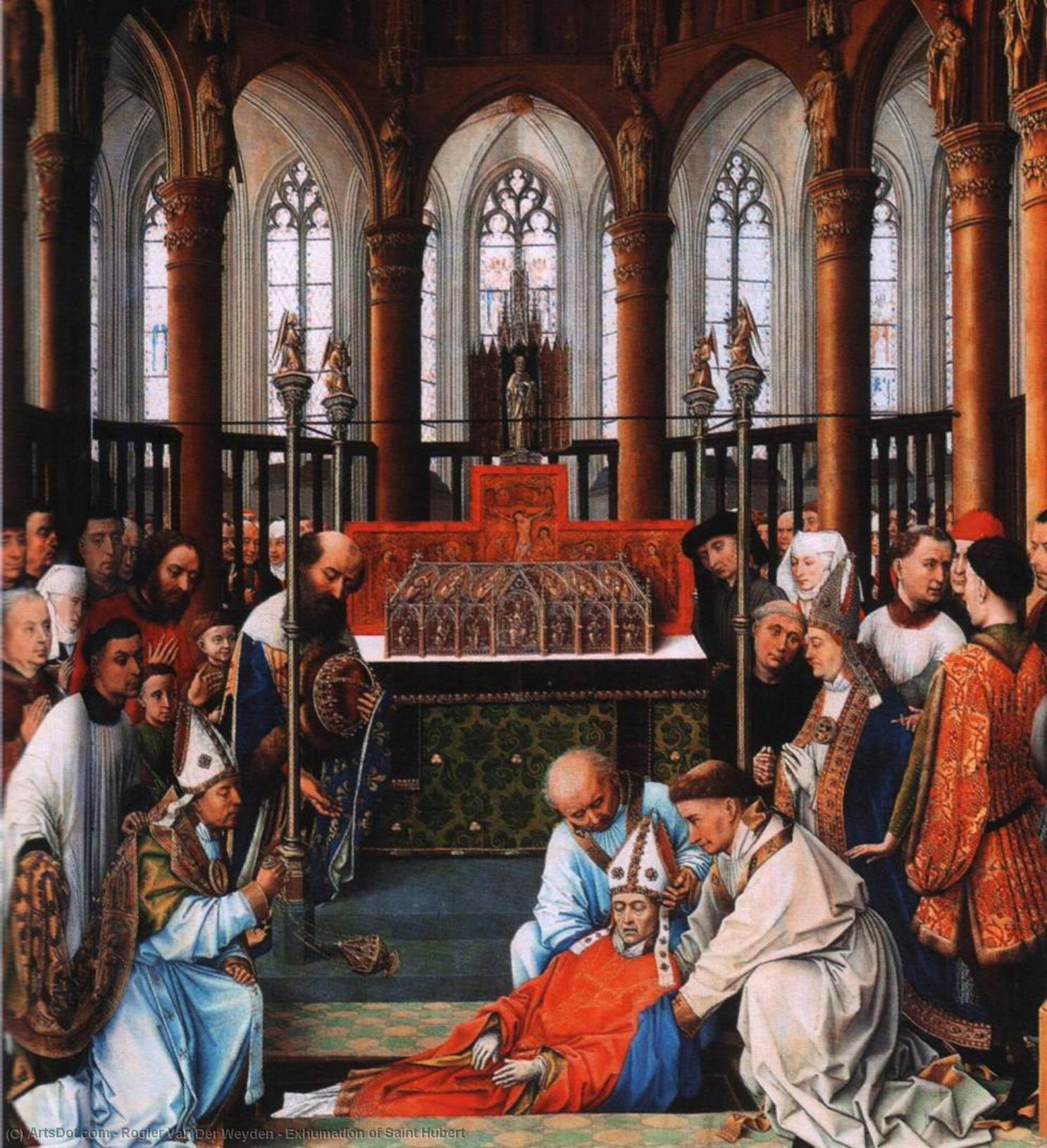
“Exhumation of Saint Hubert” was created in 1440 by Rogier van der Weyden in Northern Renaissance style. Find more prominent pieces of religious painting at Wikiart.org – best visual art database.
Rogier van der Weyden (c. 1400-1464): Master of Early Netherlandish art, renowned for emotive religious paintings, rich colors & naturalistic detail. Explore 'Lamentation' & more!
A Masterpiece of Grief: The Soulful Vision of Rogier van der Weyden
The year was 1440, and the atmosphere in Brussels was thick with artistic fervor, driven by the ambitious patronage of Dukes Philip and Johann. It was within this creative whirlwind that Rogier van der Weyden, a master whose early training as a goldsmith would forever inform his painterly precision, unveiled his profound work, Exhumation of Saint Hubert. This is not merely a depiction of a religious rite; it is an unparalleled exploration of human emotion, faith, and the inescapable reality of mortality. As one gazes upon this haunting tableau, housed in the St Janskathedraal in Brussels, the viewer is drawn into a sacred moment where the boundaries between the earthly and the divine begin to blur. The painting serves as a powerful testament to the Northern Renaissance spirit, capturing a sense of spiritual anxiety and reverence that resonated deeply within the fifteenth-century European soul.
The Sculptor’s Precision and the Radiance of Oil
What sets Van der Weyden apart from his contemporaries is his extraordinary ability to translate tactile textures onto a two-dimensional surface. His background in goldsmithing gifted him with an unwavering dedication to detail, allowing him to treat the canvas with the meticulous care of a jeweler. Unlike many artists of his era who relied on the matte finish of tempera, Van der Weyden championed the revolutionary medium of oil paint. This choice allowed for unprecedented luminosity and a seamless blending of colors that breathes life into the scene. Through the masterful use of glazing—applying thin, translucent washes of pigment over underlying layers—he achieved an ethereal glow that illuminates the faces of the faithful and the heavy folds of their liturgical garments. Every crease in the drapery and every subtle nuance of a grieving expression is rendered with such breathtaking realism that the painting seems to vibrate with a quiet, internal light.
A Sacred Tableau: Symbolism and Emotional Resonance
The composition of Exhumation of Saint Hubert is a carefully orchestrated drama of devotion. At the heart of the scene lies the casket, the focal point around which a community of believers gathers in solemn assembly. The figures, dressed in the dignified garb of religious orders, are positioned with a rhythmic grace that guides the eye through the narrative of the exhumation. Two men kneel beside the casket, their postures reflecting a profound intimacy with the deceased, perhaps preparing the relics for their new resting place. Even the subtle inclusion of birds—one perched to the left and another near the upper corner—adds a layer of naturalistic detail that grounds this spiritual event in the living world. For the collector or the interior designer, this piece offers more than just visual beauty; it provides a profound emotional anchor. It is a work that invites contemplation, making it an exquisite choice for spaces dedicated to reflection, history, and the enduring power of the human spirit.