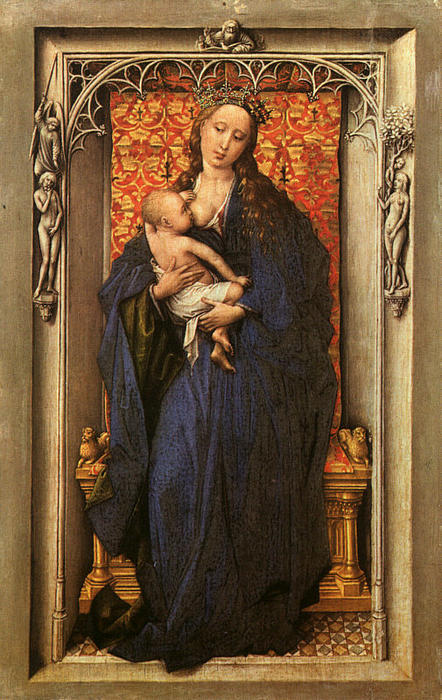
Experience the profound emotion of Rogier van der Weyden’s "Madonna and Child," a masterpiece of Northern Renaissance painting showcasing Mary tenderly holding her infant son before a majestic castle backdrop, perfect for art lovers seeking timeless beauty.
A Timeless Portrait of Devotion: Rogier van der Weyden’s Madonna and Child
Rogier van der Weyden's “Madonna and Child” stands as a cornerstone of Early Netherlandish painting, a testament to the artist’s profound understanding of human emotion and his unparalleled technical skill. Executed in oil on canvas around 1460, this iconic image transcends mere representation; it embodies the very essence of maternal love and spiritual devotion. The scene depicts Mary cradling her infant son, Jesus, in a posture that speaks volumes about tenderness and protection. The backdrop – a stylized castle-like structure rendered in a vibrant red – adds an element of regal dignity to the intimate moment, suggesting both earthly authority and divine grace.
The Master’s Hand: Technique and Detail
- Oil on Canvas: Van der Weyden's masterful use of oil paint allowed for a level of detail and luminosity previously unseen in Northern European art. The rich textures of Mary’s robes, the delicate folds of the baby’s garments, and the subtle modeling of their faces are achieved through meticulous layering and glazing – techniques that build up depth and color with astonishing precision.
- Realism and Emotion: Van der Weyden was a pioneer in imbuing his figures with palpable emotion. The gentle curve of Mary's hand, the serene expression on her face, and the trusting gaze of the infant all contribute to a profoundly moving portrayal. This focus on realism wasn’t simply about accurate depiction; it was about capturing the soul of the subject.
- Compositional Mastery: The triangular composition – with Mary and Christ forming the apex – is a classic device employed by Van der Weyden, creating a sense of stability and harmony while directing the viewer's eye to the central figures.
Symbolism Within the Scene
Beyond its immediate beauty, “Madonna and Child” is laden with symbolic meaning rooted in Christian iconography. The red background, often associated with royalty and Christ’s sacrifice, elevates the scene to a realm of sacred significance. Mary's pose, mirroring the traditional depiction of the Virgin holding the infant Jesus, connects this work directly to centuries of artistic tradition. The nursing posture itself symbolizes nourishment – not just physical sustenance but also spiritual enlightenment and salvation. The castle-like structure may represent the divine kingdom or the stability of faith.
A Legacy of Emotion: Van der Weyden’s Influence
Rogier van der Weyden's “Madonna and Child” represents a pivotal moment in the history of art. His influence extended far beyond his own time, shaping the course of Northern Renaissance painting for generations to come. His emphasis on realism, emotional depth, and meticulous technique established new standards for religious art, inspiring countless artists who followed. This reproduction offers an opportunity to experience firsthand the power and beauty of one of Van der Weyden’s most celebrated works – a timeless masterpiece that continues to resonate with viewers today.