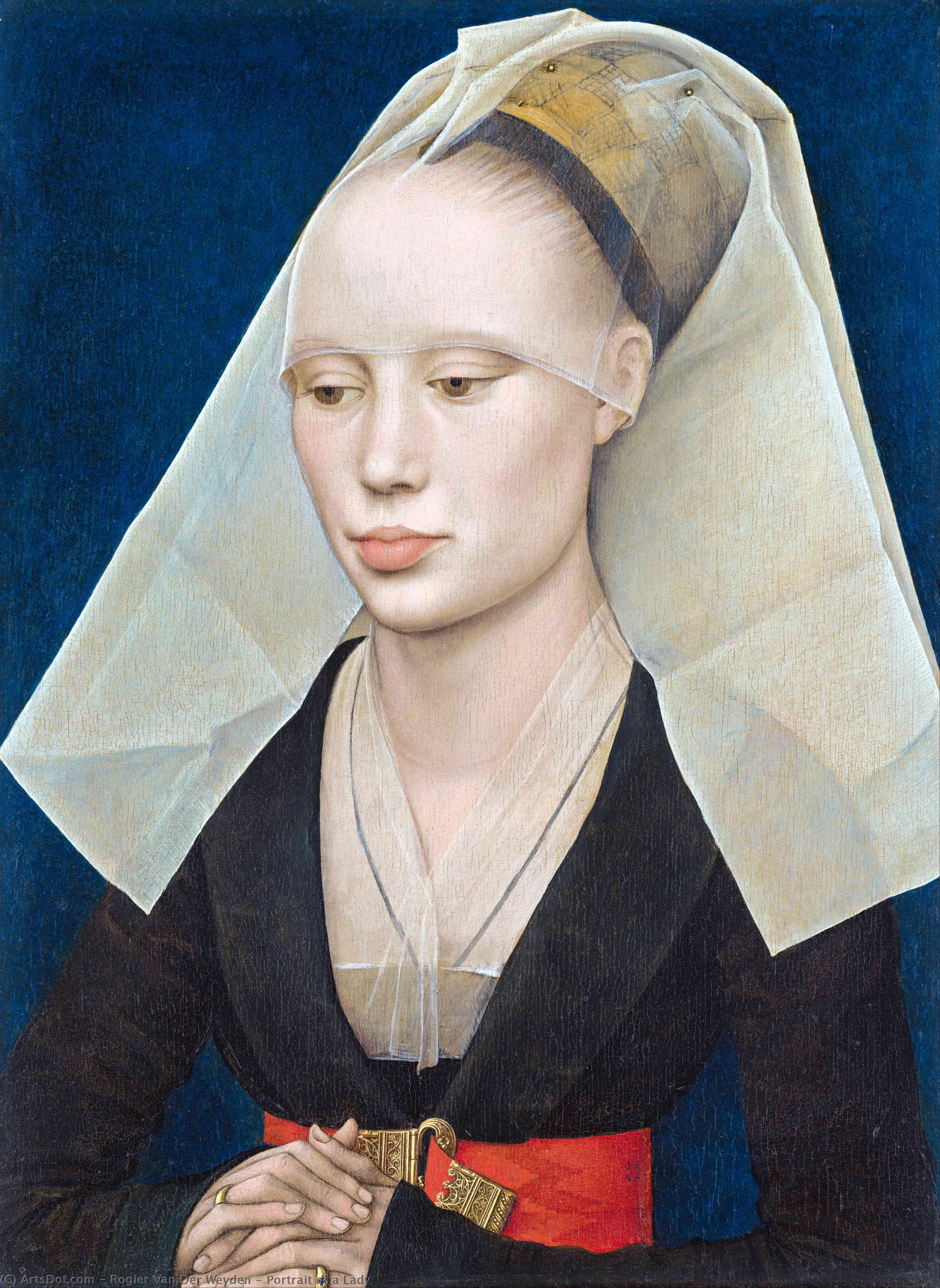
Rogier van der Weyden's
Portrait of a Lady, created around 1455, is a captivating oil-on-panel painting that exemplifies the artist's mastery in capturing the essence of his subjects. This small yet powerful work, measuring 37 x 27 cm, is housed at the National Gallery of Art in Washington, D.C.
Composition and Technique
The composition of
Portrait of a Lady is built from geometric shapes that form the lines of the woman's veil, neckline, face, and arms. The fall of light illuminates her face and headdress, creating vivid contrasts of darkness and light. This technique enhances the overall elegance and refinement of the portrait.
The Subject
The subject of the painting is believed to be a member of the court of Philip the Good, Duke of Burgundy. Her name has been lost to history, but her aristocratic reserve and introspective emotion are palpable. The downcast eyes, firmly set lips, and tense fingers convey a sense of mental concentration.
Artistic Style
Rogier van der Weyden was celebrated for his religious paintings, but he also excelled in portraiture. His use of an unusually broad range of colors and tones is evident in
Portrait of a Lady. Each tone is carefully diversified, even with whites being varied themselves.
Context and Significance
The Burgundian court was renowned for its lavish displays of luxury textiles, gold, and gems. Van der Weyden's portraits, including
Portrait of a Lady, reflect an aristocratic ideal of control and refinement. This painting is a testament to the artist's ability to capture the essence of his subjects through subtle cues like hand placement or facial expression.
Other Works by Rogier Van Der Weyden
-
Rogier Van Der Weyden: Portrait of a Lady -
Bernardino Luini: Portrait of a Lady Conclusion
Rogier Van Der Weyden's Portrait of a Lady is a masterpiece that showcases the artist's skill in capturing the character and essence of his subjects. This painting, along with other works by Van der Weyden, can be found at
ArtsDot.com, where you can explore high-quality reproductions of famous artworks. For more information on Rogier van der Weyden and his works, visit: -
Rogier Van Der Weyden - Wikipedia -
Thomas James Chimes - ArtsDot.com