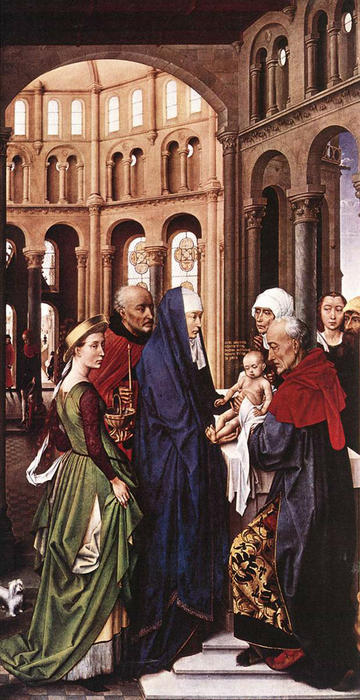
Presentation of Christ: A Masterpiece of Flemish Emotion
Rogier van der Weyden’s “Presentation of Christ” stands as an unparalleled achievement in Early Netherlandish painting, embodying the profound spiritual fervor and artistic innovation that characterized the Burgundian Renaissance. Completed around 1435 for the Leuven Guild of Archers—a commission reflecting the burgeoning civic pride of the era—this monumental altarpiece transcends mere visual representation; it strives to evoke a visceral response from the viewer, capturing the solemn majesty of faith and conveying an exquisite understanding of human emotion.
- Subject Matter: The painting depicts the biblical narrative of Jesus’s infancy – Mary presenting him to Simeon and Anna at the Temple in Jerusalem. This scene embodies themes of divine providence, humility, and the fulfillment of prophecy, central to Christian theology.
- Style & Technique: Van der Weyden employed a revolutionary approach to spatial illusionism, departing from the flattened perspective favored by earlier artists. Instead, he created a deep, richly textured space reminiscent of Byzantine icon paintings—a deliberate stylistic choice intended to heighten the emotional impact and convey a sense of timelessness. The artist’s meticulous attention to detail is evident in every aspect of the composition, from the folds of Mary’s robe to the expressive faces of Simeon and Anna.
- Material & Medium: Executed on oak panel using oil paint—a technique pioneered by Jan van Eyck—the painting demonstrates remarkable durability and luminosity. The pigments were painstakingly blended to achieve astonishing realism, capturing subtle variations in color and texture that would have been impossible with tempera paints.
- Historical Context: “The Presentation of Christ” emerged during a period of significant artistic experimentation and intellectual ferment within the Netherlands. Influenced by Byzantine art and humanist ideals—particularly those championed by Nicholas Froment—Van der Weyden’s work signaled a decisive break from medieval conventions, establishing a new standard for artistic excellence.
- Symbolism: The painting is replete with symbolic imagery reflecting Christian beliefs. The Temple itself represents God's holy dwelling place, while Simeon and Anna embody prophetic faith and divine grace. The carefully arranged figures convey an emotional depth that transcends the narrative content—Mary’s sorrowful gaze embodies maternal compassion, and Simeon’s solemn expression reflects unwavering devotion.
Beyond its technical brilliance, “The Presentation of Christ” possesses a profound psychological resonance. Van der Weyden's masterful depiction of human emotion—particularly grief—captures the essence of Christian piety and elevates the painting to an enduring testament to artistic genius. Its influence extended far beyond Leuven, inspiring artists across Europe for centuries to come.
A reproduction of this iconic artwork would undoubtedly enrich any interior space, bringing forth a sense of serenity and contemplation. ArtsDot offers museum-quality reproductions that faithfully capture the painting’s luminous colors and textural subtleties—allowing you to experience the sublime beauty of Rogier van der Weyden's masterpiece firsthand.