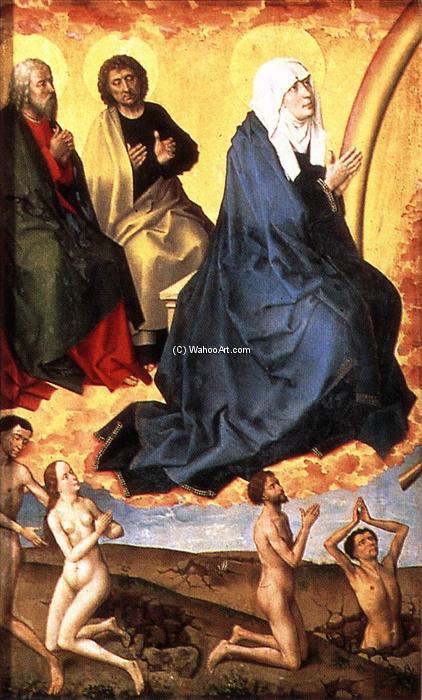
A Vision of Divine Justice: Unveiling the Drama of Rogier van der Weyden’s “Last Judgment” Detail
Rogier van der Weyden's "The Last Judgment" detail, a remarkably intimate fragment from a monumental altarpiece created around 1446-1452 for the Burgundian chancellor Nicolas Rolin, offers an unparalleled glimpse into the artist’s mastery of emotion and his profound understanding of religious iconography. More than simply a depiction of a biblical scene, this work is a carefully constructed meditation on mortality, faith, and divine judgment – a testament to van der Weyden's ability to imbue even a small panel with monumental power.
The detail focuses primarily on Mary, the Virgin Mother, seated in regal splendor upon a throne. Her hands are raised in an eloquent gesture of prayer, radiating a sense of serene authority and profound devotion. Surrounding her is a constellation of angels and saints, each engaged in their own acts of supplication, creating a harmonious tableau of spiritual reverence. Yet, amidst this heavenly chorus, two figures kneel humbly on the ground below – likely representing repentant sinners or those seeking absolution. Their presence introduces a poignant element of earthly struggle and the enduring need for divine mercy into this otherwise ethereal scene. The background remains deliberately ambiguous, hinting at a vast, undefined realm beyond our immediate comprehension, further amplifying the painting’s sense of mystery and timelessness.
The Master's Technique: Precision and Passion
Van der Weyden was renowned for his meticulous attention to detail, a characteristic vividly demonstrated in this piece. His skill is immediately apparent in the rendering of fabrics – the rich folds of Mary’s robes, the delicate texture of her veil – each element rendered with painstaking accuracy. The artist's use of oil paint allowed him to achieve an unprecedented level of realism and luminosity, capturing the subtle nuances of light and shadow that imbue the scene with a palpable sense of depth and atmosphere. Notice particularly the way he builds up color through layers of glazes, creating a shimmering effect that seems to emanate from within the painted surface.
Furthermore, van der Weyden’s mastery extends beyond mere technical skill; he possessed an extraordinary ability to convey emotion. The faces of the figures – Mary's serene contemplation, the angels’ earnest supplication, and the kneeling sinners’ palpable humility – are rendered with a remarkable sensitivity that transcends simple representation. He achieves this through subtle shifts in expression, carefully modulated color palettes, and a masterful manipulation of form. This is not merely a depiction of religious figures; it is an exploration of human experience itself.
Historical Context: A Burgundian Masterpiece
Created during the height of the Burgundian Renaissance, “The Last Judgment” reflects the artistic and cultural currents of its time. The altarpiece was commissioned by Nicolas Rolin, a wealthy and influential nobleman who sought to demonstrate his piety and civic virtue through lavish displays of art. Van der Weyden’s work aligns with the broader trends of Early Netherlandish painting – characterized by realism, meticulous detail, and a profound engagement with religious themes. The piece also speaks to the growing importance of portraiture during this period, as evidenced by van der Weyden's later works.
Interestingly, this particular detail originates from the larger “Beaune Altarpiece,” which is now housed in Beaune, France. This polyptych offers a broader context for understanding van der Weyden’s artistic vision – a complex and multifaceted work that explores themes of faith, mortality, and divine justice. The scale and ambition of the original altarpiece underscore the significance of this detail as a microcosm of a larger, profoundly moving narrative.
Bringing “The Last Judgment” Home: A Reproduction for Your Space
ArtsDot offers meticulously crafted hand-painted reproductions of Rogier van der Weyden’s "The Last Judgment" detail, allowing you to bring this iconic masterpiece into your home or office. Our skilled artisans replicate the artist's techniques and emotional depth with unparalleled precision, ensuring that your reproduction captures the essence of this extraordinary work. Whether you are an art enthusiast, a collector, or simply seeking a piece of timeless beauty, our reproductions provide a stunning way to experience the power and grace of van der Weyden’s vision. Explore our collection today and discover the perfect addition to your space.