A Bold Encounter with Familiar Forms
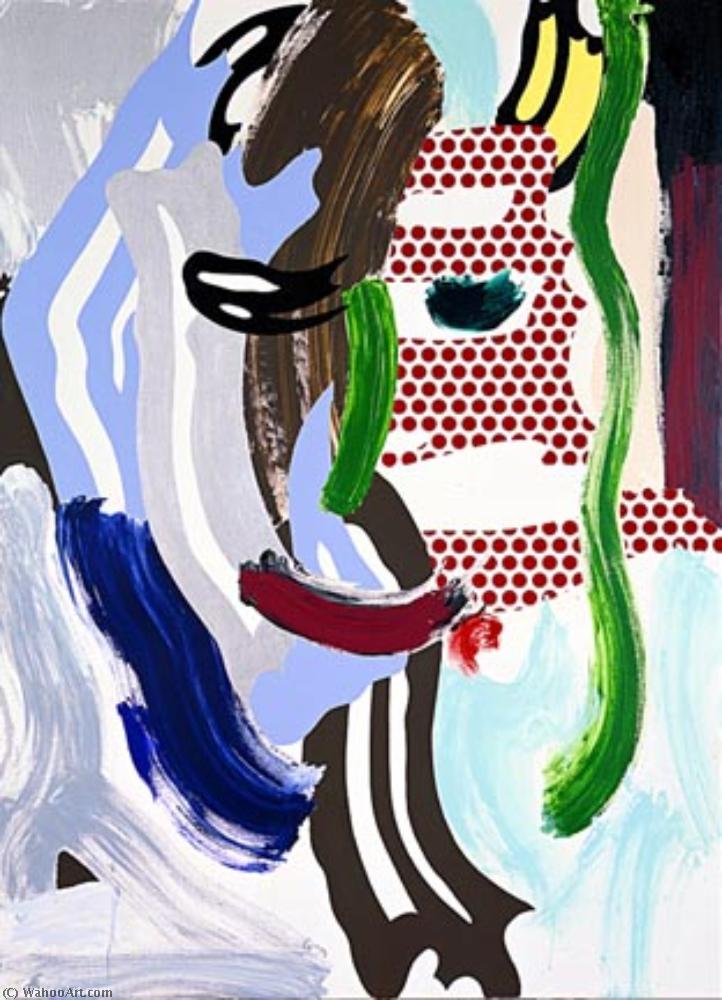
In the vibrant, pulsating dialogue between high culture and the everyday pulse of the street, Roy Lichtenstein’s "Face Green Nose" stands as a striking testament to the artist's masterful manipulation of Pop Art conventions. To gaze upon this work is to enter a world where the boundaries between a museum masterpiece and a Sunday morning comic strip dissolve entirely. The painting presents a captivating deconstruction of representation, featuring a face adorned with a vibrant green nose, set against a dramatic scarlet backdrop that commands immediate attention. This striking juxtaposition does more than merely please the eye; it embodies Lichten Lichtenstein’s deliberate challenge to artistic tradition—a challenge that simultaneously celebrates and critiques the visual language of mass culture.
The composition possesses a rhythmic, almost mechanical beauty that captures the heartbeat of mid-century Americana. Beyond the central figure, the presence of secondary faces and unexpected elements, such as the whimsical object resembling a banana, suggests a larger, interconnected narrative. This unique arrangement invites viewers to question conventional notions of beauty and identity, making it an ideal centerpiece for those looking to inject a sense of playful intellectualism into a modern interior. For collectors and designers alike, the piece offers a dynamic energy that can transform a space, turning a wall into a window onto the bold, colorful era of Post-Pop Art.
The Alchemy of Ben-Day Dots and Precision
At the core of this artwork's visual power lies Lichtenstein’s revolutionary technique—the use of Ben-Day dots. Borrowed from the world of commercial printing and mass-produced advertisements, this method involves applying tiny, meticulously placed colored dots to create an illusion of shading, texture, and depth. Unlike the heavy, emotional brushstrokes found in Abstract Expressionism, Lichtenstein employs a crisp, calculated precision. This technique produces a distinctive halftone pattern that mimics the look of a printed comic book, yet when executed on canvas, it achieves a monumental scale and a sophisticated graphic impact.
This mastery of serial reproduction allows the artist to bridge the gap between the disposable imagery of consumerism and the permanence of fine art. The flat planes of color and bold, black outlines create a high-contrast aesthetic that is both iconic and timeless. For an interior designer, this technique provides a structured yet visually stimulating texture that complements contemporary minimalist or eclectic decor. The interplay of these mechanical dots with the organic subject matter creates a tension that keeps the eye moving across the canvas, discovering new layers of detail with every glance.
A Legacy of Cultural Interrogation
To understand the emotional resonance of "Face Green Nose," one must look back to the genesis of Lichtenstein’s vision. Born in Manhattan in 1923, his artistic trajectory was shaped by a deep appreciation for both realism and the burgeoning fascination with popular culture in the postwar era. His formal training at the Art Students League provided him with foundational skills, but it was his ability to interrogate the imagery of the masses that propelled him to international fame. He did not simply reflect his era; he actively transformed commonplace fragments of our visual landscape into profound artistic statements.
The painting serves as a window into a period of significant cultural upheaval, where the heavy emotionality of previous generations was being replaced by a fascination with the industrial and the mass-produced. By elevating "low" culture to the status of "high" art, Lichtenstein invites us to reconsider how we consume images, emotions, and stories in a modern age. Owning a reproduction of such a piece is more than an aesthetic choice; it is an embrace of a pivotal moment in art history, offering a sophisticated way to celebrate the enduring power of the Pop Art movement.