A Fragmented Vision of Faith
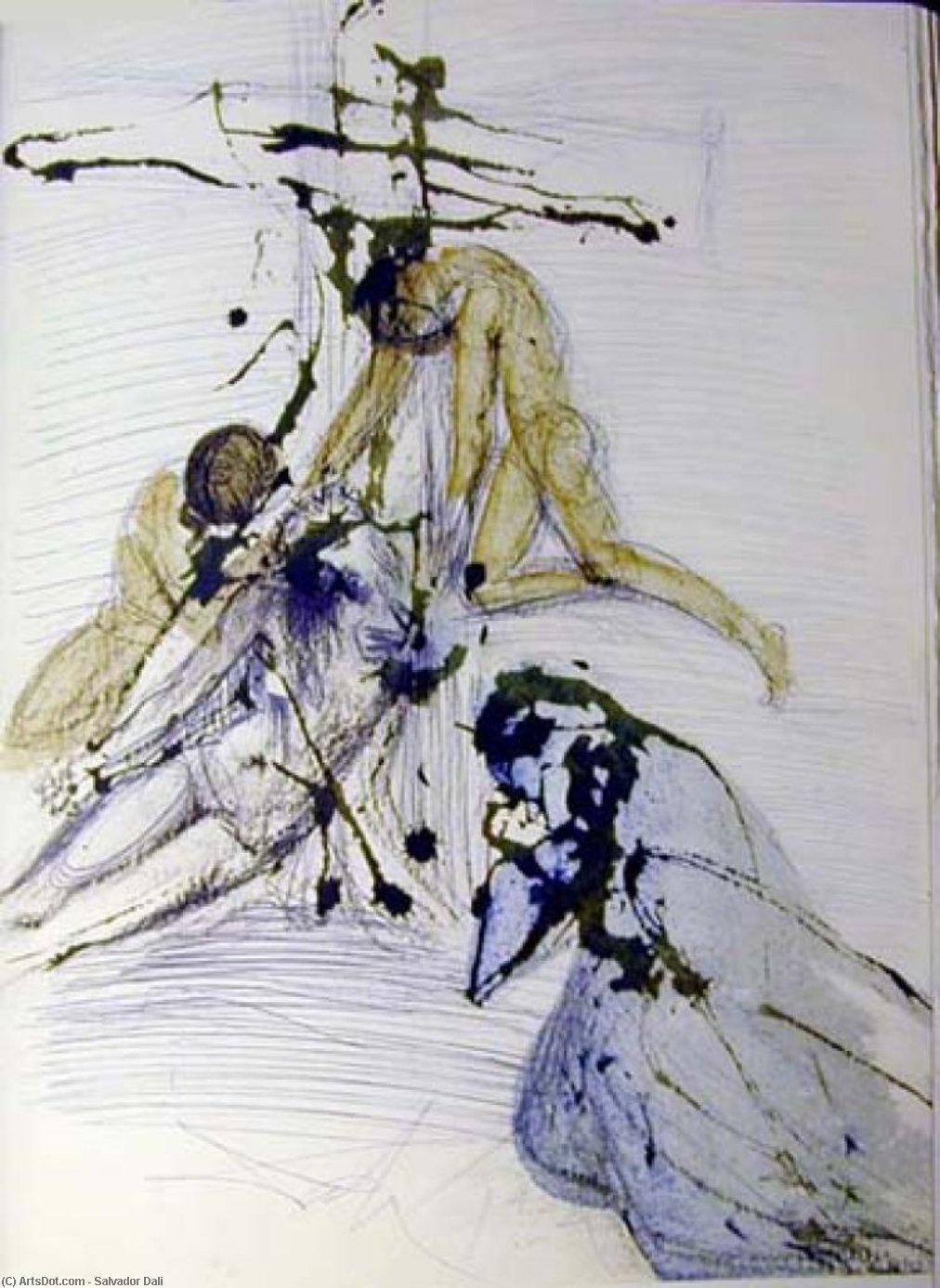
In the twilight of his prolific career, Salvador Dalí underwent a profound spiritual metamorphosis, moving away from the melting clocks and Freudian anxieties of his early Surrealist period toward a more somber, religious preoccupation. His 1967 work, De cruce depositio, serves as a hauntingly beautiful testament to this evolution. Rather than presenting a literal or anatomically precise depiction of the Deposition from the Cross, Dalí offers a fragmented vision that prioritizes psychological truth over physical reality. The piece captures a moment of profound transition, where the weight of sacrifice is felt not through dramatic musculature, but through a deliberate simplification of form and an unsettling, ethereal atmosphere.
The composition eschews traditional Renaissance perspective, opting instead for a flattened, almost claustrophobic spatial arrangement. Figures inhabit a single plane, overlapping in a way that creates a sense of disorientation and spiritual tension. This rejection of depth forces the viewer’s eye to dance across the surface, encountering a central grouping of figures that seem to float within a void. A prominent cross-like structure anchors the upper corner, acting as a silent sentinel over the scene. Through this technique, Dalí transforms a historical event into an eternal, existential meditation, making the artwork feel less like a window into the past and certainly more like a mirror held up to the human soul.
The Alchemy of Line and Shadow
Technically, De cruce depositio reveals the master’s meticulous draftsmanship, a skill honed during his formative years at the San Fernando Academy. The artwork possesses the raw, immediate energy of a study or sketch, utilizing a sophisticated interplay of ink, graphite, and diluted watercolor. Fine, parallel lines are employed with surgical precision to suggest volume and shadow, yet these are frequently interrupted by bold, erratic strokes that inject a sense of spontaneous movement. This duality—the controlled versus the chaotic—mirrors the very essence of Dalí’s late style, where technical perfection meets expressive liberation.
The color palette is intentionally restrained, leaning heavily into a monochromatic spectrum of blues, greys, and earthy browns. These muted tones are punctuated only by subtle hints of yellow or tan, creating a melancholic mood that envelops the viewer in contemplation. The use of splatters and drips adds a layer of organic texture, suggesting that the very fabric of the scene is dissolving or being reconstructed. For the discerning collector or interior designer, this piece offers a sophisticated tonal anchor; its subdued colors allow it to integrate seamlessly into refined, contemporary spaces while providing a profound intellectual focal point.
Symbolism and Emotional Resonance
Beyond its visual complexity, the power of this work lies in its ability to evoke deep-seated emotional responses. The fragmented figures, rendered with simplified and often distorted shapes, embody the anguish and spiritual fragmentation inherent in the theme of the Deposition. Dalí utilizes his signature surrealist lens to interpret Christian iconography, stripping away the decorative elements of traditional religious art to reveal the raw core of suffering and sacrifice. The central crucifix becomes less a physical object and more a symbol of the intersection between the divine and the mortal.
To possess a reproduction of De cruce depositio is to invite a sense of quiet intensity into one's environment. It is an artwork that demands slow looking, rewarding the observer with layers of meaning regarding faith, loss, and the persistence of memory. Whether displayed in a private gallery or as a centerpiece in a thoughtfully curated living space, this work stands as a monumental achievement of Dalí’s later years—a bridge between the dreamscape of his youth and the spiritual searching of his maturity.