A Fragmented Communion: Decoding Dalí’s Surrealist Vision
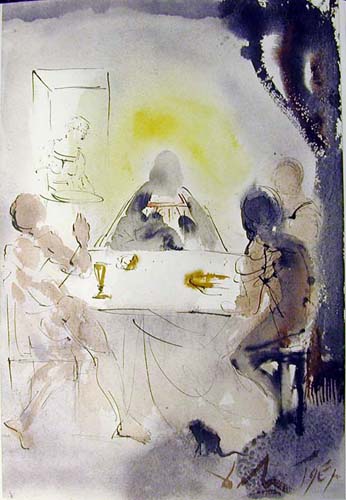
In the hauntingly beautiful canvas of “Et cognoverunt eum in fractione panis,” Salvador Dalí invites us into a realm where the boundaries between the physical world and the subconscious are perilously thin. Painted in 1964, this masterpiece—whose Latin title translates to "They knew him in the fragment of bread"—transcends the simple depiction of a meal to become a profound exploration of existential anxiety and spiritual recognition. As we gaze upon the scene, we find ourselves seated at a table laden with the fruits of the earth: vibrant oranges, deep purple grapes, and the central, symbolic loaf of bread. Yet, there is an unsettling stillness to the composition. The figures gathered around the table exist in a state of profound anonymity; their faces are obscured or turned away, creating a palpable sense of detachment and mystery that pulls the viewer into a silent, psychological drama.
Dalí’s technical mastery is on full display through his meticulous application of oil paint, where he achieves a hyper-realistic texture that makes the fruit appear almost tactile. This precision, however, is intentionally disrupted by the artist's signature use of spatial distortion. The table does not sit firmly within a recognizable room; instead, it stretches impossibly far into a receding background, creating a disconcerting illusion of depth that defies rational geometry. This technique is a hallmark of Dalí’s later period, where he utilized Surrealist principles to disrupt the viewer's sense of stability, forcing us to abandon logic and surrender to the dreamlike atmosphere of the painting.
Symbolism and the Echoes of History
To understand this work is to delve into the rich tapestry of religious and psychological symbolism that Dalí wove throughout his career. The bread, a central element of the composition, serves as a powerful signifier of both sustenance and the sacred act of communion. However, by presenting it as a fragmented object, Dalí suggests a fractured connection to faith and identity—a theme deeply resonant with the post-World War II era in which this piece was conceived. The painting reflects the broader European anxieties of the 1960s: a period marked by uncertainty, the loss of traditional certainties, and the pervasive influence of Freudian psychoanalysis.
The presence of a clock hanging on the wall further deepens the narrative, acting as a memento mori that reminds us of the relentless passage of time. Within this dimly lit room, where shadows stretch with intention and objects seem to hold secret meanings, every element—from the way a figure holds a book to the placement of a solitary cup—contributes to an atmosphere of profound intrigue. For the collector or the lover of fine art, this painting offers more than just visual splendor; it provides a window into the complex psyche of an artist who could transform the mundane into the monumental.
An Invitation to the Dreamscape
For interior designers and connoisseurs of high-quality reproductions, “Et cognoverunt eum in fractione panis” represents a sophisticated choice for creating a focal point of intellectual and emotional depth. The painting’s complex composition and moody palette make it an ideal centerpiece for spaces designed to inspire contemplation and conversation. Whether placed in a private study or a curated gallery setting, the work commands attention through its ability to evoke a sense of wonder and unease simultaneously.
Owning a reproduction of this Dalí masterpiece allows one to bring a piece of the surrealist revolution into the modern home. It is an invitation to inhabit a space where reality is not fixed, but fluid—a place where the shadows hold stories and every fragment of bread holds the potential for revelation. This artwork is not merely a decoration; it is a profound psychological experience, captured in pigment and oil, waiting to transform any environment into a sanctuary of the imagination.