A Surrealist Echo of Emotion
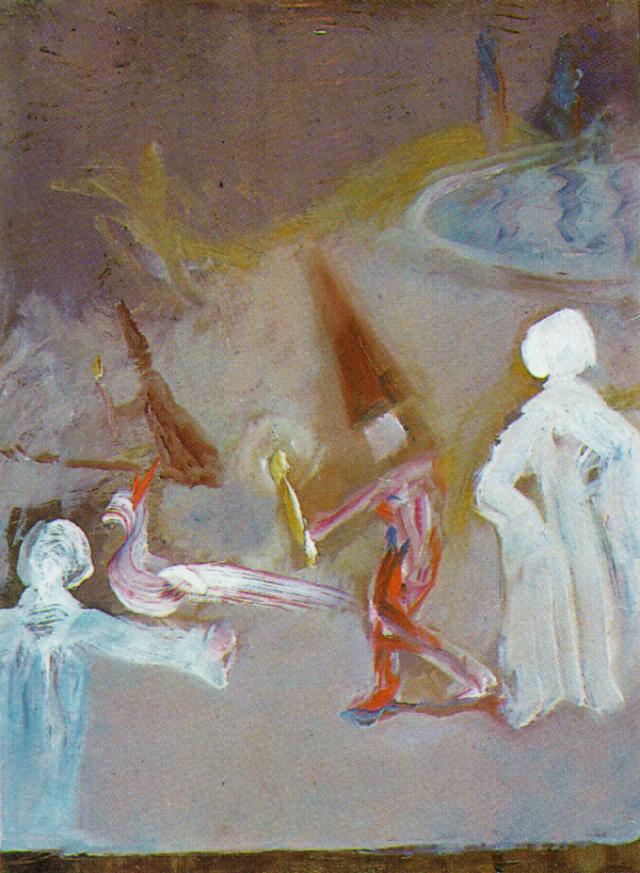
In the twilight of his long and storied career, Salvador Dalí revisited the shadows of art history to create Figures (Scene after Goya), 1981, a work that serves as a profound psychological bridge between two masters of the subconscious. This painting is not merely a tribute but a visceral reimagining of Francisco Goya’s harrowing masterpiece, Saturn Devouring His Son. Where Goya presented a raw, primal horror, Dalí offers a fragmented dreamscape, translating the terror of the flesh into the unsettling beauty of the mind. It is a piece that invites the viewer to step away from the rational world and surrender to a landscape where the boundaries between memory, myth, and nightmare dissolve entirely.
The composition unfolds as an evocative tableau, populated by figures that seem to drift through a desolate, otherworldly terrain. At the heart of this dreamscape stand two women, their presence providing a haunting focal point amidst the surrounding disorientation. One woman holds an umbrella, a gesture of protection that feels strangely futile against the vast, unsettling atmosphere of the scene. As the eye wanders, additional figures emerge from the periphery—some appearing to walk away into the void, others frozen in postures of isolation and apprehension. This deliberate destabilization of the composition mirrors the logic of a dream, where characters appear and vanish with an uncanny, unmoored fluidity.
The Mastery of Meticulous Illusion
Dalí’s technical execution in this late work remains nothing short of breathtaking, showcasing his signature ability to blend hyper-realistic precision with fantastical distortion. He employs a meticulous technique that demands close inspection; every fold of fabric, every contour of the landscape, and every subtle shift in light is rendered with an almost photographic clarity. This trompe l'oeil effect serves a deeper purpose: by rendering the impossible with such tangible detail, Dalí forces the viewer to accept the surreal reality he has constructed. The textures feel heavy and real, making the bizarre juxtaposability of the elements—such as the delicate bird perched near the top left corner—all the more jarring and impactful.
Symbolism permeates every inch of the canvas, offering layers of meaning for the discerning collector. The bird, a recurring motif in Dalí’s vast oeuvre, acts as a dual symbol of soaring freedom and profound vulnerability, watching over the scene like a silent witness to the unfolding drama. The very act of referencing Goya introduces themes of duality, loss, and the cyclical nature of artistic influence. For an interior designer or art enthusiast, this painting offers more than just visual interest; it provides a conversational centerpiece that explores the tension between the seen and the unseen, the light of consciousness and the shadows of the repressed psyche.
A Timeless Addition to the Collector's Gallery
For those seeking to curate a space of intellectual depth and emotional resonance, Figures (Scene after Goya) stands as an incomparable choice. It is a work that transcends mere decoration, acting instead as a portal into the profound psychological depths of the Surrealist movement. Whether placed in a sophisticated study, a contemporary gallery, or a curated living space, this reproduction captures the essence of Dalí’s late-period brilliance—a period marked by a masterful synthesis of classical technique and avant-garde imagination.
Owning a high-quality reproduction of such a significant work allows one to live alongside the echoes of history. It is an invitation to contemplate the complexities of the human condition, to find beauty in the unsettling, and to surround oneself with the enduring power of the surreal. This painting does not simply hang on a wall; it breathes, haunts, and inspires, making it a definitive acquisition for any serious lover of fine art.