A Descent into a Melancholy Dreamscape
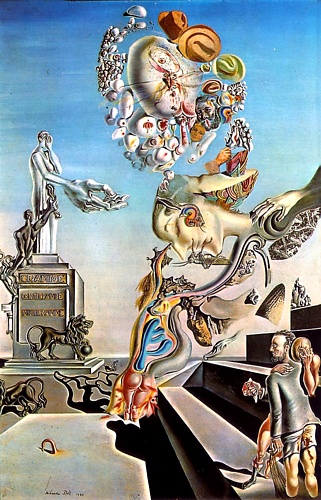
To encounter Salvador Dalí’s "The Lugubrious Game" is to step through a threshold where the boundaries of reality dissolve into the profound depths of the subconscious. Painted in 1929, this masterpiece stands as a cornerstone of the Surrealist movement, capturing a moment of chilling beauty and psychological unrest. Often referred to by its more evocative title, The Mournful Game, the work serves as a haunting testament to Dalí’s ability to manipulate visual language to express the fractured nature of the human psyche. The painting does not merely present an image; it invites the viewer into a desolate, dreamlike realm where logic has surrendered to the weight of despair and isolation.
The composition is a masterful study in fragmentation and unsettling juxtaposition. At the heart of this surreal landscape lies a central, disorienting figure: a human head that appears detached from its torso, positioned prominently upon a back. This anatomical impossibility immediately establishes a motif of broken identity, mirroring the artist's fascination with the duality of existence. Surrounding this focal point is a meticulously rendered yet bizarre collection of objects that populate this wasteland. A clock face, frozen in time, serves as a recurring Dalínian symbol for the relentless march of fate and the futility of human control. Scattered throughout are withered flowers in a vase and heavy books, suggesting a collision between intellectual pursuit and emotional emptiness, where even knowledge cannot provide solace against the encroaching shadows.
Surrealist Precision and Symbolic Depth
Dalí’s technical execution in "The Lugubrious Game" is nothing short of extraordinary, characterized by a precision that lends an eerie sense of realism to the impossible. Using oil and collage on cardboard, he employs a technique that demands close contemplation. The textures of the barren, rocky terrain are rendered with such clarity that the landscape feels palpably cold and inhospitable. This hyper-realistic approach creates a profound tension; because the objects look so tangible, the irrationality of their arrangement becomes even more disturbing to the viewer. The subtle gradations of light and shadow contribute to a sense of atmospheric gloom, enveloping the scene in a twilight that feels both eternal and suffocating.
Beyond the visual spectacle, the painting is rich with primal symbolism. The inclusion of animals—a dog, a cat, and a bird—introduces a layer of instinctual complexity, representing the raw, untamed forces of nature battling against the constraints of reason. These creatures move through the scene like ghosts of the subconscious, adding to the overall feeling of unease. For the collector or the lover of fine art, this piece offers more than just aesthetic value; it provides a window into the turbulent era of the late 1920s, a time of immense cultural upheaval and the birth of modern psychological exploration. It is an artwork that resonates with anyone drawn to the mysteries of the mind, making it a profound choice for those seeking to bring a sense of intellectual depth and dramatic intrigue to a curated space.
An Evocative Presence for the Discerning Collector
For interior designers and art enthusiasts alike, a high-quality reproduction of "The Lugubrious Game" serves as a powerful conversational centerpiece. Its ability to evoke emotion—ranging from quiet contemplation to profound melancholy—makes it an ideal selection for spaces designed for reflection or sophisticated storytelling. The painting’s complex palette and intricate details ensure that it commands attention, providing a focal point that is both intellectually stimulating and visually arresting. Whether placed in a modern gallery-style setting or a classic study, this work brings with it the enduring legacy of Dalí’s genius, offering a timeless connection to the beautiful, terrifying world of dreams.