Salvador Dalí’s Toreo Noir: A Surreal Ballet of Shadow and Spectacle
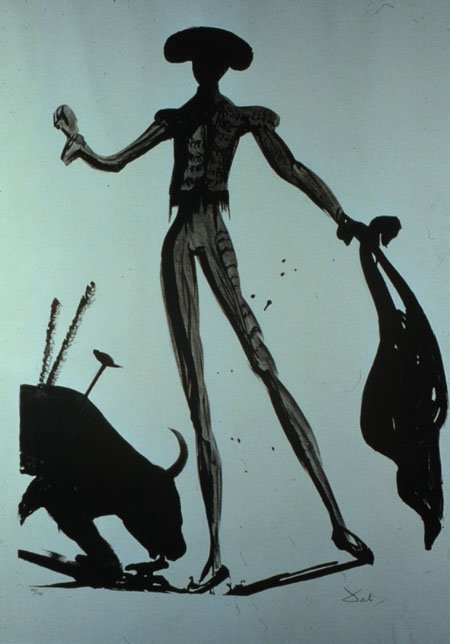
The photograph captures Salvador Dalí's 1969 painting “Toreo Noir,” an arresting exploration of surrealism that transcends mere visual representation. It’s a piece steeped in theatricality, mirroring Dalí’s own penchant for performance and his masterful manipulation of perception—a deliberate provocation designed to unsettle the viewer and invite contemplation on themes of duality and primal instinct. The stark monochrome palette – predominantly black and white – amplifies the dramatic tension inherent in the composition, prioritizing form and gesture over realistic depiction.
- Composition & Perspective: At its core lies a towering figure embodying the matador, positioned on one leg with outstretched arms holding an umbrella—a symbol of protection yet simultaneously suggesting vulnerability. Beneath him are two dogs, meticulously rendered in simplified forms, adding layers of enigmatic detail. The overall flattened perspective contributes to the dreamlike atmosphere, rejecting conventional spatial cues and emphasizing the artwork’s two-dimensional nature.
- Style & Technique: Dalí firmly establishes Surrealism's aesthetic principles. Executed with ink or charcoal on paper—likely a deliberate choice to minimize textural detail—the painting utilizes bold lines to delineate shapes and figures, creating a graphic quality that contrasts sharply with the unsettling subject matter. The elongated limbs and distorted proportions are hallmarks of Dalí’s signature style, reflecting his fascination with subconscious imagery.
- Symbolism & Emotional Impact: Beyond its visual elements, “Toreo Noir” resonates with profound symbolic significance. The matador represents courage and ritualistic confrontation, while the umbrella embodies both defense and fragility. The dogs symbolize instinct and primal forces—a juxtaposition that underscores the painting’s exploration of psychological complexities. Ultimately, Dalí seeks to evoke unease and mystery, prompting viewers to confront their own anxieties about control and transformation.
- Historical Context: Created during Dalí's prolific output in the late 1960s, “Toreo Noir” reflects a continuing engagement with Surrealist ideas—particularly automatism—transformed into a critical method aimed at harnessing delusion as a catalyst for creativity. It stands alongside other iconic works from this period, cementing Dalí’s legacy as one of the most influential artists of the 20th century.
- Further Exploration: To delve deeper into Dalí's artistic vision and the broader context of Surrealism, consider visiting The Salvador Dalí Museum in Saint Petersburg, Florida—a treasure trove of reproductions and scholarly resources dedicated to preserving and disseminating his groundbreaking oeuvre. Alternatively, explore Reynolds Morse Foundation’s impressive collection showcasing Dalí’s masterful prints and sculptures.
Recommended Reproduction: ArtsDot.com offers exceptional hand-painted reproductions of “Toreo Noir,” allowing you to experience the captivating drama and symbolic depth of this Surrealist masterpiece in stunning detail.